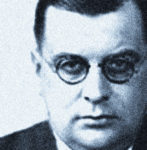

No end of apprehension, pessimism and downright paranoia in the 1950s – with a little cautious optimism thrown in.
In their radio conversation, Harrison Brown and Peter Drucker approach the future not as science-fiction dreamers but as sober analysts standing at the edge of a rapidly accelerating world. Speaking from the mid-1950s, both men frame the “next twenty” or “next hundred” years as less distant horizons than imminent realities—changes already in motion and visible to anyone willing to look carefully.
Brown, writing from a scientific and ecological perspective, emphasizes that humanity has entered an era defined by limits. Industrial expansion, population growth, and technological dependence are no longer abstract trends but forces pressing directly on resources, energy, and the environment. For Brown, the future “just around the corner” is shaped less by invention itself than by how societies manage abundance and scarcity. He warns that scientific progress, while extraordinary, carries consequences that political and economic systems are ill-prepared to absorb. The next decades, he suggests, will test whether humanity can coordinate globally rather than compete destructively.
Drucker, approaching the future as a social theorist and management thinker, is less focused on physical limits and more concerned with institutional transformation. He argues that the most dramatic changes ahead will not be technological breakthroughs but shifts in how people work, organize, and understand their roles in society. The rise of large organizations—corporations, governments, universities—signals a future in which the individual increasingly operates within complex systems rather than as an independent actor. For Drucker, the coming years will redefine authority, responsibility, and leadership.
Where the two thinkers converge is in their rejection of the idea that the future will simply resemble the present, only bigger or faster. Both insist that gradual change is an illusion; societies tend to resist adaptation until pressures force abrupt transformation. Brown points to science and population growth as destabilizing forces that cannot be postponed indefinitely. Drucker echoes this by warning that social institutions built for the 19th century are being stretched beyond their capacity in the mid-20th.
The tone of the conversation is notably unsensational. Neither man predicts catastrophe nor promises utopia. Instead, they stress inevitability: the future will arrive whether people are prepared or not. Brown underscores the need for long-range thinking, arguing that decisions made in the present will echo for generations. Drucker, meanwhile, emphasizes responsibility, suggesting that leadership in business and government must shift from short-term gains to long-term social stability.
Together, Brown and Drucker frame the future as a moral and organizational challenge rather than a purely technical one. “Just around the corner” is not a distant century but the next policy decision, the next institutional reform, the next failure to adapt. Their conversation captures a moment when optimism about human ingenuity is tempered by a growing awareness that foresight, restraint, and coordination will determine whether progress remains sustainable.
From a 1950s vantage point, the future they describe feels unsettlingly close—less a prophecy than a warning delivered calmly, rationally, and with the expectation that listeners still have time to choose wisely.
Here is that episode of Conversation from NBC Radio on June 10, 1957.
I