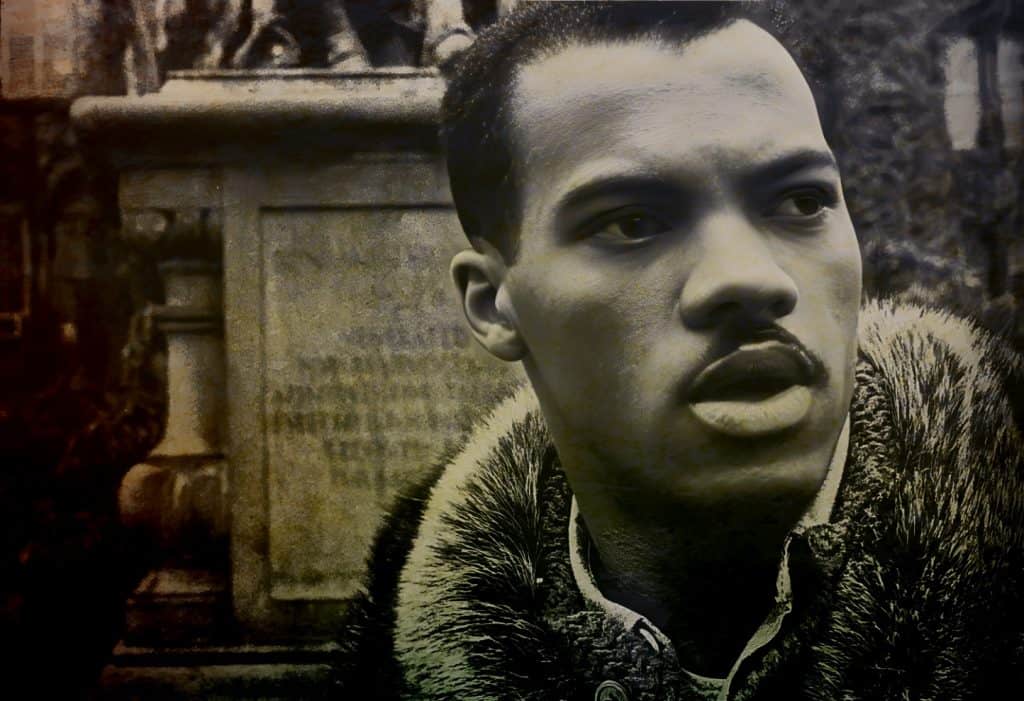
John Edgar Wideman, in a sitdown interview recorded in approximately 1969.
John Edgar Wideman (born June 14, 1941) is an American novelist, short story writer, memoirist, and essayist. He was the first person to win the PEN/Faulkner Award for Fiction twice. His writing is known for experimental techniques and a focus on the African-American experience.
Raised in Pittsburgh, Pennsylvania, Wideman excelled as a student athlete at the University of Pennsylvania. In 1963, he became the second African American to win a Rhodes Scholarship to attend the University of Oxford. In addition to his work as a writer, Wideman has had a career in academia as a literature and creative writing professor at both public and Ivy League universities.
In his writing, Wideman has explored the complexities of race, family, trauma, storytelling, and justice in the United States. His personal experience, including the incarceration of his brother, has played a significant role in his work.
He is a professor emeritus at Brown University and lives in New York City and France.
In 1967, Wideman accepted a faculty position at the University of Pennsylvania. That summer, his first novel, A Glance Away, was published. Wideman’s editor, Hiram Haydn, had seen his profile in Look and contacted Wideman before he left for Oxford, asking the aspiring author to send him his writing. While Wideman was at Oxford, Haydn read the unfinished manuscript of A Glance Away and agreed to publish it. The novel garnered positive reviews. A reviewer in The New York Times Book Review described Wideman as “a novelist of high seriousness and depth” who had written “a powerfully inventive” debut.
Wideman’s work has been, and continues to be, the focus of academic study. The John Edgar Wideman Society was formed to promote scholarship and awareness of his work. Affiliated with the American Literature Association, it held its first international conference in 2003. Wideman’s papers, including manuscripts, correspondence, and other materials, are housed at the Houghton Library at Harvard University.
Wideman’s writing is known for its complexity, with critics describing it as cerebral and experimental. It is also known for combining traditional English diction with African-American Vernacular English. In some works, Wideman’s writing relies on sentence fragments, whereas elsewhere, he has written a single sentence that spans several pages. He has sometimes used the stream-of-consciousness technique and sudden, unannounced shifts in perspective. In much of his writing, Wideman eschews punctuation such as question marks or quotation marks, relying instead on context to identify speakers or discern questions from statements. In some cases, Wideman mixes nonfiction and fiction in the same work.
Among scholars, there has been discussion as to whether Wideman is a modernist or a postmodernist writer. The scholar D. Quentin Miller, however, argues that Wideman’s works “resist categorization”.
Here is that interview.