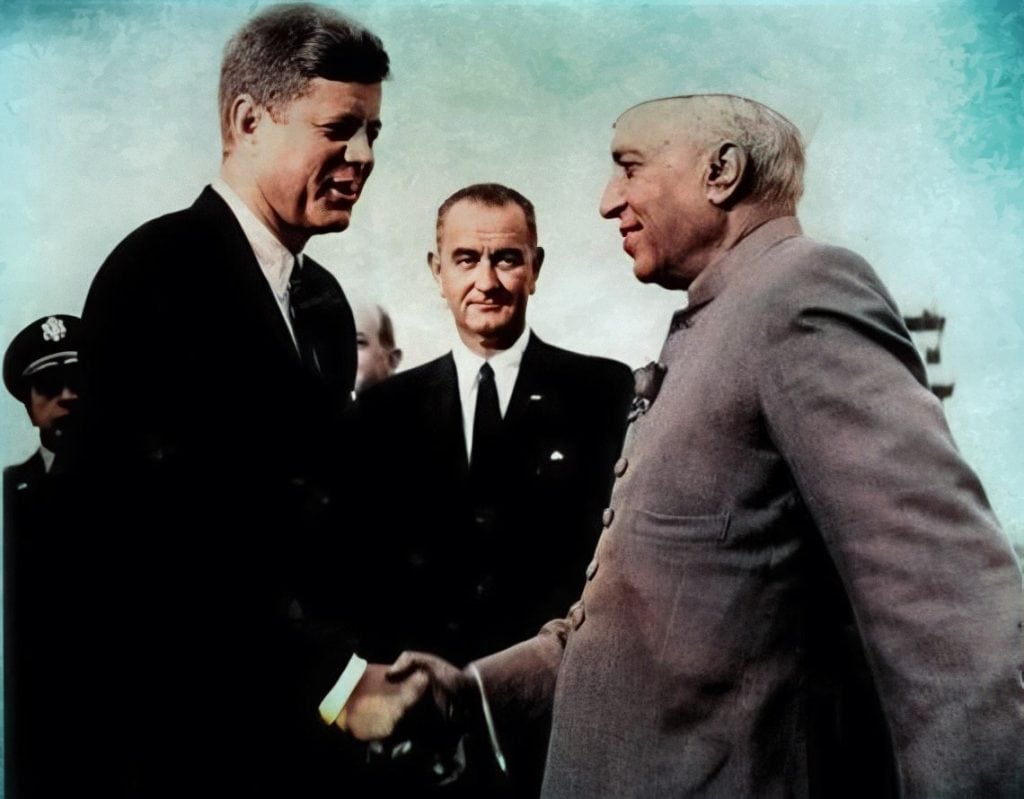
In November 1961, Jawaharlal Nehru, the first Prime Minister of independent India, made an official visit to the United States during a pivotal moment in the Cold War. The trip, hosted by U.S. President John F. Kennedy, reflected both the promise and the complexity of relations between the world’s largest democracy and the leading Western power. At a time when newly independent nations were defining their positions in global politics, Nehru’s visit highlighted the continuing effort to balance India’s policy of nonalignment with growing American interest in South Asia.
Nehru had long been a leading voice in the Non-Aligned Movement, advocating independence from both the Western bloc led by the United States and the Soviet bloc dominated by the USSR. Although India maintained diplomatic and economic ties with both sides, Nehru believed that newly independent nations should avoid entanglement in Cold War alliances. This position sometimes frustrated American policymakers, who hoped India would serve as a democratic counterweight to communist influence in Asia, particularly after the rise of the Mao Zedong government in the People’s Republic of China.
By 1961, however, relations between India and United States were cautiously improving. President Kennedy admired Nehru as an elder statesman of the post-colonial world and believed closer cooperation with India could strengthen democratic development in Asia. During Nehru’s visit to Washington, D.C., the two leaders discussed a wide range of issues, including economic development, military balance in Asia, and the emerging tensions between India and China along their disputed Himalayan border.
Economic aid was a central topic of the discussions. India was in the midst of ambitious Five-Year Plans aimed at industrializing the country and reducing poverty. The Kennedy administration signaled continued American support through development loans, food assistance, and technical cooperation. For Washington, helping India succeed economically was viewed not only as humanitarian policy but also as a strategic investment in the stability of democratic institutions in the developing world.
Despite cordial meetings, the visit revealed underlying differences. Nehru remained wary of formal military cooperation with the United States and resisted pressure to align against China or the Soviet Union. American officials, meanwhile, sometimes found Nehru’s nonaligned stance frustrating, particularly as Cold War tensions intensified elsewhere.
Nevertheless, the 1961 visit strengthened diplomatic dialogue and personal rapport between the two governments. Within a year, the relationship would take on new urgency after the outbreak of the Sino‑Indian War in 1962, when India sought emergency military assistance from the United States.
In retrospect, Nehru’s 1961 visit represented an important moment in the early evolution of U.S.–Indian relations. It illustrated the challenge of cooperation between nations pursuing different strategic visions while also demonstrating a shared commitment to democratic governance and economic development in a rapidly changing post-colonial world.
On November 9, 1961, Indian Prime Minister Jawaharlal Nehru appeared on the CBS television program Washington Conversation during his official visit to the United States. The interview took place amid a complex international climate in which India was attempting to maintain its policy of nonalignment while navigating rising Cold War tensions and regional security concerns. Speaking from Washington, D.C., Nehru discussed India’s role in world affairs and its ongoing efforts to balance diplomatic independence with cooperation among major powers.
A central theme of the discussion was India’s commitment to the principles of the Non-Aligned Movement. Nehru emphasized that India did not wish to be drawn into the rival military blocs led by either the United States or the Soviet Union. Instead, he argued that newly independent nations should pursue policies that encouraged peaceful coexistence and reduced the risk of global conflict.
The interview also touched on Asia’s shifting political landscape, particularly the growing tensions between India and the People’s Republic of China over their disputed Himalayan frontier. Although the conflict that would become the Sino-Indian War was still a year away, Nehru acknowledged the seriousness of the situation while expressing hope that diplomatic solutions could prevail.
Broadcast to an American audience at the height of the Cold War, the interview offered viewers a rare opportunity to hear directly from one of the most influential leaders of the post-colonial world.
Here is that broadcast of Washington Conversation: An interview with Prime Minister Nehru from November 9, 1961.