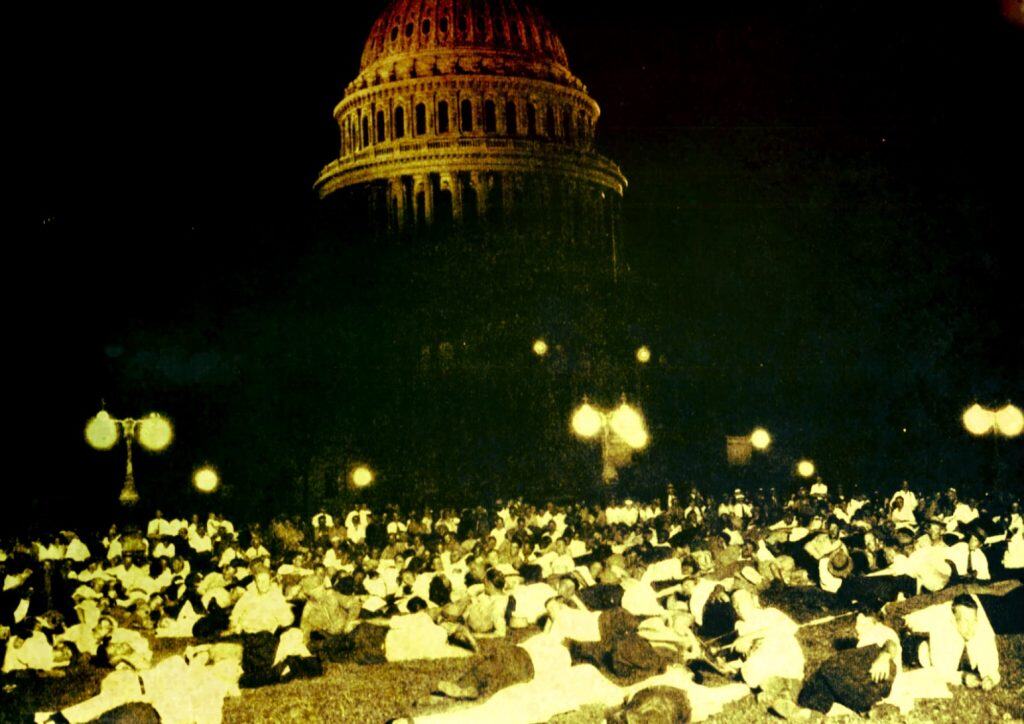
Armies Of the Unemployed – Descending on Capitol Hill
American Forum of The Air – The WPA – June 25, 1939.
By the summer of 1939, the future of the Works Progress Administration’s cultural programs had become a national controversy, debated not only in Congress but also on radio programs such as American Forum. What had begun in 1935 as an ambitious New Deal effort to provide relief for unemployed artists, writers, musicians, and performers was now under direct political attack. At issue was whether the federal government had any legitimate role in supporting the arts—and whether those arts had become a vehicle for dangerous political ideas.
The WPA’s cultural initiatives, collectively known as Federal Project Number One, were unprecedented in American history. They employed tens of thousands of creative workers during the depths of the Great Depression and brought theater, music, murals, oral histories, and public lectures to communities that had rarely experienced them. Supporters argued that these programs were not luxuries but essential forms of economic relief and public education, comparable to building roads or schools. Just as importantly, they preserved American cultural life at a moment of profound national stress.
Opposition intensified in the late 1930s as the political climate shifted. Conservative lawmakers increasingly questioned the New Deal’s scope and cost, and the arts projects proved an easy target. Critics claimed that cultural workers were being paid for “nonproductive” labor and that government sponsorship of artistic expression violated traditional American individualism. More troubling, however, were allegations that WPA arts programs—particularly the Federal Theatre Project and the Federal Writers’ Project—harbored communist sympathizers and promoted radical ideas.
These accusations gained momentum through hearings conducted by the House Committee on Un-American Activities. Although evidence of coordinated subversion was thin, the charge that federally funded art might influence public opinion proved politically potent. Plays addressing labor conditions, housing shortages, and economic inequality were portrayed as propaganda rather than social commentary. In an era of rising international tension and growing fears about ideological loyalty, nuance was easily lost.
Radio became a critical battleground in this debate. Programs like American Forum offered a public space for advocates and critics to confront one another directly, reflecting the broader national argument over democracy, culture, and state power. For listeners in June 1939, the issue was no longer abstract. Congress was actively moving to cut funding, and the survival of entire programs—and livelihoods—hung in the balance.
The outcome was swift and decisive. Later in 1939, Congress eliminated funding for the Federal Theatre Project entirely and sharply curtailed other WPA arts initiatives. The WPA itself was renamed the Work Projects Administration, emphasizing manual labor over intellectual or cultural work. While some projects lingered in reduced form, the era of large-scale federal patronage of the arts had effectively ended.
The debate captured in the June 25, 1939 American Forum broadcast thus represents a pivotal moment in American cultural history. It marks the point at which economic relief through artistic labor collided with fears of political influence and ideological control. The questions raised—about free expression, public funding, and the role of culture in a democracy—would resurface repeatedly in later decades. In 1939, however, the decision was clear: the federal government stepped back, and a bold experiment in public art came to an abrupt close.
Here is that episode of The American Forum featuring, during the 2nd half Discussion portion of the program, Orson Welles speaking on behalf of the Federal Theatre Project – June 25, 1939 from The Mutual Network.
And as a reminder we’re still knee-deep in fundraising: