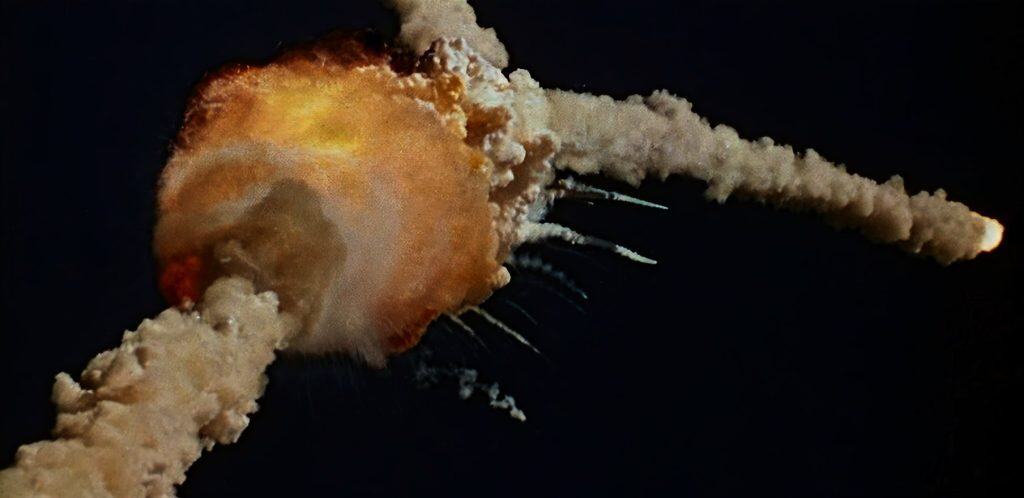
Shuttle Challenger Disaster – Capitol Hill needed answers – got a lot of finger pointing.
A very busy news day for this Wednesday, February 18, 1986.
Starting with an onslaught of rain and snow in the West that has killed at least eight people and forced thousands of evacuations piled “pain on top of more pain” today, spawning record floods and triggering deadly avalanches and mud slides. Since the storm began last Wednesday, more than 20 inches of rain has soaked Napa County, Calif., 63 inches of snow has fallen in Wyoming’s Jackson Hole ski area and winds of 100 mph have been clocked in Nevada and California. “There’s a huge dome of clouds over the entire western United States stretching out into the Pacific.’ National Weather Service meteorologist Michael Lewis said Monday. “There will be rain at some point during the day every day until Friday. Of the eight deaths in the storm, six have been in California, where four people drowned. A woman was presumed dead in a mudslide and a man was killed in a car crash. Avalanches killed a man in Wyoming and another in Utah. Flood warnings were posted today in 38 counties in northern and central California, and the Napa and: Russian rivers had both reached record heights. Heavy rain and snow was expected from Northern California to Idaho and Utah.
And from Capitol Hill, the astronauts whose lives depend on the safety of the space shuttle are emerging as active participants in the search for answers to the Challenger explosion. They are expressing their sense of urgency that a safer space program must come out of the shuttle disaster. Navy Capt. Robert Crippen L. Crippen, the astronaut who in 1981 piloted America’s first shuttle into space, has become a leading figure in the investigation into the explosion of the Challenger Jan. 28. At the Kennedy Space Center, Crippen is officially in charge of operations to find and salvage the Challenger’s debris. Unofficially, he is said to determine virtually every aspect of the inquiry here. “Crippen calls all the shots,” said an official at the Kennedy Space Center, who asked to remain anonymous.
Another influential astronaut in the space agency’s investigation is said to be Col. Robert F. Overmyer of the Marine Corps, who piloted the shuttle Columbia on its fifth voyage into space. The most visible astronaut of all in the investigation is Sally K. Ride, America’s first woman in space and the only current astronaut to have been appointed to presidential commission looking into the shuttle disaster.
Her questions at public meetings of the commission have been some of the most pointed. JOSEPH P. ALLEN, a former shuttle astronaut, yesterday summed up the concern of his colleagues, saying in an interview that the nation had a duty to learn from the Challenger disaster. “It’s imperative that the legacy of this tragedy be a program of increasingly trouble-free flight,” he said. “If that’s not the result, it will be a tragedy many times worse than the explosion itself.” Allen added that he had never heard that joints of the shuttle’s booster rockets, which are currently the chief suspect in the Challenger investigation, were “a serious potential safety-of-flight question.” No astronauts were involved in the decision to launch the shuttle Challenger and therefore they are unlikely to be excluded from taking a hand in the inquiry, according to officials of the space agency.
On Saturday William P. Rogers, chairman of the presidential commission, asked that key space agency personnel involved in the launching decision be excluded from the NASA inquiry. ASTRONAUTS, who usually have little with the operations here, other than responsibilities affecting their own missions, have often been deeply involved in past inquiries. Frank Borman, an Apollo astronaut, played a pivotal role in the investigation of the 1967 fire that killed three Apollo astronauts who were going through a dry run on the launching pad. Yesterday at Kennedy Space Center, Crippen led the formal examination of undersea photographs of what is believed to be Challenger’s right-hand booster rocket, which has been implicated in the explosion.
And finally: Johnson & Johnson, maker of Extra -Strength Tylenol, announced Monday that it would no longer sell the popular pain reliever or any other consumer drugs in capsule form., “We feel the company can no longer, guarantee the safety of the capsules,” James E. Burke, chairman of Johnson & Johnson, told a news conference at the company’s headquarters in New Brunswick, N.J. The unprecedented and costly action will result in the removal of millions of Extra-Strength Tylenol capsules from store shelves. Ten days ago, investigators in Westchester County, N.Y., discovered potassium cyanide in several capsules of Extra-Strength Tylenol, including one bottle that has been linked to the fatal poisoning of a 23- year-old woman. Less than a week later, cyanide was discovered in a second bottle of the highly popular analgesic.
“Johnson & Johnson will no longer manufacture or sell any capsule products made directly available to the consumer. And we have no plans to re-enter this business in the foreseeable future,” Burke said. Burke said Johnson & Johnson immediately would begin a campaign to replace millions of the Tylenol capsules in the hands of consumers, retailers, wholesalers and others. “Johnson & Johnson officials said the after-tax cost of the replacements, future marketing efforts and production changes necessary to make more tablets would be $100 million to $150 million.
And along with continuing rain, that’s a small sample of what happened this February 18, 1986 as reported by The CBS World News Roundup.