By Harvey Kubernik © 2024
I had seen and heard the Beatles mentioned in a Walter Cronkite CBS news television program in December 1963, one of the first times they appeared on American television.
Though I personally hadn’t watched their two earlier appearances, the Beatles had previously been seen and heard in grainy black and white snippets that had aired on the NBC evening news (Monday November 18) and four days later on the mid-morning Mike Wallace CBS show.
There was a fourth appearance on US TV of film of the Beatles prior to their historic live debut on The Ed Sullivan Show in February 1964. That came on the evening of Friday January 3rd when clips from a BBC mini-documentary filmed the previous August were aired on the Jack Paar Program – though Paar Paar concluded the sequence by telling us that the Beatles were going to be live on The Ed Sullivan Show the following month.
A bolt of lightning really jolted our Wilshire District family home in Los Angeles after glimpsing this MUSIC.
These guys were from England, but their sound wasn’t anything like “Stranger On The Shore” by clarinet player Acker Bilk, “Midnight In Moscow” from Kenny Ball and His Jazzmen or Hayley Mills’ “Let’s Get Together” b/w “Cobbler, Cobler.” Three 45 singles from Britain that radio station KRLA-AM in Southern California would spin.
What I heard by the Beatles on my black and white TV screen sounded like the records from the Specialty, Motown, Dot, Liberty, Del-Fi, and Philles 45’s in my collection.
The Beatles on Jack Parr made a lasting impression on me just as much as their first live US televised appearance on The Ed Sullivan Show.
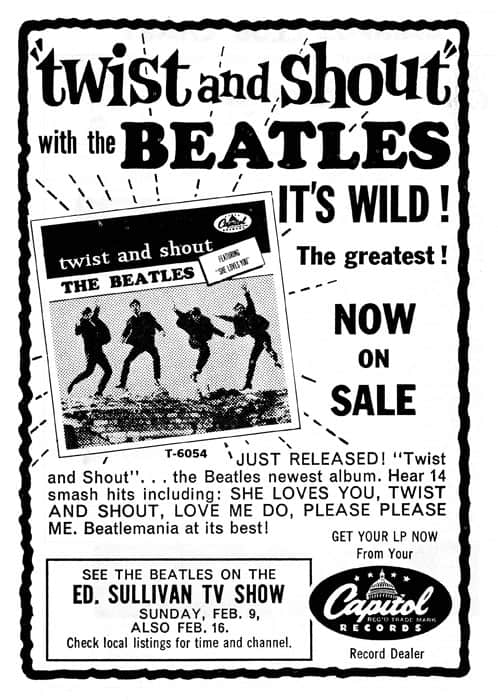
That February 1964 I skateboarded to Hollywood and bought a copy of “I Want To Hold Your Hand” at Wallichs Music City on Sunset Boulevard and Vine Street. The store on the same block from Capitol Records, the company manufacturing and distributing their records.
Where did these Beatles come from?
This century I conducted several interviews with Andrew Loog Oldham, author, deejay, record producer, music publisher, and manager of the Rolling Stones 1963-1967. During early ’63 Andrew was briefly employed by Epstein as a publicist.
In February of ’63, Andrew had made a previous main inroad into his future. Attending the pop TV show Thank Your Lucky Stars with client Mark Wynter, Oldham got “taken over” by a group from Liverpool rehearsing their spot in the show.
“Groups from Liverpool were not in the daily run of things in the front of ‘63,” perceived Oldham.
“Groups usually had their hair greased back, not dry and forward. I was watching the Beatles do ‘Please, Please Me’ and I was taken by their sound, the song, their sense of image and the possibility of another client. They were laconic as opposed to desperate. I spoke to the Beatle who seemed the most approachable to me – John Lennon. I asked him who handled him and he pointed me in the direction of Brian Epstein.”
Between February and April of ’63, publicist Oldham represented the Beatles and two of Brian Epstein’s other new acts, Gerry & the Pacemakers and Billy J. Kramer and the Dakotas, spending one of the most productive and carefree times of his life. He made sure the Beatles were interviewed by Penny Valentine and placed the group into the pages of Beat Instrumental, too.
“I was doing the Beatles’ PR in early ’63 and Kenny Lynch and the Beatles were on a tour with Tommy Roe and Helen Shapiro. It was over that tour, between ‘Please Please Me’ and ‘From Me To You,’ that you saw the chaos and the pandemonium grow to explosive proportions. Something had to give—the UK was bursting at its Beatled seams—and what finally gave was America.
“I was representing this fascinating wonder, the Beatles. I liked Brian Epstein and the way he got things done. The English managers were promoting music the establishment hoped would go away and the American managers were promoting American music, an art that they were not ashamed of.”
In 2014, Epstein (posthumously) and Oldham were both inducted into the Rock and Roll Hall of Fame’s non-performing section – the Ahmet Ertegun Award.
I asked Andrew what he learned from Brian.
“What did I learn from Brian? Oh, the danger of being in love with the act—a lesson I’m glad to say I didn’t learn. That paisley scarf didn’t suit me. That if you’ve been lucky enough to have had an education, use the accent—it works. Brian was a lovely, passionate but tortured man.
“The recent revisionist shit about ‘Our Brian with his life and too many queens,’ wishful thinking served up as British TV fodder is vomit-laden and appalling. John Lennon had a much blunter take on it all.”
Andrew detailed the impact of the Beatles landing on North American soil.
“For one, it was obvious that ‘this thing of ours’ was not going to disappear. We had come in following the twist, Davy Crockett, skiffle, and trad jazz. Skiffle and trad jazz had been very important; they had been the BBC and the Establishment’s last chance to control the key to what music we got to hear. You had shows like The 6.5 Special, hosted by Pete Murray—God bless him!—and Jo Douglas, which invited us all to deck up in jeans and sweaters and be really daring with our shirt collars turned up.
“The music was shit, with a few exceptions, like Lonnie Donegan, whose earnestness and belief were almost evangelical. The rest were a bunch of lame skiffers and jazz musicians who thought they were in a lamentable kindergarten, which they were. Yes, we had Eddie Cochran, Little Richard, Duane Eddy and Buddy Holly and the rest, but it had been a fight.
“You see, before the Beatles went to America, the best possibility that pop music offered was not having to get a regular job. You must remember that Ringo would have happily called it a hard day’s night if he’d made enough money to open a ladies’ hair salon and settle down with Maureen. Life was that simple until America entered the equation. It was an age of innocence that ended when America became a possibility. America seized the Beatles in the same way people seized Davy Crockett and Hula-Hoops.
“Then the Beatles played The Ed Sullivan Show. That moment when American youth, feeling the subtext, feeling the great unspoken hurt of a nation still traumatized by the assassination of its president just a few months before. It’s an incredible moment: suddenly American youth had its own music, a reason to be alive.”
Poet/deejay and former English and Literature Professor at Cal Poly San Luis Obispo, Dr. James Cushing, presented his theory why the Beatles became a transformative force and were available to us in February 1964.
“I begin with the poetic notion that the ritual reappearance of a Dionysian hero—young, sexy, full of vitality and signaling the return of spring—was key to the deeper meaning of JFK, and the reason so many people (women especially) loved him despite his political ineffectiveness as president.
“He had hair, he had erotic charisma, he had TV stardom and a great voice—and then, as it must with all Dionysus stories, tragedy struck. Author Don DeLillo wrote that Dallas ‘broke the back of the American Century.’ End of this Dionysus cycle? Apparently so…and then, seemingly out of nowhere (Liverpool?), on The Ed Sullivan Show, two months and two weeks after November 22, 1963, on the same TV that gave you JFK, we get—who could have predicted it?—four Dionysian heroes who wear the garb of the singer Orpheus!
“My God, the hand of fate traded Kennedy for the Beatles! And so, they blended Dionysian ecstatic energy with Orpheus’ romantic loyalty to Eurydice for an erotically unbeatable moment.
“It was a period post–Dwight Eisenhower and now post–John F. Kennedy. America was still in mourning for John F. Kennedy, and we were all still feeling freaked out about the Russians on a Bay of Pigs level. Plus, the whole question about civil rights and civil rights for Negroes were still a bunch of big issues.
“Everything on the news was challenging. Everything was tragic and everything was a bummer. And the postwar period had been primarily one of anxiety and conformity, with a few interesting rebels that stood out, like Allen Ginsberg and Elvis Presley.
“It was the reality that now we had something positive and enthusiastic. Something that gave a kind of grand permission to let all those bottled repressed feelings out. Here was permission to shake your hair, scream and go crazy. There was a sense of tremendous cool, positive energy, tremendous potential for excitement, tremendous permission. Everything about the joy of romance that can happen in public was happening there with the Beatles.
“The girls who went to the Ed Sullivan Theater or the Washington D.C. Coliseum or the Hollywood Bowl or Shea Stadium were not going to hear a concert of popular music but to worship an ancient hairy deity in its four-bodied form. Their screams are so loud because years of sexual frustration lie behind them. In looking at footage from this period, it’s the girls who are most compelling as they shatter into ecstasy while the boys smile and maintain Olympian cool,” posed James.
David Leaf is a filmmaker, author and UCLA Professor and created the course and began teaching The Reel Beatles in 2019, which is also online from a grant from the University of California to exhibit for the entire UC system.
In his 2003 DVD release, Jack Paar-Smart Television, the black and white Paar video clip of the Beatles’ segment, complete with a January ’64 date etched on the lower part of the original screen copy was displayed. Was that their first US TV appearance? Well, sort of.
NBC News in mid-November had run a story on the British phenomenon of Beatlemania, with a decidedly mocking tone.
Another TV mention of the Beatles came when they received mediocre numbers on American Bandstand’s Rate-A-Record segment.
Up until the end of 1963, their singles (on United States record labels like Vee-Jay, Swan and Tollie) had all flopped. As for CBS, unexpectedly, when Leaf interviewed the CBS newsman Walter Cronkite for The U.S. Vs. John Lennon, Cronkite mentioned that the CBS Evening News had a report on British Beatlemania ready to run in November but that events had intervened.
“Events” being the tragic, cataclysmic assassination of President John F. Kennedy. When the report finally aired on December 10th, Cronkite told Leaf that before the credits had finished rolling, “Ed Sullivan was on the phone, asking me about the Beatles.” A great story…except that the Beatles’ manager had already inked a three-appearance deal with Sullivan a full four weeks beforehand.
On Monday, November 18, 1963, The Huntley-Brinkley Report television program on NBC-TV featured the first TV appearance by the Beatles in a somewhat snide report by Edwin Newman.
Television Mike Wallace then presented a film clip of the Beatles on his mid-morning show CBS Morning News With Mike Wallace on Friday November 22nd 1963.
The tragedy of President Kennedy’s assassination naturally meant that everything else that happened before that day was of zero consequence. And as the world mourned JFK and became engulfed in the awful news, the light-hearted story that Mike Wallace had presented just two hours earlier – that had been scheduled to run as the final story on that evening’s news broadcast was instantly forgotten.
Mike Wallace’s senior colleague at CBS News — Walter Cronkite then decided to resurrect the story and on Tuesday December 10th 1963, he re-aired the sparkling five-minute film clip of the Beatles enchanting their British fans.
“Cronkite was looking for a way to lift the spirits of the devastated American public with a cheerful segment,” states British producer/writer/Beatles scholar Martin Lewis who instigated/produced multiple celebrations of the 40th & 50th anniversaries of the Beatles’ first US visit and also produced the initial 2-disc DVD release of Hard Day’s Night.
“And he recalled the film clip that Wallace had introduced on his Morning News show that dreadful Dallas morning. The clip had originally been intended to be repeated that same night (November 22nd) on Cronkite’s own newscast. But of course, the regular nightly news was preempted by rolling news coverage about the assassination.
“To a nation still reeling from the massive emotional trauma of JFK’s assassination, the exuberant optimism of the Fab Four offered solace and the promise of a New Beginning. The film clip triggered an astonishing chain reaction that kick-started Beatlemania in the USA. The Beatles would have happened in America anyway of course. But the velocity and magnitude of their American breakthrough sprang from that Walter Cronkite news story. The one that Cronkite saw Mike Wallace introduce.”
By Christmas of 1963, just prior to the release of Capitol’s first Beatles single (“I Want To Hold Your Hand”), two of America’s three networks, in one way or another, had covered the Beatles. The Paar clip, however, is still historic, because it was the first prime-time TV appearance in the USA of the group. Prime-time? Yes.
“By 1964, Jack Paar was no longer hosting The Tonight Show,” Leaf reminds us.
“Jack was on in prime-time, on Friday nights. The Beatles segment on Paar featured footage of the Beatles performing (from 1963) in England.
“Some fans, remember the electricity that particular clip created. “However,” Leaf insists, “it wasn’t Huntley-Brinkley on NBC, or Cronkite on CBS or Jack Paar who made the Beatles stars.” And, he continues, “it wasn’t The Ed Sullivan Show that made the Beatles hitmakers either.
“’I Want To Hold Your Hand’ was already at #1 before they were on Ed Sullivan. That broadcast was really a nationwide coronation, because they delivered. Unlike so many wildly-anticipated or hyped events that don’t live up to expectation (e.g., like most Super Bowls), the Beatles February, 1964 appearances on The Ed Sullivan Show (especially that first night) exceeded everything we could have imagined.
“They could sing and play and looked so different; they were electrifying as performers. And, because a lot of us were too young for Elvis and the early rockers, the Beatles were ours…our ‘discovery’…something that the older generation…and even older teens didn’t necessarily like. Remember all the inane chatter from adults about ‘their hair?’”
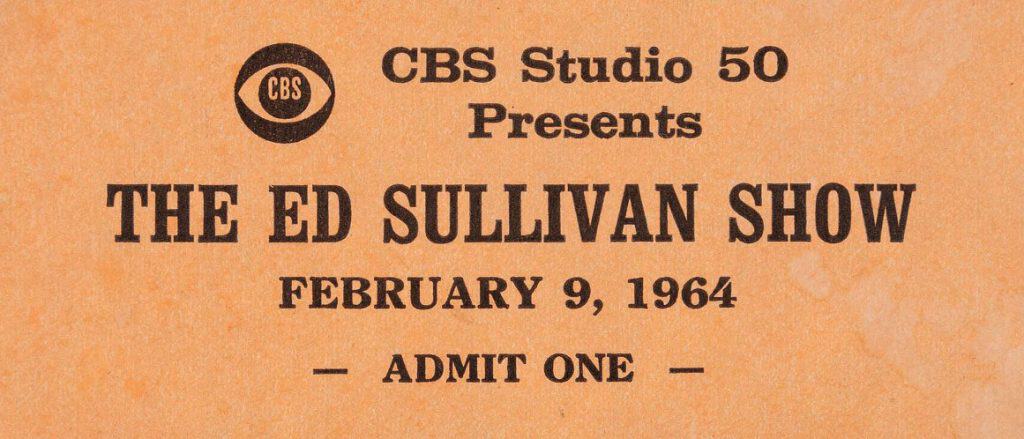
When the Beatles stepped onto Ed Sullivan’s New York stage on Sunday, February 9, 1964, to make their American TV debut, 86% of all TVs on at that hour—73 million Americans—were tuned in. It was the most watched program in history to that point and remains one of the most watched programs of all time. To some, it will always be remembered by his introduction: “Here they are—the Beatles!”
The New York–based Sullivan was best known for his influential television hosting duties of the 1950s and 1960s, but before the small-screen exposure, he had been a newspaper columnist and show business personality beginning in the early ’30s.
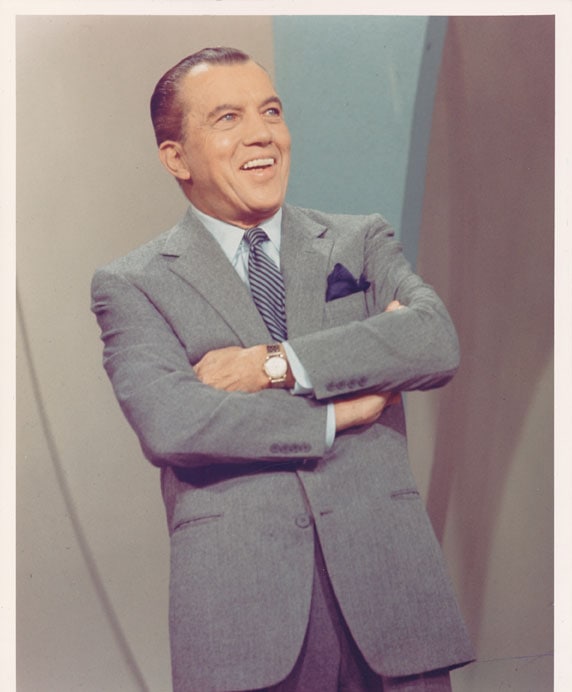
Ed presented more than 10,000 performers over his prime-time TV career. He also portrayed himself in the movie Bye, Bye Birdie.
The Sunday night variety show, which ran from 1948 to 1971, was seen live in the Central and Eastern time zones but fortunately was taped for airing in the Pacific and Mountain time zones.
Sullivan initially became aware of the Beatles when arriving on a flight at London airport (subsequently known as Heathrow) on Friday October 31, 1963. Having witnessed the hysteria of fans at the airport to greet the group’s arrival home from a Swedish visit – he made note of the pandemonium. He was thus aware of the group when he was approached for a meeting by their manager, Brian Epstein.
On November 5, 1963, immediately following the band’s historic Royal Command Performance, Epstein flew to New York with Billy J. Kramer in order to huddle with the all-important editor of 16 magazine, Gloria Stavers. On his visit to New York, Brian met twice with Ed Sullivan in order to negotiate appearances by the Beatles on The Ed Sullivan Show.
At first, Sullivan offered Epstein and the Beatles only a spot during one broadcast. Epstein, who had his strategic eye on the prize of TV exposure did not focus as most managers would do on the fees. He even offered to pay travel, lodging and expenses, after Sullivan first declined a headline date.
Then Epstein countered with a guarantee for two different headline appearances. Sullivan was rather surprised by Epstein’s firm demands. They settled on two principal shows on successive Sundays – live on February 9th in New York and live on February 16th in Miami. With a third performance to be taped in New York to be shown at a later date.
As it happens the third performance was taped on the afternoon of the first show (Feb 9th) and then aired on Sunday Feb 23rd. Meaning that the Beatles appeared on three successive Sundays – though that third airing date was not initially scheduled. It was after the first appearance that Sullivan realized that he could capitalize on his good fortune by airing that additional performance to make it three consecutive weeks of the Beatles.
Epstein then skillfully used the fact that he now had a commitment for three Sullivan TV spots to finalize an already in-discussion negotiation with Capitol Records president Alan Livingston for US releases of the Beatles. He got Capitol to commit to a vast promotional budget for his group.
Writer/producer Martin Lewis – who was a protégé of former Epstein assistant (and subsequently key Beatles publicist) Derek Taylor – instigated and ran the successful campaign to get Epstein into the Rock and Roll Hall.
“When I launched the campaign in 1998, I had a couple of meetings with Alan Livingston,” Lewis offered in a December 2023 interview.
“He told me that Brian Epstein had played a brilliant game of poker with him. Brian had phoned Livingston in mid-November 1963 – hustling to get Livingston to commit to releasing the Beatles in the US. His underlings at Capitol had already rejected the group on four occasions in 1963.
“When Livingston played coy and refused to commit – Epstein acted dumb. ‘I understand that TV is very important in your country. Would it help if I could get my Boys a slot on one of your American TV shows?’ Livingston said that it would. ‘What about a program which I think is called err… ‘Ed Sullivan’ – if I could get them on that show – would that help?”
“Livingston was convinced that the Englishman on the other end of the phone was a naïve loser. When Epstein said ‘well if I can get them an appearance on the Sullivan show – THEN will you commit to release my group in the US?’
“Livingston agreed. Then Epstein went for the kill. ‘And if I could get them THREE appearances on Sullivan – would you commit to a large promotional budget to launch them?’
“Certain he was dealing with a fantasist, Livingston readily agreed. What did he have to lose? A totally unknown manager representing a totally unknown British music act with strangely long hair and no US record deal – had no chance getting his act on the Sullivan show once – let alone three times.
“Livingston immediately gave his word and hung up.
“With his trap sprung Epstein waited a couple of days – so that he could create the illusion of having had sufficient time to negotiate such an improbable deal. Then he called Livingston and told him the Beatles had got a commitment for three Sullivan appearances!
“Livingston told me that at that point he was certain that Epstein was crazy. He said he’d have to call Epstein back. He then phoned Bob Precht the producer of the Sullivan show – certain that he’d be told that the show had never heard of the Beatles.
“To his astonishment he learned two things. Firstly, that the Beatles indeed had got a contract for three Sullivan appearances. And secondly – that the contract had been signed two weeks earlier! That Epstein had the signed contract in his back pocket when he first phoned Livingston and had asked if getting a US TV show might help him get a record deal!
“Livingston told me, ‘I realized immediately that I had been played. Out-played. Brian had bluffed me brilliantly. I wasn’t mad. I was thrilled. If this guy was that skillful and that passionate about out-smarting me. If he was that skillful and that passionate to get Sullivan to commit to showcasing his group on three shows – I knew I was dealing with a promotional genius. I’d already given my word for a generous deal if Brian delivered. And as he had delivered, I committed to the deal for the Beatles on that phone call. I wasn’t sure yet about the Beatles. But I WAS getting in business with the guy who was sure…’”
After Ed introduced the debut of the Beatles Sullivan told his North American viewers, “Those first three songs went out to Johnny Carson, Randy Paar [Jack’s daughter], and [newspaper columnist] Earl Wilson.”
The Beatles would have TV dates on Sullivan three more times: the following Sunday live from Miami, the show taped on the afternoon of their first appearance aired on February 23, and finally on September 12, 1965. In all, the Fab Four performed 20 songs (15 different ones), from “All My Loving” and “I Saw Her Standing There” (twice each) to “I Want to Hold Your Hand” (three times), “Yesterday” and “Help!”
There were other entertainers on The Ed Sullivan Show when North America saw the Beatles.
Another British lad was on the call sheet at the venue, David Jones, who would achieve worldwide success as Davy Jones, a member of the Monkees.
This century, Jones talked to videographer, music archivist, librarian Gary Strobl, definitive expert of the Monkees.
“When I was on The Ed Sullivan Show, it was the first time The Beatles appeared in America. I remember the little bit from Oliver! (singing), ‘I’d do anything for you. I’d give anything…’ Georgia Brown, Clive Revill and different people were in Oliver! with me.
“I was standing in the elevator and Ringo Starr got in. He’s obviously a nice chap and he’s got his qualities, but he was an ugly bugger, you know? He had this massive nose. Pop singers were sort of like Dave Clark and Paul McCartney. I was always a cheeky little guy. He had a bad cold at the time and he was about to blow his nose. I said, ‘No, let me hold the handkerchief, I’m closer than you are.’ Ringo said, ‘I know.’
“And then I saw what happened on the show, and I couldn’t believe it. All these girls started screaming at the Beatles. All these guys were coming right down and jumping on the Beatles and saying, ‘You know, I got my first set of drumsticks because of you.’ I wanted a piece of that action. That’s when it first struck me.”
“The Beatles beamed in to American homes on the evening of the February 9th Ed Sullivan Show commandeering 73 million viewers or literally taking over 1 in 4 television sets in an invasion like no other,” underpins writer Chuck Gunderson, who authored the 2-volume book set SOME FUN TONIGHT! The Backstage Story OF How The Beatles Rocked America: The Historic Tours Of 1964-1966, published by Gunderson Media, LLC.
“Moms and Dads had a hard time understanding, but teenagers knew exactly what was going on. Instead of Elvis there were now four guys to choose from who could all sing and create music- ‘sorry girls, he’s married’ and we all know who we’re talking about. The tail end of the Baby boom now became a musical sonic boom for everyone that wanted to be them. Sure, grow your hair long, pick up a guitar and write your own music. Future legends were born that night and sixty years later we still talk about it.
“Liverpool to Hollywood is a giant leap. One can only imagine what was going on in their heads? Dingy, cold, grey fog off the Mersey to warm, vibrant breezes off the Pacific. Movieland, stars and starlets. They arrived from an underground black and white cellar, called the Cavern to one of the most prestigious, brightly lit stages in America-the Hollywood Bowl.
“The group knew they would be a success on the Sullivan show, why wouldn’t they be? Their confidence always abounded and their thirst for progress was their primary driver. Why not tour the North American landscape? Why not do 32 shows in 33 days? That’s what August and September during that first tour was made for. America was on one long continuous scream during that summer as a half a million people were introduced to the Beatles in person, no less for the first time.”
Martin Lewis summarized the paradigm shift that occurred in February 1964:
“The Sullivan show at that time is still in black & white. Sullivan wasn’t transmitted in color until September 1965. But watching video of the 1964 show tells the whole story. The studio audience members are in black & white. In fact, they appear to be shrouded in Eisenhower gray. It’s still the 1950s in America. But by comparison the Beatles appear to be in 3-D Technicolor. It’s already the 1960s in their Fab bubble. America is about to be dragged into the future by four lads from a galaxy far, far away. The British Empire is striking back…”
Over 50 years after the four seminal live performances of the Beatles on The Ed Sullivan Show, those cherished memories were shipped to retail outlets in September 2010 on home video, with newly remastered audio and restored video, from Universal Music Enterprises (UMe) and produced by SOFA Entertainment, which purchased all 1,050 hours of The Ed Sullivan Show in 1990.
Few tapes had been transferred to a contemporary format until SOFA head Andrew Solt obtained the rights.
The well-respected music and TV/film writer/producer Solt is a graduate of Hollywood High School and holds a master’s degree in Broadcast Journalism from UCLA.
Solt’s other credits range from the 1979 TV special Heroes of Rock and Roll and the 1988 feature documentary Imagine: John Lennon to the 1991 Warner Brothers theatrical feature film This Is Elvis to the 1995 TV documentary series The History of Rock ’n’ Roll and the 2006 home video Elvis: The Ed Sullivan Shows. SOFA Entertainment has produced approximately 400 programs for television and home video.
“We used the full extent of today’s technology,” specified Solt, executive producer/CEO of SOFA Entertainment, from his West Hollywood Sunset Boulevard offices. “The quality is better than it ever was, in fact, better than when the shows aired, especially visually.
“Usually when there is a major historic moment, it’s seen on every channel,” noted Solt. “What makes the first Beatles performance so unusual is that The Ed Sullivan Show was the only place you could see it. Even though their music was everywhere, we had never seen them live. It was a shared joyous moment for an entire generation and still is today.
“For example, the February 16 performance was from Miami’s Deauville Hotel, not from a studio,” explains Solt. “The quality of the tape image was very fragile. We went back and improved it frame by frame.”
With a running time of more than 250 minutes, The 4 Complete Ed Sullivan Shows Starring the Beatles have these shows uncut, including not only all of the other performances but also all of the original commercials.
The audio is available in both mono and 5.1 remix. Also housed on the two-DVD set is material from other Sullivan shows, notably a short interview with the Beatles that had not been seen since its original television airing in 1964.
Few moments of the Beatles’ performances had ever been seen before a similar DVD package were in retail outlets in 2003, but distribution at that time was via a small independent company. Now with UMe, the item is more widely available at traditional record shops, bookstores, chain locations and from the internet.
Plus, the new DVD set has been augmented with approximately 13 minutes of additional footage. The added material, rare Beatles-related gems from additional Sullivan shows, is placed at the end of each disc.
Among the delights is a brief London interview with the Beatles by Sullivan that had not been seen since the day it aired (May 24, 1964); a 1966 black-and-white commercial for Beatles dolls introduced by Sullivan in color; and the host reading a 1967 telegram from the Beatles congratulating him on the renaming of the studio to “The Ed Sullivan Theater.”
“For so many people who experienced those first shows originally, including myself,” ventured Solt, “we remember where we were. But we never saw them again. Now we can, and in context—the complete shows—with all the raw energy and excitement, the audience going crazy.
“There’s also a new generation, one that has bought the reissues, the Rock Band video game, seen Paul McCartney play on the marquee of the Ed Sullivan Theater that’s the home of The Late Show with David Letterman, heard the songs on American Idol. They know the music so well even if they were born decades later. A word like timeless gets overused, but it definitely applies to The 4 Complete Ed Sullivan Shows Starring the Beatles.
“Sullivan knew how to give a show that was for every generation that might be watching. It was for the kids to the grandparents. And he knew how to bottle lightning. And he also knew, because he had great instincts, not only how to produce a show but who to put on and what order. And he really was the arbiter of taste for a period of time, which was that postwar era, the birth of television, until the birth of the seventies. It is a remarkable reflection of American history.
“The bonus material includes some material that is very unusual that we have used and has never been seen since it was out before, which was, Ed flew to England in 1964 and does a two-minute interview with the four Beatles in London just before the release of A Hard Day’s Night. It’s unusual and special. Also, these moments where Ed reflects on the Beatles, either coming on or having been on his show, the reaction, the success. But what is really interesting is their great performances and how excited they are. How they are so together.”
Solt also referenced the world of black-and-white film that captured the televised musical exploits of the Beatles in North America:
“I think because the footage is black and white it takes you back even more into an era which to today’s generation, nobody understands why anything was ever in black and white. I think what really comes across is their excitement, their charisma, their talent, and when you start to think those haircuts were considered revolutionary, weird and longhair, that those Beatles boots that they wore were really different, that they were so unusual. And in retrospect it’s humorous, but that is Day 1 of the evolution of rock ’n’ roll post-Elvis.
.
“That era of the Sixties starts February 9, 1964, in America. And it is the first-time rock ’n’ roll ever comes to us. Because before that, rock ’n’ roll was an exported item. It was never imported. And they reinvent it and bring it back and it changes the face of American pop music completely. And that happened there and the city goes mad, the country goes wild, the whole place is affected, and the beauty is watching the faces of these four young guys. And then knowing that they’ve waited for this moment. They came to America with a No. 1 record. They had it all lined up. And they told that to Brian and it happened.
“And for those of us who remember the music arriving around September 1963, by the time they get to February, it’s after the John F. Kennedy assassination and we had been through the doldrums of a very horrific time where everything is questioned. Bomb shelters. I never thought I would see grownups running around, crying like the world had ended. I didn’t know what was going on, it was so severe,” lamented Andrew.
“And then 10 weeks later or less, these guys land on our shores, and euphoria reins. And this is the moment. And this can now be enjoyed by people around the world in a way that matters,” beamed Solt.
Before tastemaker Ed Sullivan presented the Beatles to North America, Lesley Gore, Jackie Wilson, the Angels, Ertha Kitt, Chubby Checker, and popular British acts Cliff Richard & the Shadows, Georgia Brown, and Frank Ifield were showcased in 1963.
In the June 13, 1971, issue of West, a magazine supplement in The Los Angeles Times, Ed Sullivan capped off his television career to Wayne Warga: “We did it all. And there wasn’t really that much more to do. It was nearly impossible to find new acts for the show. Rock groups, our big attraction the last several years, don’t do that much television. They make their success and their money in concerts. I’m convinced there is still a place for a show like ours, that there are people who want the kind of thing we offer. We got caught in the squeeze of dropping ratings and network budgets, and so it’s over.”
In 2011 Andrew Solt and I reminisced about Ed Sullivan’s defiant efforts exposing the omnipresent and telegenic Black entertainment world, besides the pop, jazz, country and rock ‘n’ roll 1956-1971 recording artists he introduced to us.
Sullivan was the first to bring country music (Chet Atkins, Johnny Cash, Loretta Lynn, Jimmy Dean, Brenda Lee and Buck Owens) to national television viewers alongside political figures Presidents Dwight D. Eisenhower and John F. Kennedy.
In a time of segregation, Ed Sullivan, an influential civil rights advocate, invited African-American actors (Pearl Bailey, Diahann Carroll), athletes (Muhammad Ali, Jackie Robinson), comedians (Moms Mabley, Richard Pryor, Flip Wilson) and musicians (Harry Belafonte, James Brown, Motown artists such as the Four Tops, the Temptations, the Supremes), to name a few. Dancer Chester “Peg Leg” Bates was on Ed’s program at least 22 times.
“Ed had a fascination with African-American culture,” reiterated Solt. “He loved talent. He stood up for Harry Belafonte and Marian Anderson. Mahalia Jackson sang on the show and one of the very first shows W.C. Handy sang was on Ed Sullivan. He is considered the father of the blues.
“A Harlem DJ, Dr. Jive, introduced R&B artists to America in late 1955. ‘Rock Around the Clock’ was blasting out of every transistor radio and the main titles of Blackboard Jungle. Ed loved introducing African Americans on his stage, and most of all he enjoyed giving people big breaks and the most desired gift, national TV airtime.
“Ed liked his role as showbiz kingpin, and he knew he was very fortunate to be such a powerful arbiter of American taste. He took pleasure in influencing our culture and acts that would make us gasp and swoon. He was an unlikely hero,” underlined Solt.
In 2020, Andrew Solt/SOFA Entertainment partnered with UMe for Ed Sullivan Show digital global rights.
When the Beatles first came to the US in 1964, primarily to appear on The Ed Sullivan Show, they also arranged two live concerts. The first of these concerts—their first ever in the U.S.—occurred in Washington, D.C., at the Washington Coliseum on February 11th.
The Washington D.C. Coliseum was an indoor arena where college amateurs and professional basketball teams played. It held approximately 8,000 for the concert. The biggest venue they had played to date was the Empire Pool in the U.K. which held 8,000. They went down to Australia in June of 1964 and performed to 10,000 but it was in America at the Cow Palace on August 19th.
The Beatles also made another live stop during their February 1964 U.S. visit—at New York City’s Carnegie Hall on February 12. In New York there were two shows, but in Washington, only one. It was filmed in black and white video by CBS with the permission of the Beatles’ manager, Brian Epstein.
Just before the Beatles debut on The Ed Sullivan Show on February 9th, I heard a commercial on my Hollywood KFWB AM radio station about the Beatles, Beach Boys and Lesley Gore in person during March we could see at the nearby Wilshire Theater around the corner from our house. I bought a ticket for the show scheduled the following month.
This historic TV theater package was videotaped for a national closed-circuit theater viewing audience, and then packaged a month later with pre-taped television studio live sets by the Beach Boys and Lesley Gore for a 90-minute silver screen event, The Beatles: Direct From Their First American Concert, that was broadcast in over 100 North American movie houses, employing a system generally utilized for boxing matches and live sporting broadcasts.
Snippets of the March 1964 closed-circuit event had been utilized for the Beatles Anthology and other filmic collections.
In 1961, Quincy Jones returned from Europe, Irving Green at Mercury Records hired him as an A&R man (artists and repertoire), then promoted him to Vice President the following year. Jones discovered Lesley Gore as a teenager and produced her terrific hit singles.
During 1961-1965, Jones wrote arrangements and made records with Gore, Dizzy Gillespie, Count Basie, Brook Benton, Dinah Washington, Sarah Vaughan, Ella Fitzgerald, Billy Eckstine, Frank Sinatra, and Sammy Davis, Jr,.
It was Quincy who heard the Beatles literally before anyone Stateside. Brian Epstein personally presented the group to him. Little Richard, fresh off European gigs with the Beatles, was newly signed as well to Vee-Jay in the USA. Jones had produced Little Richard and his return to rock, The King of Gospel Singers, in 1962.
At a 1977 Billboard magazine Disco Convention panel inside the Century Plaza Hotel in Century City, I spoke with Jones about Ray Charles, Herman Leonard, and his music teacher, French composer Nadia Boulanger.
The next year I worked with Quincy at MCA Records when he produced the movie soundtrack to The Wiz. I was the West Coast Director of A&R for the label. Mr. Jones said “it was the worst gig of my life, but I met Michael Jackson on that Wiz movie set.”
During that ’77 Billboard gabfest, Quincy told me he knew about the Beatles before they went to the US, and “thought they were fantastic.” He also tried to secure an American record deal for the band and Brian Epstein in 1963.
Even the band had concerns about succeeding on the record charts in the States. Jones said that many record company heads at the time didn’t think, “a United Kingdom act could break the dominance of American music.” His Mercury Records label apparently passed on the Beatles for North American distribution.
Jones and Gore had seismic hits. Their 1963 collaboration, “You Don’t Own Me,” reached the number 2 position on the Billboard Hot 100 chart and remained in that position for three consecutive weeks when February 1964 began, and was never able to overcome the Beatles’ “I Want to Hold Your Hand.”
However, Jones’ ‘63 productions did permeate the Beatles’ subsequent recording activities.
“The only time I’ve ever heard about The Fabs and the Q spoken of in the same sentence,” revealed Toronto, Canada resident, writer and music historian Gary Pig Gold, “was Lennon and McCartney asking George Martin in ’63 how to get ‘the Lesley Gore sound’ on their vocals. Hence the abundant double-tracking of the voices from With The Beatles especially onwards.
“Lesley was blessed with a most expansive and expressive voice to begin with, of course. In a recent New York club appearance of hers I was fortunate to attend, she remarked how Quincy nicknamed her ‘Little Bits,’ marveling at such big sounds coming from such a small girl. But under his perfect guidance, those early records of hers somehow almost scaled Phil Spector’s sonic Wall!”
The promoters, National General Corporation and venture partners did extremely well, garnering millions of dollars in the limited rollout of the Beatles/Beach Boys/Gore billing.
The Beatles’ public appearance at the Washington D.C. Coliseum, located at 3rd and M Streets N.E., occurred during a cold and snowy night.
It was their first live American performance after their televised appearance on The Ed Sullivan Show. It was the longest-ever set filmed of them in concert.
Opening that show were the Caravelles, a British girl duo with a 1963 hit record, “You Don’t Have to Be a Baby to Cry,” Tommy Roe of “Sheila” notoriety, the Chiffons, known for “He’s So Fine” and “One Fine Day,” Jay and the Americans, “She Cried,” plus the Righteous Brothers duo, with their often requested “Little Latin Lupe Lu.”
When the Beatles came on, the place erupted with screaming and incessant flash bulbs. They played for nearly an hour. Because of the setup in the Coliseum, the Beatles were essentially performing on a boxing-ring-type stage, requiring them to move their equipment around onstage a few times in order to give everyone in the audience a chance to see them. Ringo was seen moving his drum kit around on stage between songs, aided by roadie Mal Evans.
Their set lasted about 35-40 minutes.
Roll Over Beethoven
From Me to You
I Saw Her Standing There
This Boy
All My Loving
I Want to Be Your Man
Please Please Me
Till There Was You
She Loves You
I Want to Hold Your Hand
Twist and Shout
Long Tall Sally
The concert showcased the group for the first time in front of a live United States audience. It was the big market Brian Epstein and “The Lads” dreamed of scoring.
In the mid-seventies I asked Beatles’ associate Mal Evans, then living in Los Angeles, during a Keith Moon recording session at the L.A. Record Plant studio, about that gig. Mal replied, “Oh yes…That was a good one!”
After their live D.C. conquest, the group went to a ball at the city’s British Embassy.
The Beatles that day returned to New York by train for their Carnegie Hall concerts—two 25-minute performances before 2,900 fans attending each show.
About a month later, in mid-March 1964, The Beatles: Direct From Their First American Concert—the complete 90-minute black and white film of the Beatles’ D.C. show with footage of Beach Boys and Lesley Gore performances—was transmitted over telephone lines to selected U.S. and Canadian theaters in four separate shows—two each day—over the weekend of March 14-15, 1964.
Among the receiving theater locations that Saturday were the Stanley Theater in Pittsburgh, Pennsylvania; the Hippodrome Theater in Cleveland, Ohio; the El Monte Legion Stadium in El Monte, California; the Public Auditorium in Portland, Oregon; and many others.
The following day, the show went out again to a number of locations, including the Norva Theater in Norfolk, Virginia; Lake Theater in Oak Park, Illinois; Fox Theater in San Jose, California; and the Washington Coliseum in Washington, D.C. The Lyric Theater in Indianapolis, Indiana received the show on both days, as did the State Fair Coliseum in Dallas, Texas.
The total audience for the Beatles’ concert film was expected to exceed 500,000. The shows were seen in more than 100 theaters in the U.S. and Canada. The promoters—identified in advertising as the National General Corporation, or their subsidiary, Theater Color Vision—made millions.
One 1964 estimate placed the take at some $4 million, or roughly $30 million in today’s money. This Beatles-driven package was possibly the first use of closed-circuit broadcasting for a rock concert, as previously this theater network had been used only for championship boxing matches.
Before this silver screen event, I’d seen personal appearances, and Television City CBS-TV tapings of Superman (George Reeves), the duet of Barbra Streisand and Judy Garland, Pinky Lee, Engineer Bill, the Beach Boys, Frank Sinatra, Soupy Sales, Dick Dale, and Spike Jones with Helen Grayco.
I’d already seen the Beach Boys in 1962 in Culver City and I was collecting their singles and early LP’s. I had watched Lesley Gore on afternoon TV shows in late 1963.
I was super charged by this Washington, D.C. cosmic experience, and afterwards thought I attended a live concert with the Beatles, Beach Boys and Lesley Gore. (I only discovered this century the Lesley Gore and Beach Boys segments were videotaped in late January ’64 in Burbank, California, at the NBC Television Studios and part of a separate in-studio staging hosted by local deejay Roger Christian).
The world had just changed right in front of me, just weeks after becoming a teenager.
The Beatles weren’t scary like characters in Rod Serling’s stories from 1959–1963 first-run Twilight Zone episodes. They were welcomed visitors from another planet I didn’t know existed, who didn’t look or sound like anyone else. Their presence was an example of what Twilight Zone writer Richard Matheson described “as the powerful chilling charismatic effect of black and white film.”
There was a revealing aftermath from this Tall Boy five-ton-like music-driven celluloid bomb that landed on the fringes of Beverly Hills. The Wilshire Theater was the movie house in 1963 that showed one of my favorite movies, the aptly futuristic The Great Escape. Every schoolgirl around me wet their cushioned seats minutes after the curtain opened.
In 2004 I spoke with Andrew Loog Oldham about my 1964 Beatles’ exposure. I asked Andrew, if it was akin to “how he and British folks witnessed Elvis Presley in movie theaters?”
“Elvis…Man of hope, dreams and glory,” declared Andrew.
“Elvis gave us hope and attitude. The Beatles opened our minds and hearts but Elvis opened our legs, of course the pill helped.
“You must remember that Elvis only toured the UK on screen and vinyl, therefore he had the first and last word and the best audio and lighting. This was also the era when TV was a black and white affair afforded by the few that ran from 5PM to 10 PM and did not feature the likes of Elvis.
“I think King Creole, Jailhouse Rock and Flaming Star were best; loved the interplay with Katy Jurado; loved him with Carolyn Jones in King Creole …
“Elvis seemed to have these great confrontations with older ladies in his flicks, Lizabeth Scott in Loving You. The images that I remember best are Elvis singing ‘Crawfish’ on a balcony in New Orleans is just classic, singing ‘Baby, I Don’t Care’ poolside in Jailhouse Rock in those great Zoot suit pants, cable knit sweater with the pure Armani neck and those black and white loafers to die for.”
“Hollywood and the Beatles were the two greatest romances of the 20th century,” suggests Dr. James Cushing. “What did they have in common? How did they intersect? How did one of these great affairs learn from the other?”
It’s not a secret why the Beatles had an emotional, musical, physical, and spiritual relationship to Hollywood and Southern California.
In the mid-seventies John Lennon moved to Los Angeles, liked it too much, and returned to New York to retire. Paul, George, and Ringo all purchased homes in Los Angeles County; George died in 2001 and cremated at Hollywood Forever Cemetery. His funeral was held in Pacific Palisades at the Self-Realization Fellowship Lake Shrine.
“I think Hollywood–the town and the industry–really set the stage for Beatlemania,” asserts UCLA graduate, and novelist Daniel Weizmann, “by raising a generation on Anglophilic fun from Alice in Wonderland to Peter Pan to all the Hayley Mills classics. The daughter of actor Sir John Mills and novelist-playwright, Mary Hayley Bell, Hayley Mills was every local boy’s British dream girl.
“Her big hit single “Let’s Get Together” for The Parent Trap, written by Disney employees Robert and Richard Sherman, was cut on Sunset Boulevard with producer Tutti Camarata at his Sunset Sound Recorders.
“It’s almost impossible to overstate how Anglophilic Hollywood was in those days–and not just on the big screen. From the faux Tudor architecture to actors wearing ascots to even the street names…I myself grew up on Ben Lomond Place–5,000 miles from the loch!
“It was a funny post-war exchange, this Angeleno /Anglo connection, parodied in Evelyn Waugh’s The Loved One: An Anglo-American Tragedy. L.A. hungered for English sophistication, but the actual Brits who came here were seeking the new thing, sunburst electric innocence.
“European intellectuals like Reyner Banham, Christopher Isherwood, and Aldous Huxley travelled to the Far West as a way of escaping Western Civilization. They wanted to dig the future, in all its surf-crazy, open-hearted glory. The Beatles, raised not just on American R&B but also on Honey Pie’s Hollywood Dreams, are the ne plus ultra of this exchange.
“They played the Hollywood Bowl on August 23, 1964 to roaring crowds. Exactly four days later, on August 27th, Mary Poppins–featuring classic songs like ‘Chim Chim Cher-ee’ also written by the Shermans—premiered at Grauman’s Chinese on Hollywood Blvd. The world was getting smaller, faster than anybody could have predicted.
“A year later, at Walt’s request, the Shermans wrote ‘It’s a Small World.’”
During 1998 I met author and philosopher Ram Dass of Be Here Now fame. One of his instructions was to “honor the incarnation.”
His directive pertains to the Beatles. It starts with their 1963 discs from EMI Recording Studios, later renamed Abbey Road, that penetrated our ears.
Abbey Road mainstay Allan Rouse was the Project Coordinator of The Beatles in Mono.
In 1991, Rouse had his first involvement with the Beatles copying all of their master tapes (mono, stereo, 4-track and 8-track) to digital tape as a safety backup.
That job was followed by four years working with Sir George Martin as assistant and Project Coordinator on the TV documentary The Making of Sgt. Pepper’s and the CD’s Live at the BBC and The Anthology.
Additional projects followed: The Beatles Anthology, The First U.S. Visit and Help! DVD and the albums Let It Be…Naked and LOVE along with George Harrison’s Concert for Bangladesh DVD and album.
I interviewed Allan Rouse in 2011 from Abbey Road about Norman Smith, the engineer on every session by the Beatles thru Rubber Soul. Smith played bongos on “A Hard Day’s Night.”
The George Martin and Norman Smith studio partnership is another reason why we first devoured those 1963-1965 gifts from the Beatles.
“Norman was a musician’s engineer, and had formed his own band in the 1940s,” clarified Rouse.
“So, for the Beatles’ early sessions, he understood that they had hardly any experience in a recording studio but a great deal in performing live and that is the feel he wanted to capture. I believe the approach Norman took in recording them this way helped them settle into studio life and allowed them to perform in a way that made them feel the most relaxed and I think it shows in their performances.
“By the time I started copying the Beatles’ tapes, Abbey Road was already able to sync two 24 track analogue machines together and also had 24 and 32 track digital machines. When I started copying their four and eight track tapes and was able to isolate the different tracks, I was astonished at what they had been able to achieve, particularly when they started bouncing down (mixing) four tracks to another four-track tape to allow them to do overdubs.
“In particular I think it illustrates the skills of the engineers and George Martin. The other thing that I remember vividly was isolating the vocal tracks; it was remarkable to listen to their unaccompanied voices, be it solo or as a group.
“Having listened to the multi-tracks in detail I had been made aware of the astonishing quality of the recordings. But one of the problems that was eventually encountered during the sixties was too few tracks to record a song. So, the engineer would mix the first four tracks of the recording to a new four track tape, but only using one or two tracks, leaving two or three for further overdubbing.
“We eventually devised a way of syncing these two four track tapes together, allowing us to then use the initial four track tape rather than the later mix down with the overdub tape. This often gave us as many as seven instead of four tracks and it is this practice that allowed us to re-mix in new stereo and surround sound for the film Yellow Submarine and subsequently the Anthology and Help! DVDs. Hearing the Beatles in surround is a unique experience and, because of the greater separation of tracks, permits you to hear the arrangements in a totally different way.
“Having managed to get a job at Abbey Road Studios and working on many sessions as a tape-op then eventually engineer, I thought that the closest I was ever going to get to a Beatles experience was being able to work in Studio Two. However, to sit in my room many years later with George Martin researching the Beatles’ four track tapes for Sgt. Pepper’s was as good as it gets. At the end of that job, I had no idea that I was going to work with George again and with the Live at the BBC I ended up spending many more months with him.
“I think everybody learned a lot from each other during the sessions. It was a perfect combination of group, producer and engineers, but George’s previous musical experiences brought something different to the Beatles’ arrangements and productions that made them unique from other groups at the time.”
Rouse and I dialogued about today’s digital world and overseeing the transfer of analog tapes and how it might have enhanced the Beatles’ catalogue.
“Since the Beatles first appeared on CD in 1987, digital technology has improved a great deal, and the recent transfers now sound much closer to the master tapes. In addition, computer technology has allowed us to do things today that were previously hard or impossible to achieve, such as remove or improve technical issues such as tape drop-outs, bad edits, electrical clicks, vocal sibilance and microphone pops.
“I believe that the combination of the improved transfers and the removal of technical problems have allowed us to issue the catalogue in the best possible way since the albums’ initial release.
“I have had the good fortune of working on a number of projects in recent years that have involved re-mixing to stereo and 5.1 surround with remarkable results by engineers Peter Cobbin, Paul Hicks and Guy Massey. But I still have the utmost admiration for the sound that the Beatles, Sir George Martin, engineers Norman Smith, Geoff Emerick, Ken Scott, Phil McDonald and Glyn Johns managed to achieve in the sixties with recording technology in its infancy.”
Acclaimed engineer/record producer Ken Scott (David Bowie, Pink Floyd, Jeff Beck, Procol Harum, Duran Duran, Elton John, Missing Persons), is another EMI Recording Studio veteran.
Scott is the author, (with Bobby Owsinski) of Abbey Road to Ziggy Stardust: Off the Records with The Beatles, Bowie, Elton John & So Much More.
Scott’s first day as a second engineer was June 1, 1964, during sessions for the Beatles’ A Hard Day’s Night. He taped songs not utilized in the film: “I’ll Cry Instead,” “I’ll Be Back,” “Matchbox” and “Slow Down.” Ken worked on Help! and Rubber Soul, before engineering Magical Mystery Tour and the bulk of The Beatles (White Album).
At the EMI Recording Studios, one of his first jobs was “banding,” which was putting exactly five seconds between each track on the albums. Scott subsequently learned the mastering process.
In a 2011 interview with me, Ken recalled his work in the mastering lab.
“The whole thing that one learned from the mastering, first and foremost, was what could go onto vinyl. Because you could put a lot more onto tape than you could on vinyl. You had to watch the amount of low end, all of that kind of thing because it would make the stylus jump. That was really why they put you into mastering before allowing you to engineer.
“The other aspect of it that you learned was about EQ. Tone control. Bass, middle, high- end and how you could affect that. What sounded good and what didn’t sound good and how much it took to try and change a sound. After a few days you learned you could make it perfect just by adding one notch as opposed to piling it all on.”
Scott also commented on Norman Smith.
“On the first album Norman wanted to capture them live in the studio. So, he let them on the first album. Each one was different. To me, the way the Beatles got into experimentation a lot of that came from how they saw Norman changing things.
“Obviously they caught the ball and ran with it. Unlike anyone else at the time. But he was the one I think that first instilled in them ‘it doesn’t always have to be the same every album. You can change it sound wise.’ Obviously, there was musically their experimentation with other instruments. Norman was the first pop engineer to record sitar at Abbey Road. He was amazing and was always pushing it.”
Scott also commented about the longevity of Beatles’ catalog.
“Because of the changes going on in that period of time their music and they have become more important. They were very much a part of the major change within the western civilization. A lot of it stemming from the second World War. Because of the baby boom. Younger people were getting more of a say. More power. And that helped to change things, which they were a major part of.
“I also feel that a lot of it is because it’s real. They were performances. It’s not like it is today where it’s all pieced together. Yes, we would do punch-ins and that kind of thing, but there wasn’t copying one chorus and putting it in every chorus so it’s always exactly the same. They had to sing and play everything. And they had this ability, which so few other acts had, the closest I would probably come is U2, but they had this ability of being able to take the audience, their audience through changes. Without losing them. They always moved just enough that they could pull their audience with them and have the audience grow along with them.”
Richard Bosworth is a Hollywood-based engineer and record producer who worked with Johnny Rivers, Neil Young, Carlos Santana, Marty Balin, Kim Carnes, KISS, the Knack, and with the Hollies at Abbey Road.
“Norman Smith, their first engineer, regardless of his age at the time, he was a young engineer,” observed Bosworth in a December 2023 conversation.
“Norman was not a long-term staff guy at the EMI Studio, who happened to come along in an era and started doing things like closer microphone placements for the aggressive sounds. When you consider Smith went all the way through Rubber Soul. Just Incredible.”
Bosworth points to a piece of equipment engineers Smith, Scott, and EMI Studio engineers had at their disposal capturing other worldly vocals committed to vinyl.
“EMI Recording Studio had a custom-built wind screener pop filter closer to the mike being the plosives where certain sounds would become very powerful and actually collapse the microphone capsule,” Richard elaborated.
“You could get the vocalist closer to the microphone and a more in-your-face sound. They came up with a metal windscreen that had two different screens and two different meshes on them and different physical angles, where the one metal mesh was rounded and one was flat.
“The patterns of the mesh were diagonal to each other. Bolted tight onto the microphone, made with custom metal for EMI Studio. People started noticing quickly that moisture would get on the microphone capsule and you’d have to replace the capsule. Any pop filter changes anything to a certain extent. Unlike screen pop filters made out of foam, these were made out of metal and certainly not dampening high end. Those are unique.
“I had the wonderful opportunity at Abbey Road Studio 2 while Beatles era EMI Chief Technical Engineer Ken Townsend was the then Studio Manager who worked with the Hollies going back to 1964. Townsend was gracious and forthcoming explaining to me how he had designed ADT (automatic double tracking) tape flanging and STEED (Send Tape Echo Echo Delay). Although familiar with these techniques and the mechanics of them it was extraordinary to have the actual inventor excitedly tell me his very personal story how it all came to pass,” marveled Bosworth.
We’ve all heard and been profoundly inspired by the work of Beatles’ engineer Geoff Emerick. From Revolver on he was the full-time recording and remix engineer under George Martin. “Tomorrow Never Knows” was his first session with the Beatles. Geoff was behind the console until midway through the recording of the Beatles’ White Album. He later returned to engineer Abbey Road.
Emerick is, with Howard Massey, the author of Here, There and Everywhere: My Life Recording the Music of the Beatles.
“I hear music in colors,” Emerick explained to me in 2006 at Capitol Records Studio B in Hollywood. “Bass and drums are always my favorite,” volunteered Geoff. “And just building stuff around that, from color textures in my head, based upon what’s happening in the studio.”
Emerick’s drum and bass sounds have motivated generations of musicians. His recording techniques and innovations include automatic double-tracking; backwards guitar solo and loops, and real-time varispeed manipulation that infused John Lennon’s signature vocal echo.
Dick Clark Meets The Beatles
In 1999 I visited the sorely missed radio DJ/entrepreneur and entertainment business titan Dick Clark in his Burbank, California office.
I danced on 1966 episodes of Clark’s American Bandstand after the ABC-TV network program relocated to Hollywood from Philadelphia.
Clark hosted the first television bookings of the Penguins, the Crows, Little Richard, Chuck Berry, Fats Domino, and Bo Diddley on American Bandstand.
Dick’s complex was filled with photos of John Lennon, and Stuart Sutcliffe artwork. I quizzed him about the Beatles. Clark showed me a Swan Records staff photo and a record presentation to the Beatles on their first American tour in 1964.
“You asked for it,” America’s oldest teenager warned me. “Here’s a November 1961 ticket stub from a Beatles show which amounts to about 42 cents US money.
“Here’s the photo of Bernie [Binnick] and Tony [Mammarella], my former partners in Swan, with the Beatles when I was in the music business. After the government forced me out of the music business, they went on with it.
“The first record Bernie brought back was from these four kids from England with the funny haircuts. Another TV mention of the Beatles came when ‘She Loves You’ received mediocre numbers on American Bandstand’s Rate-a-Record segment. And the kids gave it a 73. They didn’t like it. I thought they looked strange. I didn’t particularly care for it, because I thought it was derivative,” he quickly replied.
“It sounded like the Crickets and Buddy Holly, and a little Chuck Berry. Recycled old American music. I didn’t focus in on the fact that it had a different thrust. I had no idea they would go on and make their own music and change the world.
“The irony of the picture of Bernie and Tony with the Beatles and the record ‘She Loves You’ was that, had Swan sold 50,000 copies of ‘She Loves You’ that we played on Rate-a-Record, we would have had the rights to the Beatles ad infinitum.
“I said to Bernie years later, ‘Why didn’t you buy 50,000 copies?’ [Laughs.] This was their second release. Vee-Jay and Ewart Abner had them first. Bernie was an alert guy. Someone called his attention and he went over to England to check the Beatles out. At the time, Capitol didn’t want them in the US.
“How fate changes things. We did Birth of the Beatles, and Pete Best got aced out of a drummer’s job and I met him and talked to him. I wondered, how did this man walk around without being a total nutcase, knowing that he got aced out of a job as one of four musicians who changed the world? He was the technical advisor on our show. A sweet man. I still hear from him.”
Dick caught the Beatles on their 1964 US tour. I asked about their show.
“I saw them in Atlantic City on their first tour here. The first time I saw them in the flesh. Several times thereafter. It was interesting because it was like the first time, I saw Elvis Presley. There was this shriek, this sound, which I think is part of the reason they gave up performing in person. It was very hard to hear the music. The audience reaction was phenomenally interesting. That’s what I found about Presley.
“I saw Presley in the ’50s at the Arena in Philadelphia, a 4,000-seater. It was the first time my ears rang after a concert. The same thing happened in Atlantic City when I saw the Beatles. So, you knew something was going on. We later promoted them in Pittsburgh, I think. We had to pay them $25,000 for the night, which was just incredibly expensive in those days.”
“In 1962, Canada was still known then as the Dominion of Canada with close ties to the United Kingdom,” expounds Piers A. Hemmingsen, the Toronto-based author of The Beatles In Canada (RED and BLUE books), published by Hemmingsen Publishing. His Red (and soon Blue) books are distributed in the UK and Europe under agreement with Music Sales/ Omnibus Books, London.
“There was a large number of expatriate Britons living in Canada at that time, and Capitol’s Canadian A&R man Paul White, who had left England for Canada in 1957, selected singles from the UK Top 30 that he believed would do well in Canada.
“New musical releases by Capitol of Canada were sourced directly from the Capitol Tower in Los Angeles and directly from EMI in England; Capitol singles by Cliff Richard, Helen Shapiro, The Temperance Seven, Charlie Drake and others, saw Top 30 chart action in Canada in 1963. An imported copy of ‘Love Me Do’ had been aired once by Ray Sonin on his CFRB Toronto radio Saturday program Calling All Britons in December 1962. Paul White opted to release The Beatles’ ‘Love Me Do’/ ‘P.S. I Love You’ on Capitol in early 1963.
“The disc debuted on CFMB Montreal’s weekly chart on February 27, 1963. On March 2,1963, expatriate Scotsman Sandy Gardiner became the first pop journalist in North America to write a review of ‘Love Me Do,’ writing ‘Another British group sure to crawl into the charts here with their debut disc…’.
“Through 1963, White would proceed to release the first four Beatles singles for the Canadian market, when his American counterpart, (longtime Capitol Records executive, A&R man and producer), Dave Dexter Jr. chose not to.
“Sales of the first three Beatles singles in Canada were not significant, but with each new release, sales slowly increased and the word was spreading. The rise in popularity of the Beatles in Canada in 1963 can be seen as the accidental result of ‘early adopters’ returning to Canada from the United Kingdom with news of, and discs by, the Beatles.
“Along with my two older brothers, I attended a school in Salisbury, Wiltshire from 1961 through 1963. We saw ‘scruffy’ Beatles perform ‘Please Please Me’ on the British Thank Your Lucky Stars TV program in January 1963. Our family moved back to Canada from England in August 1963, and with us came my brother’s stereo copy of the Beatles’ Please Please Me LP and the Parlophone ‘From Me To You’ single.
“My brother convinced local disc jockey Roger Stanion at Pembroke radio station CHOV, to spin the Beatles for its teen listeners. At this same time, word of mouth had already played a vital role in the establishment of the first North American Beatles fans clubs in Montreal and Toronto. Capitol’s ‘From Me To You’ single charted in Winnipeg and Vancouver in the early summer of 1963, in the face of competition from Del Shannon’s own cover of the song. The Beatles’ version rose to number one, of all places, in Sault Ste. Marie, Ontario in mid-September 1963.
“However, Paul White has stated that it was the follow-up disc ‘She Loves You’ that broke the Beatles in Canada in late 1963. The Beatles’ popularity escalated in Canada when teens could read about, and see pictures of, the Beatles in Sweden in October 1963. White took the bold step to release the With The Beatles LP in Canada on November 25, 1963, just one business day after its UK release date. Less than two weeks later, in early December, ‘She Loves You’ hit the number one spot on the CFPL London, Ontario chart.
“Sandy Gardiner alerted his Ottawa Journal readers on November 23, 1963, that the Beatles would be appearing on The Ed Sullivan Show in February 1964.
“When my family gathered in our frozen Petawawa basement on the night of Sunday, February 9, 1964, the Beatles we watched on a snowy B&W TV screen, opened with ‘All My Loving.’ They seemed so different from what my brothers and I had seen in England in early 1963. When The Beatles finally came to conquer America in February 1964, Trudy Medcalf and Dawne Hester, teen representatives of the official Canadian Beatles fan club, flew to New York City. Dezo Hoffmann took their pictures with their Beatle idols, as they feigned to sort through bags of Beatles USA fan mail.
“On that first visit to North America, millions of teens in the United States claimed the Beatles as theirs, and of course Canadian fans did as well. It was always Brian Epstein’s mission for the Beatles to crack North America in 1964, it just happened in Canada first, thanks to Capitol Records and the early fan clubs, in late 1963.”
Beatlemaniac Gary Pig Gold also reminds us how Canada initially ushered in the Beatles to the North American marketplace.
“Growing up in Canada during the mid-Sixties as a 10-year-old constantly craving rock ’n’ roll did have its distinct advantages,” Gold admits.
“For example, I remember ‘yeah-yeah-yeah’-ing along to ‘She Loves You’ back when Dale & Grace were still busy topping the American charts.
“The British never needed to invade Canada,” explains Gold. “They were invited.
“The first ever broadcast of a Beatles recording anywhere in North America was ‘Love Me Do’ on CFRB Toronto’s weekly Calling All Britons show, December 1962. Also, ‘Please Please Me’ charted during April of ’63 on CFGP-AM, Grande Prairie, Alberta, three months before ‘From Me to You’ charted on KRLA, which is usually cited as the Beatles’ first chart placing in North America.
“Capitol Records there, much unlike their big brothers down in the States, loved and released Beatles records right from ‘Love Me Do’ onwards. And while they didn’t initially sell as well as, say, Capitol of Canada’s Cliff Richard releases, by the time of ‘She Loves You,’ even mighty 1050 CHUM-AM in Toronto were going all-out for all things mop-top.
“In fact, the Canadian Beatlemania! album—identical in content and even packaging (save for some added front-cover verbiage from the Ottawa Journal) to none other than With the Beatles—was the first Beatle long player released anywhere in North America.
“Of course, Canada has always enjoyed extremely close-knit ties with Britain. Everyone has dear friends and family back in the homeland, and in 1963 many of the newspaper clippings and even vinyl they were sending over to the colony concerned that big beat seeping down from Merseyside.
“Soon, those young Canucks already blessed with their own drum kits and guitars were busy learning and adding the latest Pacemakers and Billy J. [Kramer] B-sides to their sets, thrilling local audiences with this strange new sound and style which, when it finally hit stateside big time on the 2/9/64 Ed Sullivan Show, already seemed somewhat old hat to with-it kids in Winnipeg.
“In fact, as no less an authority on all things Beatles, Canada-style as Burton Cummings offers, ‘We heard the English Invasion early. Why do you think I end my solo piano concerts with ‘Ferry Cross the Mersey’?
“Meanwhile,” Gold continues, “in the fab fervor which engulfed all of America immediately post-Sullivision, it was none other than good ol’ Capitol Canada who came to the rescue of Yankee pressing plants already swamped with ‘I Want to Hold Your Hand’ and Meet the Beatles! back orders, by exporting down to key New York retailers tens of thousands of Canadian ‘Roll Over Beethoven,’ ‘All My Loving’ and ‘Twist and Shout’ 45s.
“The Fabs’ ‘Roll Over Beethoven’ had already proved so popular with North American audiences (for example, released as a Capitol Canada 45 a-side on December 9th ’63, it hit #2 on the CHUM Chart) that Capitol in the U.S. wanted to release it as the follow-up to ‘I Want To Hold Your Hand’! (note how that title was featured on the front cover of the Second Album).
“However, with ‘Can’t Buy Me Love’ already in the pipeline (and, according to legend, George Martin loathe to feature a Harrison lead vocal on the band’s all-important sophomore American topside) that plan was scuttled. Nevertheless, apparently tens of thousands of Canadian ‘Beethoven’ 45s were exported down for sale in the American northeast during February of ’64.
“In fact, not only was “Roll Over Beethoven” the all-important lead-off track on the Second Album, it was added to the expanded 2023 Beatles 1962-1966 Red Album as well!!
“So then, as the Beatles were not the first or last to demonstrate, it always seems best, and easiest, to get irrevocably into America by way of that big back door up North.
“However, when it came to actually seeing my new favorite group, us Torontonians had to patiently await a certain Ed Sullivan Show just like the rest of North America.
“But save for several solid faux-concert scenes in A Hard Day’s Night, it wasn’t until the extremely late Seventies, via an embargoed video machine in a local Media Arts college, that I was able to view an entire set of vintage ’64 Beatles in action for myself. And that footage, scratchy and blurred and worse for all the countless generations from its original source it may then have been, luckily was of the band’s first—and probably still best—American concert ever. Washington, D.C. February 11, 1964.
“Here were four musicians more than happy, hungry, and positively burning with the excitement of finding what seemed to be the entire world at their leather-pointed feet. Making sure to tip hats towards St. Louis’ own Chuck Berry with their opening ‘Roll Over Beethoven’ and not once letting the fervor drop from then onwards, these were Beatles firing on cylinders I’d bet even they didn’t think existed.
“Ringo especially flails and pounds with a flash and determination which would reach forward at least to Nirvana’s Dave Grohl, while his accomplices that evening more than rise above faulty microphones, flying jelly beans, and a drum riser which appeared to be left over from a Three Stooges recital. If there was better music being made anywhere in the world on this particular night, I for one have yet to hear, or even hear about it.
“This was before the American label Capitol Records had issued an American-edition debut album and a slew of singles after they had turned down both “Love Me Do” and ‘Please Please Me.’ Principal company (and London-based) EMI simply ordered their American licensing agency, Transglobal, to place the band with any other American label they could find.
“Vee-Jay, at that point having great pop success with the Four Seasons, released both ‘Please Please Me’ and its follow-up ‘From Me to You.’ Neither was successful, and Vee-Jay was by mid-’63 having severe cash-flow problems. So, they passed on both ‘She Loves You’ b/w ‘I’ll Get You’ (which Transglobal then leased with Dick Clark’s co-owned Philadelphia-based Swan label) and the proposed summer 1963 release of the Introducing the Beatles LP.
“Up until the end of 1963, their singles (on United States record labels like Vee-Jay, Swan and Tollie) had all flopped. Tollie was actually a subsidiary of Vee-Jay, and was not launched until February of ’64 (to issue ‘Twist and Shout’/ ‘There’s a Place,’
Tollie 9001) In other words, Vee-Jay, then Swan, were the only two labels who released Beatles vinyl in the US in 1963. Tollie came the next year.”
Two of America’s foremost nonfiction filmmakers, Albert Maysles and his brother David (1932–1987), are recognized as pioneers of “direct cinema,” the distinctly American version of French cinéma vérité. It is a method in documentary in which events are recorded that couple naturalistic techniques without pre-planned setups or agendas.
They earned their distinguished reputations by being the first to make nonfiction feature films: movies in which the drama of human life unfolds as is, without scripts, sets, or narration.
The Maysles were also the first to capture the Beatles’ first US visit, chronicling the remarkable two weeks in February 1964 that began America’s still-enduring love affair with the group in their Here’s What’s Happening Baby—The Beatles! The telling document caught the hysterical reaction to the Beatles that was the real-life blue print for A Hard Day’s Night.
David and Albert were granted all-area access to the band. They shadowed them in dressing rooms, hotels, outdoor photo sessions, and press conferences, as they traveled from New York to Washington, D.C., and Miami. Many manic moments were of frenzied fans from the Beatles’ arrival to America on Pan Am Flight 101 to New York.
In the process it established the benchmark for rock ’n’ roll cinematography. The Maysles’ 1964 footage is now incorporated into a retail DVD, The Beatles: The First U.S. Visit.
Born in Boston to Jewish immigrants from Eastern Europe, Albert received his B.A. at Syracuse and his M.A. at Boston University, where he taught psychology for three years.
He made the transition from psychology to film in the summer of 1955 by taking a 16mm camera to Russia to film patients at several mental hospitals. The result, Psychiatry in Russia, was Albert’s first foray into filmmaking.
In 1960, Albert was co-filmmaker of Primary, a film about the Democratic primary election campaigns of Kennedy and Hubert H. Humphrey. The use of handheld cameras and synchronous sound allowed the story to tell itself.
Then came his and his brother’s trend-setting nonfiction feature film Salesman (1968), a portrait of four door-to-door Bible salesmen from Boston. It won an award from the National Society of Film Critics and is regarded as a classic American documentary. In 1992, the Library of Congress saluted the film for its historical, cultural and aesthetic significance.
Albert was made a Guggenheim Fellow in 1965. His next three films became classics. After Salesman was Gimme Shelter (1970), the dazzling portrait of Mick Jagger and the Rolling Stones on their American tour that culminated in a killing at the notorious concert at Altamont.
In 1994, Albert reunited with the band to film an up-to-date portrait, Conversations with the Rolling Stones, broadcast on VH1. He revisited them again with the film Get Yer Ya-Ya’s Out! (2009), a chronicle of the Stones’ epic performance at Madison Square Garden in November 1969.
In 1994, the International Documentary Association presented Albert with its Career Achievement In 1999 Eastman Kodak saluted Albert as one of the world’s 100 finest cinematographers.
In 2011, Albert released The Love We Make, which followed Paul McCartney through the streets of New York City in the immediate aftermath of the 9/11 attacks as he organized an all-star benefit collaboration, The Concert for New York City, in the fall of 2001. The 16mm film, shot in black and white and co-directed by Maysles and his filmmaking partner Bradley Kaplan, premiered on the Showtime channel.
He also is the founder of the Maysles Cinema, a nonprofit theater in Harlem dedicated to the exhibition of documentary films.
Albert Maysles and Harvey Kubernik Interview
Q: Your Here’s What’s Happening Baby—The Beatles! 1964 documentary movie captured the inside story of the band’s first two chaotic weeks in America during February ’64.
It chronicled the energy around stops the Beatles made to east coast cities, and the environmental graphic that stemmed by gracing The Ed Sullivan Show stage. You and David were granted all-area access. Hotel rooms, a discotheque. It certainly was the blueprint for the UK-lensed movie A Hard Day’s Night. This century your original documentary was integrated into a DVD from Apple/Capitol, The Beatles: The First U.S. Visit. How did this gig ever happen?
A: On February 7, 1964, I got a telephone call from Granada Television, whom I never had worked with, but I think they had seen my first film, Showman, about Joseph E. Levine. And they said, “The Beatles are arriving in two hours at JFK Airport. Would you like to film them?” So, I put my hand over the phone and immediately turned to my brother David and asked him: “Who are the Beatles? Are they any good?” Fortunately, David knew. “Oh. They’re great.” And he had a big smile on his face.
We both got on the phone and made a deal for TV and rushed out to the airport just in time to see the plane coming in to land. David had his sound recorder and I had my camera. We jumped in the limo with them and off we were running, so to speak. We drove with them into New York City and spent the next four or five days with them.
When the Beatles actually went to The Ed Sullivan Show I didn’t go inside and watch the performances. Better than that, when they walked into CBS to do Sullivan, we realized there was no point in going with them. Because to film them, we would have to go through the whole union process. And by the time we started on that, they would be out of there. So instead, we just walked down the street, got into an ordinary tenement building, we’re on the third floor, heard music from a household, knocked on the door, and filmed a family watching the Sullivan Show. So that was much better.
It’s always trying to get behind the scenes to get close towards what is going on. We did go to the Beatles’ Washington, D.C., show. There were two versions of the film. That wasn’t the Beatles. That was their management—“Make it more commercial.” That was broadcast in 1964 on CBS-TV as The Beatles in America.
Q: What was going through your mind during your time with the Beatles? Did you have any clue you’d be talking about them five decades later?
A: [Laughs.] I was as mystified as the public was. People have said when they arrived at the airport maybe 10 or 20 people would show up. But instead, 5,000 when they got off the plane.
Q: You and David captured many aspects of their initial US landing. Footage of their manager Brian Epstein in action, the very popular New York DJ Murray the K conducting and broadcasting a live hotel-room interview with the lads, and then over to the discotheque. Plus, you chronicled moments like fans at the hotel corridor and the fascination of the Beatles by the print and photographers.
A: Yes. We had access, but we had confidence that no matter what, no matter whom, if I should film, I’ll get the OK and film it. But we weren’t aware at the time we were a witness to history.
“The Beatles changed the game,” praised drummer Dino Danelli of the Rascals in our 2010 interview.
“I mean, that’s the reason we got together. Felix [Cavaliere] and I were in Las Vegas together when the Beatles came over. And we just looked at one another and said, ‘Wow. Look at what these guys are doing.’ We heard them on the radio before we saw them on Ed Sullivan. That was it. We knew. We had just met a little bit previously and wanted to do something together seriously in a band.
“And then here comes these guys. So, they were responsible for us to really making the jump and putting the Young Rascals band together. We had an animal name. We wore knickers in the early days. The hair, mop-tops. And the Beatles were leading the way. They understood harmonies and melodies. And from 1964 we were all constantly listening to them. Their influence came into the writing, performing and the recording. They were setting the way for the world.
“And we were just taking their influences on the Rascals and making it our own. We saw them at Shea Stadium in 1965. We were there but it was nothing but screaming. We were in the dugout but couldn’t hear a note.
“And I would compare ‘How Can I Be Sure’ to McCartney’s ‘Yesterday.’ It’s classic and gorgeous. Felix wrote one of the most beautiful melodies in a rock situation I can remember. And Arif [Mardin] wrote a beautiful arrangement for it. Everybody just clicked on it. Eddie’s performance was outstanding. You could not fight that song.”
“The Beatles changed my whole life,” Rascals guitarist Gene Cornish confessed in another 2010 dialogue.
“Before I heard them or saw them, when I was a guitar player it was to be behind the singer in the background. Las Vegas was maybe one of the places you would end up at. Maybe the guitar player on some tour behind Freddy Cannon. Now, all of a sudden, the Beatles come out and I can walk up front. There were no sidemen in the Beatles. There were no sidemen in the Rascals. There are no sidemen in the Rolling Stones. Or the Who. It was us. I could stand there and wait for my solo. But it wasn’t just the solo. I added to the rhythm.
“We were a four-man team. And then the Beatles wrote their own music. We could sing it and play up front and it wasn’t just the lead guy singing up front. It was no longer, ‘mind your own business and stay in the back.’”
“The first time I heard ‘I Want to Hold Your Hand,’ my mother-in-law goes, ‘they’re called the Beatles. They are the biggest new things in radio,’” enthused Brian Wilson to me during a 2007 lunch interview.
“They didn’t scare me but made me jealous. I was so jealous I could have cried. Because they got a lot of attention we didn’t get. And I didn’t want them to eclipse the Beach Boys, so to speak.”
I wanted if Brian had a couple favorite records by the Beatles.
‘“Michelle’ and ‘All My Lovin’’ would be my two favorite Beatles records. Also, Paul McCartney’s song ‘Let It Be’ that saved many bad nights of mine when I was going through a really rough trip and ‘Let It Be’ would come right to me. Out of nowhere. It healed me. I would call Paul McCartney a very wonderful singer. I love Paul’s ‘The Long and Winding Road’ because of the chord structure and the message. My favorite John Lennon song is ‘Across the Universe.’ I also love ‘Because.’”
In 2007 Brian and I discussed Rubber Soul one afternoon.
‘“Norwegian Wood’ completely blew my mind. And marijuana was around for Pet Sounds. Listening to music on pot I got more into it than usual. When you smoke pot, you can really get into music. Well, when I first listened to Rubber Soul, I then went to the piano and all I could see were my keys. I locked in with the keyboard and wrote ‘God Only Knows.’”
I mentioned to Brian that Paul McCartney told me how much he liked the bass lines on Pet Sounds and how Brian utilized the bass as a principal instrument.
“On ‘Here Today’ the bass is playing an octave higher on the rhythm bed track. Because the bass parts resound better in a studio and you can take three hours to get one line if you really needed it. You could take forever and get a goddamn line.
“I learned about Chuck Berry in the mid and late fifties. And it helped me learn how to write rock ‘n’ roll songs.”
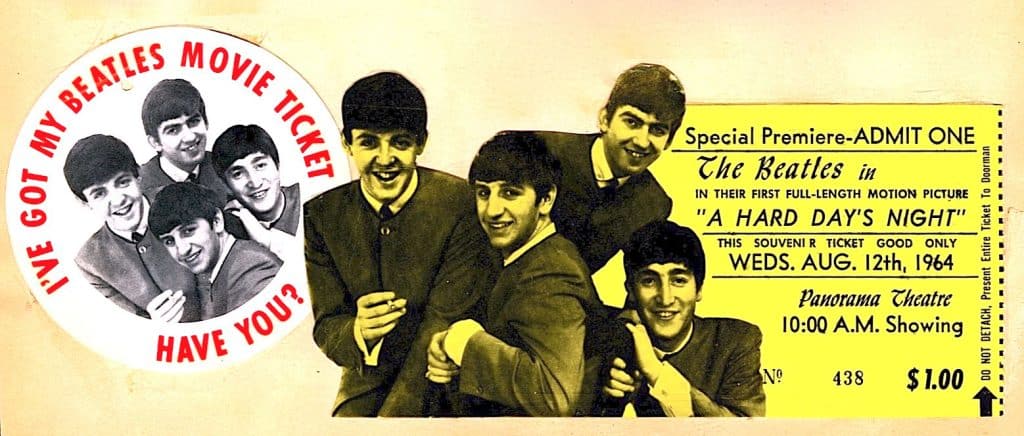
On August 11, 1964 A Hard Day’s Night starring the Beatles was theatrically released in the US by United Artists. The film, directed by Richard Lester, written by Alun Owen and produced by Walter Shenson was a critical and box office success.
“The Beatles changed everything,” mused photographer/musician, Henry Diltz. “They took our Everly Brothers harmony and put it together with that skiffle music and came up with a new joyful thing. As folk musicians in early 1964 we heard and saw them on The Ed Sullivan Show.
“We pulled into a motel, rented a room and watched them on television. We saw them and said, ‘Wow.’ We want to make music like that. Why are we singing about the ox driver? We want to make joyful music, and we need to get an electric bass and trade in our upright bass. So did every other folk group, like the Byrds and then Buffalo Springfield.
“In 1964 our band, the MFQ [Modern Folk Quartet], were in New York. And we were with a big agency and we did get booked for The Ed Sullivan Show. One of our really good friends, Jimmy Gavin, his father was kind of a psychic guy and had a very intense dream that New York fell into the ocean. And our agent canceled our appearance.
“We would go back and forth between New York and Los Angeles. We’d sometimes play the Troubadour for a week or two weeks in a row. And A Hard Day’s Night was billed at two all-night movie theaters on Hollywood Boulevard.
“The Pix Theatre on Hollywood Boulevard had double features and was open to 4:00 am. All of us went to a screening after a Troubadour show. I had a little reel-to-reel tape recorder, and I sneaked it in under my coat and sat it on my lap and recorded the whole soundtrack to A Hard Day’s Night. ’Cause I wanted to also hear the dialogue with the songs. I went back and saw it a second time,” exclaimed Henry.
“It was around the time I first met Gene Clark. I was at the Troubadour one night when they had tables near the bar. And there was my friend David Crosby and Jim McGuinn, with another guy. ‘Hey Tad. Meet our new friend Gene Clark. He just moved here from St. Louis and we’re going to start a group and call it the Beefeaters.’ I went, ‘Oh man, that’s great.’
“I was Tad at the time, and changed my name, like Jim later did to Roger, from our belief in Subud. They loved the Beatles, and McGuinn would get up on stage at the Troubadour hoot nights and do Beatles songs solo on a Rickenbacker.”
“The Beatles’ coming in February 1964 was such a healing presence after the horror of the Kennedy assassination,” reflected Chris Hillman, bassist and songwriter for the Byrds and co-founder of the Flying Burrito Brothers. “They brought such joy and light to the world. The dark clouds were lifted.
“We were all emulating the Beatles to some degree at first. The Byrds certainly were. And then, I mean, my God, when I joined the Byrds they were still doing Beatlesque songs that Gene was writing. But then we got into doing other material.”
“We liked the Beatles from the time Billy Preston came back from Europe and knew about them,” recollected Dorsey High Schooler Johnny Echols, lead guitarist and co-founder of Love.
“I had played with Billy before Love, and he was a good friend, and I met them in 1965. They sent us backstage passes for the Hollywood Bowl show. I went with a fantastic jazz musician, Michael Bolivar.
“It was loud. And we saw this fantastic thing that we had not expected. At that time there was this thing happening with the audience and the musician but never like this. I mean, this was over the top. And that was the point and I had to tell Arthur [Lee] about it. ‘This is where we want to go, man.’ We wanted to leave the chitlin’ circuit and whatever that’s gonna be behind. And we want to move to this circuit.’
“Because this is where the money’s at and this is where all the happenings are. ’Cause they can play the kind of music they want, out of respect, be revered, loved and have this huge audience.’ That was where we wanted to go. Absolutely.”
Heather Harris, is a graduate of the Westlake School for Girls and UCLA. A music photographer, photojournalist and commercial artist who once worked in the publishing division of A&M Records, she attended the Beatles’ 1964 and ’65 Hollywood Bowl concerts and their ’66 Dodger Stadium show in Los Angeles. In December 2023, Heather emailed her memories when the Beatles came to play in L.A.
“Teenaged and/or pre-teenaged recherche du temps perdu remain notoriously inaccurate, ruled as they are by hormonal, passionate emotions rather than staunch objectivity. However, this former pre-teen well recalls the first Beatles concert at the Hollywood Bowl, oasis of wondrousness observed in an otherwise dire pre-adolescence.
“I was a powerless pre-teen, landlocked in my passions for doing visual art and following music by a familial regime bent on churning out clones of socialite, debutante, non-vocational mommy-track forebears devoid of outside purpose. Listening to my transistor radio under the pillows in bed at night, I heard ‘I Want to Hold Your Hand’ (the first widespread US Beatles release) and the earth shifted on its axis for me.
“It’s said that universal pop music introduces pre-adolescent females to the opposite sex by offering slightly gender-neutral totems of directed passion, not too scary or overtly sexual, from Avalon to Cassidy to Bieber. In the case of the Beatles, this is hogwash. No matter how thoroughly Brian Epstein cleaned them up, the bad boys came through, much as the syndrome had with early Elvis Presley despite his Colonel.
“As with early-’60s European nouvelle vague movie stars, the Beatles’ outsider long hair signified danger and a new generation’s look. The self-written, self-performed, harder rock music also denoted a demographic sea change of non-formulaic, uncontrolled talents, which spilled over into all the arts. And those witty press conferences, with Lennon & Co.’s ad libs, added just the right frisson of intellectualism to rope in smart teens.
“Overall assessment: every young female I knew, from honor students to proto-slackers, wanted to fuck a Beatle. (And some actually did. But that’s another tale.) I even made pocket change drawing fellow student/clients en flagrante with their favorite Beatle or Rolling Stone.
“However, as a powerless pre-teen, scalper ticket prices were not at my avail, plus the 1964 Hollywood Bowl appearance sold out within hours the same day, an impossible barrier to pre-Internet, non-driving pre-teens. (Los Angeles then as now has no really reliable public transportation.)
“I desperately prevailed upon every entertainment biz contact in my purview, which meant fellow classmates’ parents. My own parents were virulently anti-showbiz, since my former singer father had quit with an ‘If I can’t, nobody in this family can!’ obstructionism (to last all my life).
“Last resort: my parents’ friends at their church. Where I struck gold. One of their church chums was Randy Wood, president of Dot Records and Ranwood Records (sample artists: Ivory Joe Hunter, Pat Boone, the Del-Vikings, Arthur Alexander, Jimmy Gilmer & the Fireballs—pals of Buddy Holly with a giant hit record ‘Sugar Shack’), which had distribution ties to Vee-Jay Records, which, unbeknownst to most all but completionist record collectors, was the Beatles’ first record label in America until Capitol Records sorted out their domestic ownership of them via EMI.
“Randy told me to not count on it, and kindly gave me the consolation prize of a Beatles’ interview 45 record. This was a promo item with dead air time for whatever DJ at whatever radio station to ask the Beatles questions, then the pre-recorded Beatles provided answers afterwards. This gift engendered a great introduction to the real world of the music business at a tender age! Then he came through with a single ticket.
“Much negotiation to get parents to drop off and pick up. Reward: 35 minutes of audience hysteria and itty-bitty Beatles! But no complaints. One could see they did play their own plugged-in instruments, even if one could barely hear same or any vocals whatsoever. In-person vindication! (Answer to unspoken question: even the teens I knew with good cameras and telephoto lenses got terrible pics, given the huge distance betwixt audience and band. With my then crap equipment I didn’t even bother.)
“I attended the next year’s Hollywood Bowl and following year’s Dodger Stadium shows as well, the last one with teen musician guy friends who tried to document same on one of the era’s giant reel-to-reel tape recorders.
“I was dragooned into smuggling the enormous interloping machine in my typical girl’s beach bag. The straw-woven bag burst under the weight and spilt one reel of tape unspooling down an entire bleacher stairs in the stadium, top to bottom. Tape undamaged, hasty retrenching and re-spooling unseen by the long arms of the law. Of course, all my guy friends got was the din of audience screaming…”
“Beatles music of course underscored my determination to work my visual magics in service to the business of music, and I changed my name to something easier to remember once I started getting published nationally at age 18.
“I then experienced and documented one of the most creative fertile explosions of art of all time, photographing as many of the greats who came through my native Los Angeles as I could for the next half century. In retrospect, what I failed to realize back in 1964 was how fucking good those Beatles were for being that young. We all were young, and our youth was shared cloak of invisibility at the time.”
The direction of Steven Van Zandt’s entire life was shaped by Meet The Beatles. Although the first concert he saw was Little Anthony and the Imperials. However, after hearing Meet The Beatles in Boston, Massachusetts at age 13, he no longer wanted to be Frankie Valli, Little Anthony, Curtis Lee or the Isley Brothers.
I’ve known Van Zandt since 1975, interviewing him a handful of occasions the last half century for newspapers, magazines and my books.
“The Beatles were a band,” stressed the author, radio programmer, actor, and guitarist in Bruce Springsteen & the E Street Band.
“Before then it was individuals or singing groups and this was communication from a band. After seeing the Beatles on The Ed Sullivan Show in February 1964, everyone wanted to start a band.”
In a November 6, 1976 conversation we had for the now defunct Melody Maker, Steven’s ongoing devotion to “The English Invasion” was very evident, even back then.
Besides the Beatles, the Who, Kinks, Donovan, the Rolling Stones and other British producers who influenced Steven’s life path, he cited the Rolling Stones’ “Play With Fire,” produced by Andrew Loog Oldham and the specific geography in the record.
“But there’s universal street corners, and no-one feels isolated or left out. The Stones used to talk about places in England (Knightsbridge in ‘Play With Fire’) and everyone could relate. Maybe it even added to it, not being a common place.”
Two months after the Beatles were off the Sullivan screen, and after the initial assault on our senses, came The Beatles’ Second Album, the second LP for Capitol Records, and their third long player compiled for the United States, following a Vee-Jay Records platter, Introducing…The Beatles.
There is one important Beatles on American television 1964 moment that seems to be underserved in history which made an indelible mark in the country, courtesy of the 1964-1966 ABC-TV series Shindig!
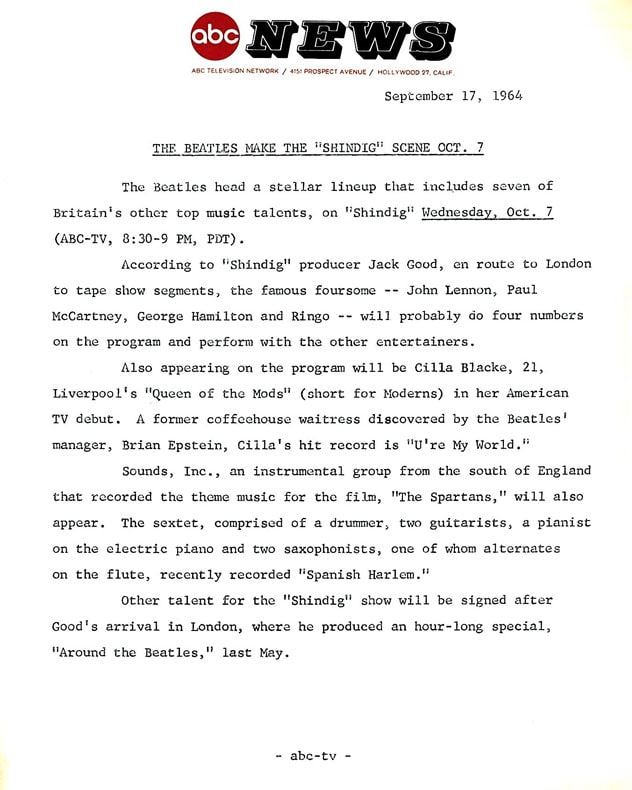
Due to the popularity of the program and the Beatles reverence with British producer Jack Good, who they grew up with watching on English television, arrangements were made for a Shindig! crew and host Jimmy O’Neil to fly to London and to tape an episode. They band agreed to perform on October 3, 1964 after two days of rehearsal for a union fee of $1,400.00.
Members of the London Beatles Fan Club were invited to the Granville Studio where the group played three songs live: “Kansas City/Hey-Hey-Hey-Hey,” “Boys” and “I’m a Loser.”
O’Neil’s introduction of the Beatles in ’64 said it all, “The entertainment phenomena of the century!”
The records of “Kansas City” and “I’m A Loser” were not issued in the States for many months later. US deejays had a field day, as they had a Beatles scoop, as they recorded the 2 songs off the Shindig! broadcast. Capitol eventually stopped them from playing the 2 songs!
This Shindig! Goes To London packaged other acts for this special occasion: Sandie Shaw, Tommy Quickly, PJ Proby, Sounds Incorporated, Lyn Cornell and the Karl Denver Trio.
This edition of Shindig! was broadcast on October 7, 1964, but never seen in Britain. It’s the only US show that had the Beatles on live TV (not film clips) other than The Ed Sullivan Show!
In 2010 I appeared with Jimmy O’Neil on KCET-TV’s Things That Aren’t Here Anymore filmed at the former ABC-TV studios in Hollywood where Shindig! was lensed and I attended tapings.
Jimmy, a former deejay in Hollywood on stations KRLA, KFWB and KDAY enthused, “It was an amazing experience that I’ll never forget because it happened at a time when they did Shindig! right at the peak of Beatlemania.”
In 1965, Ed Sullivan continued his association with the Beatles.
There is a fifty-minute-long documentary The Beatles at Shea Stadium in New York City from their August 1965 tour. It was directed and produced by Bob Precht for the Sullivan Productions company, in association with Brian Epstein’s NEMS Enterprises and the Beatles’ Subafilms.
In front of 56,000 fans, Ed Sullivan introduced the Beatles. “Now, ladies and gentlemen, honored by their country, decorated by their Queen, loved here in America, here are the Beatles!”
Ed Sullivan isn’t in The Rock and Roll Hall of Fame, and his vast contributions providing a platform for Black artists on his television series is underserved by pop culture historians.
“The relationship between Berry Gordy’s Motown label and The Ed Sullivan Show made music and television history,” illustrates Andrew Solt.
“Soon after the Supremes’ appeared on Sullivan (December 1964), it was clear that showcasing the latest Motown releases on CBS on Sunday nights (35 million viewers was average) until 1971 was a way to expose the record company’s newest hits and boost the show’s ratings. Sullivan introduced nearly all the Motown acts, including the Supremes, the Temptations, Stevie Wonder, the Four Tops, Smokey Robinson and the Miracles, Marvin Gaye, Gladys Knight and the Pips, and the Jackson 5.”
“For us, being on The Ed Sullivan Show was so much more than record sales,” reinforced Mary Wilson of the Supremes in my 2016 interview with her.
“It wasn’t about promoting us. It was about that we had grown up watching The Ed Sullivan Show. We had grown up watching shows where you didn’t see a lot of black people starring on those shows. For us, we were like every other family in America who spent hours watching Ed Sullivan. So, for us, being on the show was such a great honor, because we were there to see the world changing. To see America changing. We were excited! We’re on The Ed Sullivan Show.
“We came from a time when a whole family of all different colors didn’t sit around watching black people on television. The Dick Clark Caravan of Stars tours where before us and there were segregated hotels.
“For us, that is what it was all about. We were part of that change. We were part of helping America to see black people, black women, being proud, beautiful and successful. It wasn’t just us, many people before us. But they didn’t have the television to expose them to that wide range of people as we did at the time when we came. We were lucky. And we stood on a lot of shoulders. But we were there when the doors opened.”
“It was really a battle in those days to get black artists on network television in prime time,” confirmed Barney Ales, VP general manager of Motown in a 2020 email with me.
“Sammy Davis Jr. and Nat Cole were about the only ones—anyone else, they just weren’t accepted. But when the Supremes broke through, we knew we had an opportunity. They looked so great, as well as sounding great. And Harvey Fuqua and Maxine Powell did a wonderful job, grooming the girls, getting them ready for prime time.
“The Ed Sullivan Show was the real breakthrough. Sunday nights, millions of people watching. Once Sullivan took to the Supremes, we knew we were on the right track. And album sales picked up like crazy whenever they were on, so we always made sure to tell the distributors they needed to check their inventory. After the Supremes, we got everyone on Sullivan’s show: Stevie, Gladys, the Temptations. We had a good relationship with the producer, Bob Precht. He liked Motown, and Esther, Berry’s sister, used to take the dressing room keys afterwards as souvenirs. They’re probably somewhere in the Motown Museum to this day.”
“The other thing,” added Mary Wilson, “was that we were seen in color after our initial appearances were in black and white.
“Recently, my granddaughter was watching a DVD collection of the Supremes. And she said to me. ‘Grandma! What happened to the color?’ ‘Cause she has never seen a black and white TV!”
After speaking with Mary Wilson, I went to a Los Angeles Dodgers baseball game with multi-instrumentalist Chris Darrow at Chavez Ravine, a mile from the Queen of Angels Hospital I was born in overlooking the Hollywood 101 Freeway.
During the traditional seventh inning stretch, I came to a sudden epiphany America was defined by baseball, and the game and country changed after UCLA graduate, and Dodger legend, Jackie Roosevelt Robinson teamed with Dodger owner Wesley Branch Rickey Jr. persuading major league baseball to allow Jackie to participate, breaking the color barrier.
It had an effect on the music audience in North America, followed by Ed Sullivan’s bold TV booking policy, Sun Records’ Sam Phillips and Elvis Presley, Dick Clark’s American Bandstand, Berry Gordy Jr.’s Motown Tamla Records, and drastically altered forever by the Beatles’ records and 1964 US tour, forging a new environment of possibility and inclusion.
By March of ’64, numerous efforts were made by black and white artists to start desegregating venues.
In a ’64 tour negotiation, Brian Epstein and Norman Weiss at the talent agency General Artist Corp. had a clause in their North American contract rider, “Artists will not be required to perform before a segregated audience.” This stipulation wasn’t needed for concerts they did around the world.
“I think that it’s complexly tied in with race and class,” pondered Dr. James Cushing.
‘‘Because the covers that the Beatles were doing, in almost every case, as Paul McCartney said at a press conference, were by ‘colored American groups.’ In other words, it was white people doing black music. Renditions of Berry Gordy Jr.’s Motown label records. But it was nothing like Pat Boone de-clawing Little Richard. If anything, the Beatles were adding their own muscle to it.”
In November 1974 for Melody Maker, I interviewed Bobby Rogers, a member of the Miracles, and a Tamla Motown artist since their inception in 1958, when he joined up with his sister Claudette, Ronnie White, Pete Moore, and William “Smokey” Robinson.
Bobby and I were in Sound Recorders studio owned by engineer, producer and mixer Armin Steiner. In December 1967 the Jimmy Webb written, produced, arranged “MacArthur Park” by singer/actor Richard Harris was done in this facility.
Johnny Rivers waxed Realization at this room, and where George Harrison produced Jackie Lomax’s Is This What You Want? for the Apple label. On the Beatles first visit to Hollywood, George, Ringo and John went to the Whisky A Go Go when Rivers was headlining. In the seventies Paul McCartney mixed Ram at Sound Recorders.
I queried Bobby about the Beatles and the Motown/UK musical community.
“I really loved touring with the English groups, back in 1963 and 1964. We used to tour with the Rolling Stones and people like Georgie Fame. During the breaks from touring, a lot of the groups would ask questions about certain songs on our albums.
“Man, those early tours were a trip. Endless hours of bus rides and all these skinny English dudes asking us about the Tamla-Motown sound. Like that blond boy [Brian Jones]. I never realized how important or influential we were on groups like the Stones and Beatles. George Harrison said he was in a band named the Beatles. We used to party with all the groups, and have become good friends.
“The best thing that ever happened to music has got to be the What’s Going On album by Marvin Gaye. Marvin was listening to everything that was around. Beatles, Rolling Stones, pop, jazz, etc. You know that Sgt. Pepper LP? It was always on Marvin’s turntable,” smiled Bobby.
“When The Beatles Second Album had three of our songs ‘Money (That’s What I Want),’ ‘You’ve Really Got A Hold On Me,’ and ‘Please Mr. Postman,’ it just indicated to us that they obviously had been listening to our music and they were aware of it, enjoying it and loving it” emphasized Berry Gordy, Jr. in my 1995 interview for HITS magazine inside his Bel-Air, California home.
I told BG I dug the story in his autobiography, To Be Loved, about his 1964 negotiation with an executive representing the Beatles and three Jobete Music publishing copyrights earmarked for The Beatles Second Album.
The Beatles’ negotiator was requesting a reduced rate for the tunes on the highly anticipated Beatles’ second LP.
“I think there was some guy there doing his job, trying to get rates on whatever they were doing. They were doing more than one song. If it had been one song, I could say to them, ‘You’re doing one song.’ But, ‘You’re doing three songs,’ on The Beatles Second Album, and it’s negotiating, like when you go to the supermarket and you buy more than one thing, you get a deal.
“So, I thought it was business and I say it in the book. Somebody was doing their job on behalf of the Beatles.”
Berry accepted the deal just minutes before a desperate Capitol Records imposed deadline, who had already pressed hundreds of thousands of units at their plant.
Did he laugh when those songs shipped millions of units and became part of the Beatles’ live tours?
“Sure, I chuckle, even today. I say it in there (the book). It’s funny and if I had to do it all over again (accept a discount rate for the three Jobete copyrights) I would make the same decision. It’s better to have a part of something than all of nothing.
“England, the Continent, Europe. A very loyal audience but a very deep-feeling people. They certainly are not fickle in their musical tastes. Fans are fans and they are great. I wanted them,” maintained Gordy.
“They were just together. I loved their creativity with what they did with our album covers and how they just did it. And when we first went over there with the fan clubs, and the signs and stuff that they had for us. So, the UK has always been special for Tamla-Motown.”
In March 1965, Gordy and the Motown Revue toured England. Berry would meet Brian Epstein on August 13, 1966 when Brian visited Motown in Detroit, Michigan.
Gary Pig Gold reiterates Gordy’s relationship with the UK.
“Check Out this all Tamla Motown British releases (originally licensed to the UK London American label, then to Fontana, then Oriole, before landing with EMI’s Stateside label in late ’63, when the damn really burst open for ‘The Sound of Young America’ in Britain….just as, not coincidentally at all, ‘Please Mr. Postman,’ ‘Money,” and ‘You Really Got A Hold On Me’ all came out on 11/22/63 within With The Beatles)…
“Here in O Canada of course, not only was most every Tamla and Motown release granted Canadian release via Quality Records (beginning, I believe, way back with Mary Wells’ ‘Bye Bye Baby’ in 1960!! on the Quality-distributed Reo label)… but the all-important Windsor Ontario-based AM stations such as CKLW were often used by Berry & Co. as ‘testing grounds’ for imminent Motown releases.”
Drummer Clem Burke, co-founder of Blondie, certainly agrees with Berry Gordy, Jr. and America’s 1964 welcome to the Beatles.
“They were the natural progression from the roots of the music. The early recordings spread the gospel of Little Richard, Buddy Holly, and Motown to a new generation of rockers. They are and always will be my muse. I’ll listen to a few songs before a show and get a rush of emotions. They had the best drummer in rock ’n’ roll that really made the recordings creative,” observed Clem.
I met record producer Sir George Martin at The Hollywood Bowl last century who had a lot to do with documenting the creativity of the Beatles.
I talked to Martin again in 2006 at Capitol Records Studio B in Hollywood about a Frank Sinatra recording session he witnessed in this very same room on his first visit to Hollywood in 1958.
The EMI label sent him over the pond after Martin was invited by Capitol executive Voyle Gilmore to visit the American division. Martin described that date when Sinatra was backed by Billy May’s orchestra while actress Lauren Bacall was in attendance. The songs were placed on Sinatra’s Come Fly With Me LP.
I thanked Martin for discovering and signing the Beatles to their British record label deal. I complimented his persistent determination, along with Brian Epstein, in prodding Capitol Records to have faith in Martin’s groundbreaking Parlophone/EMI recordings with the boys in 1963.
One of Martin’s productions by the Beatles started playing. Try hearing their sound over custom TAD monitors inside Capitol Records…George autographed a solo album, and remarked, “Pretty good stuff. Don’t you think?”
Looking back at the ‘64 North American undertaking, author Chuck Gunderson summarizes the landmark expedition.
“It was record-shattering, precedent-setting, groundbreaking, earth-shaking and moneymaking. The Beatles’ 1964 tour of North America would turn the entertainment business on its ears and forever change the landscape of the concert touring industry, morphing it into the multi-billion-dollar business it is today.
“The tour is now legendary as the group encountered total chaos in every city they played. Bomb threats, blackmail plots, teenagers who infiltrated their hotels dressed as maids and even a prediction from an astrologer that they would all die in a plane crash.
“Elaborate plans were drawn up to transport the Fab Four to hotels and venues. These included the use of ambulances, police cars and, in one case, an empty fish truck. Hucksters as well as managers from fine hotels gathered up bed linens, pillowcases and even the carpet the Beatles walked on to be cut up and sold off to fans who were eager to get their hands on anything the Beatles touched. Fans clamored and fought over cigarette butts left in ashtrays, grass the Beatles walked on and even resorted to removing door knobs from their hotel rooms. However, it was their music and, personalities that was the driving catalyst of that first summer in America.
“By the time the tour ended, the Beatles would play a staggering 32 shows in 26 venues in 24 cities in just 34 days. The group would log 22,621 miles on the North American continent by air and road before returning to London.
“It’s estimated the Beatles earned nearly $1.2 million before expenses which translates into almost $12 million in today’s money.
“As for the Hollywood Bowl? All 17,000 plus seats sold in 2 hours way before a thing called the internet was even conceived. 60 years later, 100 years later and maybe even a 1000 years later and we still talk about it. Perhaps no musical act before or since will ever rival the Beatles’ incredible tour of 1964.
“John Lennon, Paul McCartney, George Harrison and Ringo Starr would leave an indelible impression upon their fans in the United States and Canada, leaving Liverpool behind as a distant memory.”
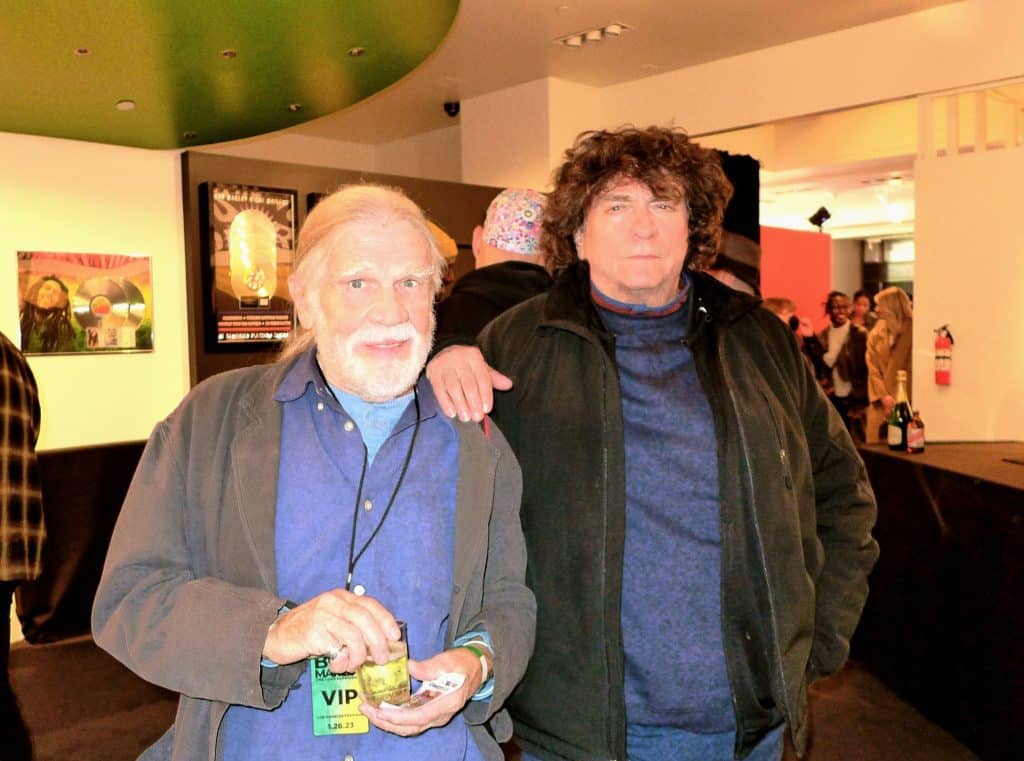
(Harvey Kubernik met the Beatles and wrote weekly for Melody Maker 1974-1980. He is the author of 20 books, including 2009’s Canyon Of Dreams: The Magic And The Music Of Laurel Canyon, 2014’s Turn Up The Radio! Rock, Pop and Roll In Los Angeles 1956-1972, 2015’s Every Body Knows: Leonard Cohen, 2016’s Heart of Gold Neil Young and 2017’s 1967: A Complete Rock Music History of the Summer of Love.
Sterling/Barnes and Noble in 2018 published Harvey and Kenneth Kubernik’s The Story Of The Band: From Big Pink To The Last Waltz. In 2021 they wrote Jimi Hendrix: Voodoo Child for Sterling/Barnes and Noble.
Otherworld Cottage Industries in 2020 published Harvey’s It Was 50 Years Ago Today The Beatles Invade America and Hollywood. Kubernik’s Docs That Rock, Music That Matters was published by Otherworld Cottage Industries during 2020.
In October 2023, ACC ART BOOKS LTD published THE ROLLING STONES: ICONS. Introduction is penned by Harvey Kubernik. The volume spans six decades of tours, album covers, and eminent names in photography.
Kubernik’s writings are in book anthologies, including, The Rolling Stone Book Of The Beats and Drinking With Bukowski. Harvey wrote the liner notes to the CD re-releases of Carole King’s Tapestry, The Essential Carole King, Allen Ginsberg’s Kaddish, Elvis Presley The ’68 Comeback Special, The Ramones’ End of the Century and Big Brother & the Holding Company Captured Live at The Monterey International Pop Festival.
Kubernik was a West Coast /Director of A&R for MCA Records (now Universal Music Enterprises) during 1978-1979. Harvey Kubernik is a native of Los Angeles, California).
During 2006 Kubernik spoke at the special hearings initiated by The Library of Congress in Hollywood, California, discussing archiving practices and audiotape preservation. In 2017 Harvey appeared at the Rock and Roll Hall of Fame in Cleveland, Ohio in their Distinguished Speakers Series, and appeared in a 2023 stage panel at a Grammy Museum Reel to Reel event about The Band’s The Last Waltz.
In 2024, Harvey Kubernik and director Christopher M. Allport are co-producing, co-writing and co-editing a documentary, The Sound of Gold, about the legendary Dave Gold and Stan Ross Gold Star recording studio in Hollywood).