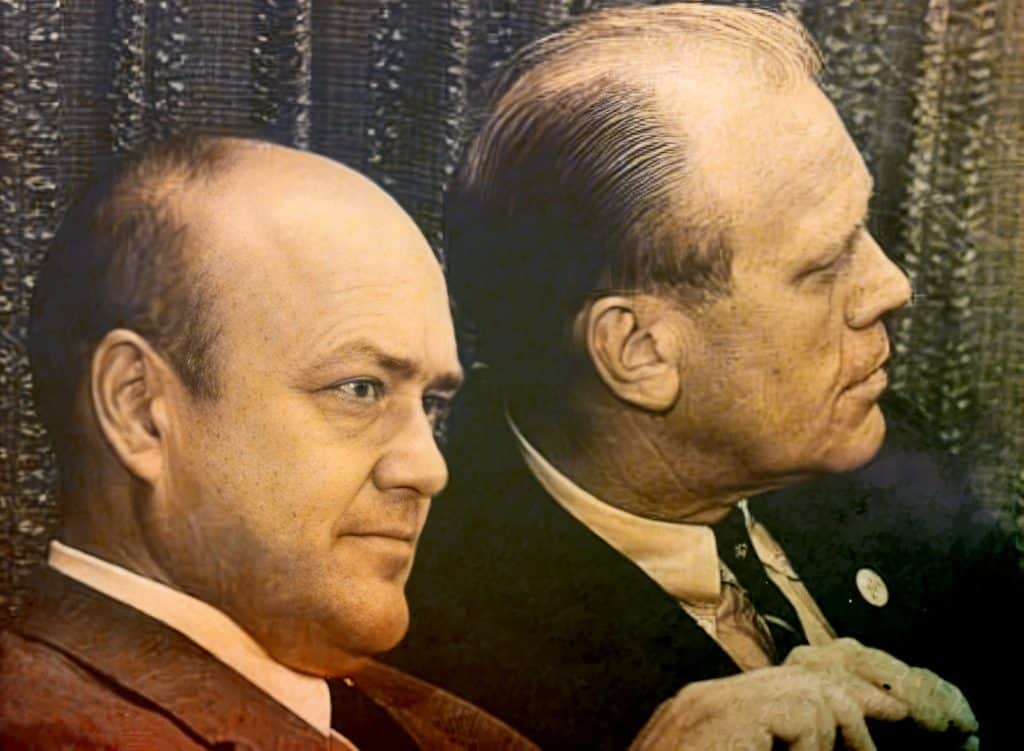
NBC-Monitor: Meet The Press – Melvin Laird – Gerald Ford; Guests – January 8, 1967
The 90th United States Congress and the Republican Response to the Johnson Era, January 1967
When the 90th United States Congress convened in January 1967, it did so at a moment of mounting political tension and uncertainty. Democrats retained overwhelming majorities in both the House and Senate, and President Lyndon B. Johnson entered his final full year in office still formally committed to the expansive vision of the Great Society. Yet the political atmosphere was shifting rapidly. The Vietnam War had intensified, public confidence in government was beginning to erode, and Republicans—though in the minority—were positioning themselves as a credible alternative to Democratic governance. These dynamics were clearly reflected in the January 8, 1967 Meet the Press broadcast featuring House Minority Leader Gerald Ford and Representative Melvin Laird of Wisconsin.
Ford and Laird represented the emerging Republican strategy within the 90th Congress: firm opposition to unchecked executive power, skepticism toward the conduct of the Vietnam War, and a critique of what they characterized as excessive federal spending and administrative overreach. Though Republicans lacked the votes to dictate outcomes, they used public forums such as Meet the Press to frame the debates that would increasingly dominate Congress over the next two years.
At the center of these debates was Vietnam. By early 1967, U.S. troop levels exceeded 380,000, and war appropriations consumed an ever-larger share of the federal budget. Melvin Laird, a senior member of the House Armed Services Committee, emerged as one of the most prominent Republican critics of the Johnson administration’s war strategy. While not an antiwar figure in the protest movement sense, Laird questioned the lack of clear objectives, the absence of measurable progress, and the administration’s reluctance to provide Congress with candid assessments. His concerns reflected a broader unease within Congress about the erosion of legislative authority in matters of war and peace.
Gerald Ford, newly elevated as House Minority Leader in 1965, sought to present Republicans as responsible but vigilant critics. On Meet the Press, Ford emphasized congressional oversight, fiscal restraint, and the need for honest dialogue with the American public. He framed Republican opposition not as obstructionism but as a necessary check on a presidency that had grown increasingly insulated from dissent. This approach was especially significant in the context of the 90th Congress, where Democratic dominance masked growing fractures within the governing coalition.
Domestically, the Congress faced rising unrest in American cities, growing crime anxieties, and continued struggles over civil rights enforcement. While landmark achievements such as the Fair Housing Act of 1968 still lay ahead, early sessions of the 90th Congress revealed increasing resistance to further Great Society expansion. Republicans, joined by conservative Democrats, argued that federal programs had failed to deliver promised results and that social disorder demanded a stronger emphasis on law and order. These arguments, voiced publicly by figures like Ford and Laird, resonated with a segment of the electorate unsettled by rapid social change.
The Meet the Press appearance underscored another critical reality of the 90th Congress: much of the real political struggle was shifting from legislative chambers to the public arena. Television had become an essential tool for shaping public understanding of congressional power, responsibility, and accountability. Minority voices, though numerically disadvantaged, could exert disproportionate influence by framing issues in ways that anticipated future electoral shifts.
In retrospect, the opening weeks of the 90th Congress marked the beginning of the end for the political consensus that had sustained the Great Society. The skepticism articulated by Ford and Laird foreshadowed the Republican resurgence of 1968 and the eventual reorientation of American politics toward restraint, skepticism of federal authority, and heightened concern with national security and domestic order.
Seen alongside the January 8, 1967 Meet the Press broadcast, the 90th Congress appears not merely as a legislative body, but as a turning point—where opposition hardened, assumptions were challenged, and the contours of the post-Johnson political era began to take shape.