
One of the more memorable days in recent history – presented via The BBC World Service (since the crisis was worldwide, after all) on October 1, 2008
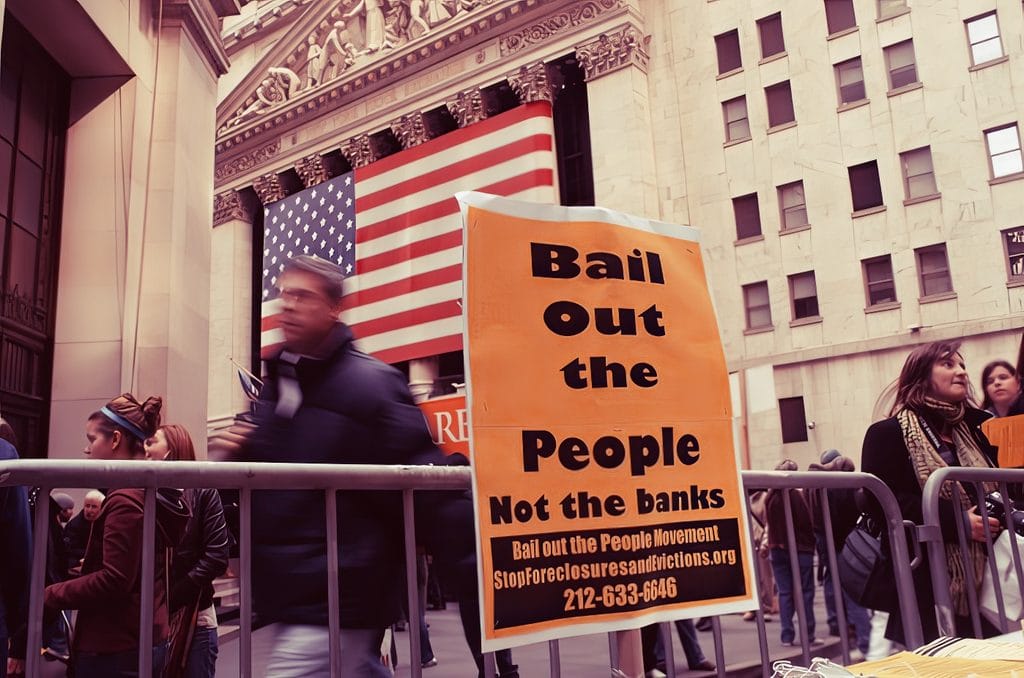
The big story – The failure of the bailout package in Congress literally dropped jaws on Wall Street and triggered a historic selloff — including a terrifying decline of nearly 500 points in mere minutes as the vote took place, the closest thing to panic the stock market has seen in years. The Dow Jones industrial average lost 777 points Monday, its biggest single-day fall ever, easily beating the 684 points it lost on the first day of trading after the Sept. 11 terrorist attacks. As uncertainty gripped investors, the credit markets, which provide the day-to-day lending that powers business in the United States, froze up even further. At the New York Stock Exchange, traders watched with faces tense and mouths agape as TV screens showed the House vote rejecting the Bush administration’s $700 billion plan to buy up bad debt and shore up the financial industry. Activity on the trading floor became frenetic as the “sell” orders blew in.
The selling was so intense that just 162 stocks on the Big Board rose, while 3,073 dropped. The Dow Jones Wilshire 5000 Composite Index recorded a paper loss of $1 trillion across the market for the day, a first. The Dow industrials, which were down 210 points at 1:30 p.m., nose-dived as traders on Wall Street and investors across the country saw “no” votes piling up on live TV feeds of the House vote. By 1:42 p.m., the decline was 292 points. Then the bottom fell out.
Within five minutes, the index was down about 700 points as it became clear the bill was doomed.
“How could this have happened? Is there such a disconnect on Capitol Hill? This becomes a problem because Wall Street is very uncomfortable with uncertainty,” said Gordon Charlop, managing director with Rosenblatt Securities. “The bailout not going through sends a signal that Congress isn’t willing to do their part,” he added. While investors didn’t believe that the plan was a cure-all and it could take months for its effects to be felt, most market watchers believed it was at least a start toward setting the economy right and unlocking credit.
Sen. Chris Dodd, D-Conn., said there was scant time to reopen legislation that was the product of hard-fought bipartisan negotiations. “What happened today was not a failure of a bill, it was a failure of will,” said Dodd, the Banking Committee chairman. “Our hope is that cooler heads will prevail, people will think about what they did today and recognize that this is not just scare tactics — it’s reality.” A brutal round of partisan finger-pointing followed the vote. Republicans blamed Pelosi’s scathing speech near the close of the debate — which assailed Bush’s economic policies and a “right-wing ideology of anything goes, no supervision, no discipline, no regulation” of financial markets — for the defeat.
Meanwhile, there was other news: Somali pirates plying the Gulf of Aden in speedboats equipped with grenade launchers and scaling ladders have launched what the maritime industry calls the biggest surge of piracy i in modern times. As a result, shipping costs are soaring and the world’s navies are scrambling to protect the main water route from Asia and the Middle East to Europe. Pirates from the failed African state of Somalia have attacked at least 61 ships in and around the Gulf of Aden this year, 17 of them in the first two weeks of September, according to the International Maritime Bureau’s piracy reporting center in Malaysia. That compares with 13 attacks in the area for all 2007. “In my time here, I must say, this is the most concentrated period of destabilizing activity I have seen in the Gulf of Aden,” said British Commodore Keith Winstanley, deputy commander of the Combined Maritime Forces.
The coalition, headquartered in Bahrain, includes the militaries of the United States and 19 other nations. The latest hijackings include the capture off Somalia on Thursday of a Ukrainian cargo vessel with 33 Russian-made T- 72 tanks aboard.
And finally – A hiker in a rugged part of eastern California found an ID and oth- er items possibly belonging to Steve Fos- sett, the adventurer who vanished on a so- lo flight in a borrowed plane more than a year ago, authorities said Wednesday. The items were found Monday near the town of Mammoth Lakes, Inyo National Forest spokeswoman Nancy Upham said. “We have some ID that has the name Steve Fossett,” Mammoth Lakes police In- vestigator Crystal Schafer said. “They were turned in to us and are in our pos- session.” A Federal Aviation Administration identity card, a pilot ID and about $1,000 in cash were found in a bush, according to David Baumwohl, an attorney for the hiker who recovered the items.
All that and a lot more via this edition of The World Today from The BBC World Service for October 1, 2008.