
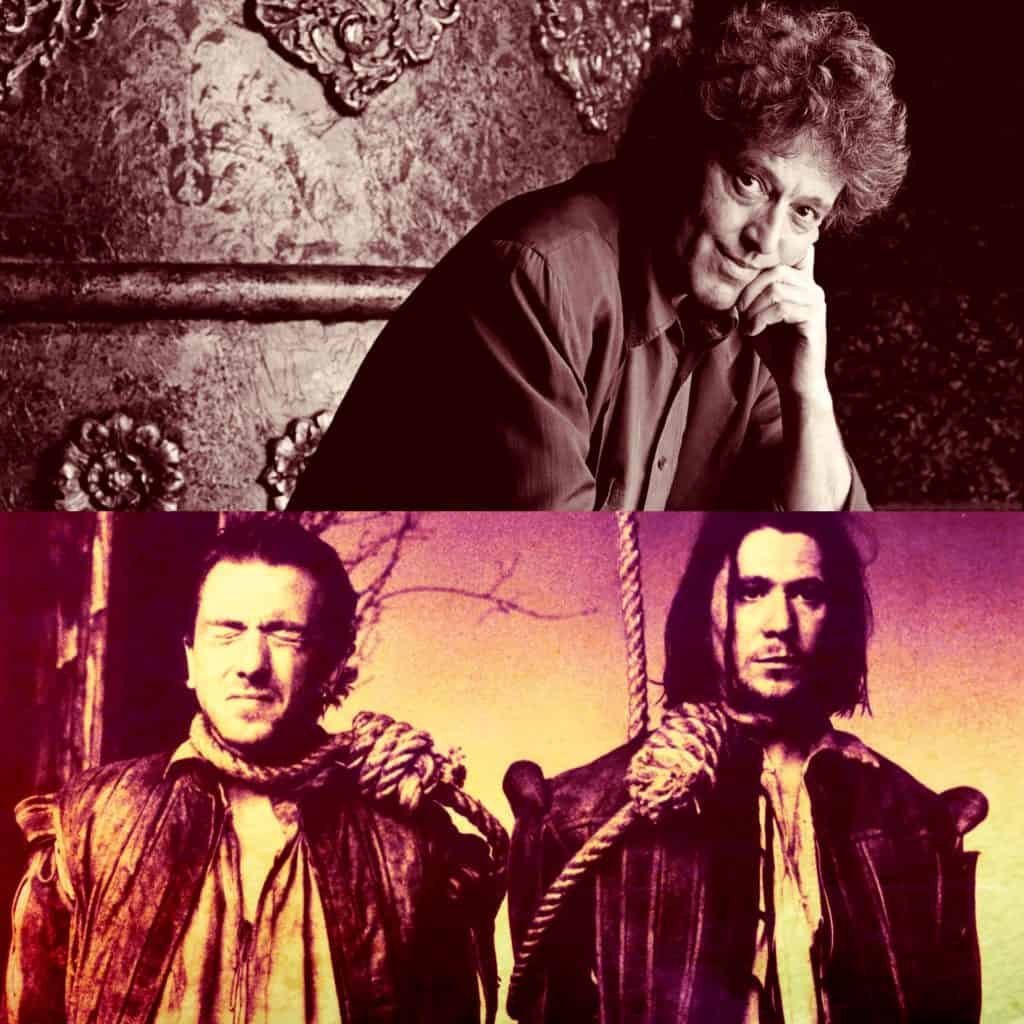
(Top) Tom Stoppard – (Bottom) Tim Roth (r) – Gary Oldman (l) – 1990 Film Adaptation.
With the sad news of the passing of playwright Tom Stoppard, one more vestige in the creative revolution that pretty much started in the 1950s and flourished in the 1960s is gone.
From a period of time, post-World War 2, where neo-realism and what became known as “Kitchen Sink Dramas” swept the Arts, neo-surrealism and absurdist drama and issues of human rights and freedoms were gaining a secure foothold in Theatre – one of those voices was Tom Stoppard, whose biting satire and plays became key elements in the Arts as consciousness raiser in the area of Human Rights, Censorship and Political freedom.
Of the substantial catalog of works for stage (as well as radio and film), one that probably stands out as his most prominent was Rosenkrantz And Guildenstern Are Dead. Rosencrantz and Guildenstern Are Dead (1966–67) was Stoppard’s first major play to gain recognition. The story of Hamlet as told from the viewpoint of two courtiers echoes Beckett in its double act repartee, existential themes and language play. “Stoppardian” became a term describing works using wit and comedy while addressing philosophical concepts. Critic Dennis Kennedy commented:
It established several characteristics of Stoppard’s dramaturgy: his word-playing intellectuality, audacious, paradoxical, and self-conscious theatricality, and preference for reworking pre-existing narratives… Stoppard’s plays have been sometimes dismissed as pieces of clever showmanship, lacking in substance, social commitment, or emotional weight. His theatrical surfaces serve to conceal rather than reveal their author’s views, and his fondness for towers of paradox spirals away from social comment. This is seen most clearly in his comedies The Real Inspector Hound (1968) and After Magritte (1970), which create their humour through highly formal devices of reframing and juxtaposition.
Stoppard himself went so far as to declare “I must stop compromising my plays with this whiff of social application. They must be entirely untouched by any suspicion of usefulness.” He acknowledges that he started off “as a language nerd”, primarily enjoying linguistic and ideological playfulness, feeling early in his career that journalism was far better suited for presaging political change, than playwriting.
No doubt, just about every Theatre major is familiar with this play, and has most likely performed it at one time or another. But in the event you aren’t familiar, here is a version originally produced in 2007 on the occasion of Tom Stoppard’s 70th birthday.
And it’s only natural to run it as tribute to an iconic and important figure in the world of Arts and expression; one so desperately needed now.
On to the play.


