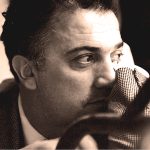

Dennis Brain and the music of Richard Strauss this weekend – his Horn Concerto number 1 opus 11, performed with the North German Radio Symphony conducted by Hans Schmidt-Isserstedt in this broadcast studio recording from May 7, 1954.
By 1945, Dennis Brain, at 24 years of age, was the most sought-after horn player in England. His father injured himself in a fall, and retired from the BBC Symphony Orchestra, although he remained professor at the RAM until his death ten years later. After the war, Legge and Sir Thomas Beecham founded the Philharmonia and the Royal Philharmonic orchestras, respectively. Brain was principal horn in both, playing for Beecham alongside the woodwind players dubbed “the Royal Family” – Jack Brymer (clarinet), Gwydion Brooke (bassoon), Terence MacDonagh (oboe), and Gerald Jackson (flute). Later, he found that he did not have enough time to fill both positions and resigned from the Royal Philharmonic.
Dennis Brain originally played a French instrument, a Raoux piston-valve horn, similar to that used by his father. This type of instrument has a particularly fluid tone and a fine legato, but a less robust sound than the German-made instruments which were becoming common. In 1951 he switched to an Alexander single B♭ instrument. It had a custom lead pipe which was narrower than the usual, and offered a sound which, if not comparable to the Raoux, at least gave a nod in the direction of the lighter French instrument.
Pursuing his interest in chamber music, Dennis Brain formed a wind quintet with his brother in 1946. He also established a trio with the pianist Wilfrid Parry and violinist Jean Pougnet. Briefly, Brain put together a chamber ensemble consisting of his friends so that he could conduct. From 1945 he played with Karl Haas’s London Baroque Ensemble, both on recordings and in concert. Showing his humorous style, Brain performed a Leopold Mozart horn concerto on a rubber hose pipe at a Gerard Hoffnung music festival in 1956, trimming the hose with garden shears to achieve the correct tuning.
In November 1953, under the direction of Herbert von Karajan, and accompanied by the Philharmonia, Dennis Brain recorded the four Mozart Horn Concertos for Columbia. In the same month, together with Sidney Sutcliffe (oboe), Bernard Walton (clarinet) and Cecil James (bassoon), he recorded Mozart’s Sinfonia Concertante for Four Winds. In July 1954, again conducted by Karajan, Brain played the organ part in a recording of the Easter hymn from Pietro Mascagni’s Cavalleria rusticana. With Sutcliffe, Walton, James and the pianist Walter Gieseking he recorded Mozart’s Quintet for Piano and Winds, K452, in April 1955.[24] Of Brain’s other recordings, Legge singled out his playing in the four Brahms Symphonies conducted by Otto Klemperer, Mozart’s B flat Divertimento with Karajan and Strauss’s Der Rosenkavalier, “the horn-player’s opera par excellence!”
Dennis Brain was a keen motorist. His brother called him “the finest driver I have ever ridden with”.
On 1 September 1957, at the age of 36, Brain was killed driving home to London after performing the Tchaikovsky Symphony No. 6, Pathetique with the Philharmonia under Eugene Ormandy at the Edinburgh Festival. He had driven his Triumph TR2 sports car off the road and into a tree on the A1 road opposite the north gate of the De Havilland Aircraft factory at Hatfield.
Now to the music.