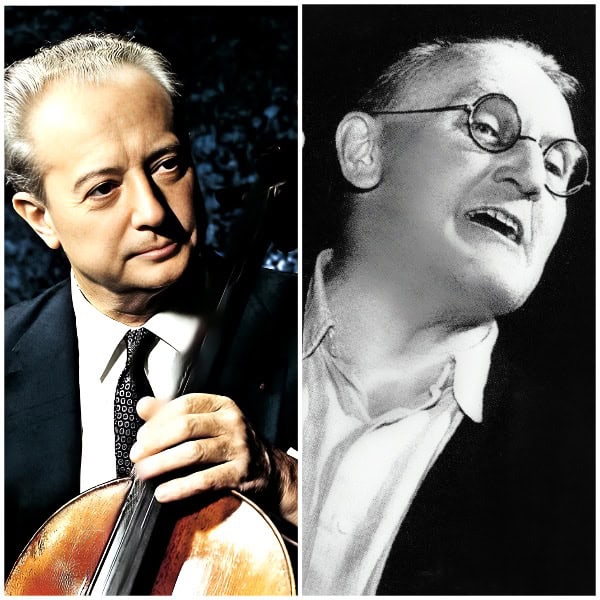
More rarities from the vaults of Italian-Swiss Radio. This week it’s a performance of Dvorak’s Cello Concerto op 104 featuring cellist Pierre Fournier and the Orchestra of Radio Suisse Italienne, conducted by Hermann Scherchen, from a concert given on April 25, 1962.
Pierre Fournier received early training from Odette Krettly, and from 1918 studied with André Hekking and later with Paul Bazelaire. He graduated from the Paris Conservatory at 17, in 1923. He was hailed as “the cellist of the future” and won praise for his virtuosity and bowing technique. In the period 1925–1929 he was a member of the Krettly Quartet, led by Odette’s brother Robert Krettly.
He became well known when he played with the Concerts Colonne Orchestra in 1925. He began touring all over Europe. At various stages he played with many of the most highly acclaimed, prestigious musicians of his time, and recorded the complete chamber music of Brahms and Schubert for the BBC on acetates. However, these deteriorated before the recordings could be transferred to a more durable medium. He is also praised for his recordings of the Bach suites (Beethoven-Saal, Hannover, December 1960), which are regarded even now as some of the best versions ever made (released on Deutsche Grammophon “Archive” records). His other discs include LPs of Beethoven’s cello sonatas and Elgar’s Cello Concerto; these have long since been available on CD.
Fournier was a teacher at the École Normale de Musique in Paris and the Paris Conservatoire from 1937 to 1949. He made his first tour of the United States in 1948 and played to great acclaim in New York and Boston.
Hermann Scherchen was born in Berlin. Originally a violist, he played among the violas of the Bluthner Orchestra of Berlin while still in his teens. He conducted in Riga from 1914 to 1916 and in Königsberg from 1928 to 1933, after which he left Germany in protest of the new Nazi regime and worked in Switzerland. Along with the philanthropist Werner Reinhart, Scherchen played a leading role in shaping the musical life of Winterthur for many years, with numerous premiere performances, the emphasis being placed on contemporary music. From 1922 to 1950, he was the principal conductor of the city orchestra of Winterthur (today known as Orchester Musikkollegium Winterthur).
Making his debut with Schoenberg’s Pierrot Lunaire, he was a champion of 20th-century composers such as Richard Strauss, Anton Webern, Alban Berg and Edgard Varèse, and actively promoted the work of younger contemporary composers including Iannis Xenakis, Luigi Nono and Leon Schidlowsky.
He was the teacher of Karel Ančerl, Egisto Macchi, Marc Bélanger, Françoys Bernier, Anna Renfer, Frieda Belinfante and Karl Amadeus Hartmann, and contributed to the libretto of Hartmann’s opera Simplicius Simplicissimus. He also premiered Hartmann’s early work Miserae. Conductor Francis Travis was a pupil, then conducting assistant, for five years.
He is probably best known for his orchestral arrangement (and recording) of Bach’s The Art of Fugue. His 1953 “Lehrbuch des Dirigierens” (Treatise on Conducting, ISBN 3-7957-2780-4) is a standard textbook.
Sit back and enjoy – get your batteries charged.