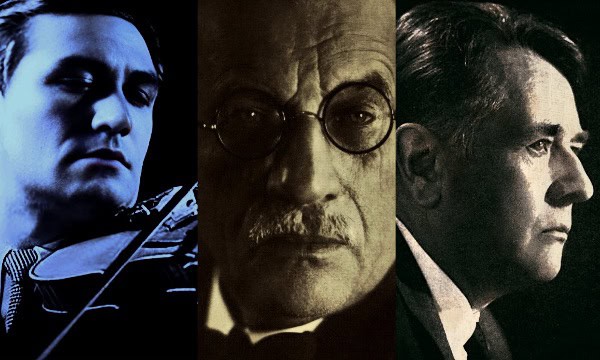
Legendary German violinist Gerhard Taschner with conductor Gustav König and the Hessian Radio Symphony in a broadcast performance of Hans Pfitzner’s Violin Concerto – recorded on April 28, 1955.
The Noted Musicologist and author Nicholas Slonimsky has this to say about Hans Pfitzner:
Pfitzner, Hans (Erich), eminent German composer, conductor, pedagogue, and writer on music; b. Moscow (of German parents), May 5,1869; d. Salzburg, May 22, 1949. He was a student of Kwast (piano) and Knorr (composition) at the Hoch Cons, in Frankfurt am Main (1886–90). In 1892–93 he taught at the Koblenz Cons. From 1894 to 1896 he conducted at the Mainz City Theater, where his first opera, Der arme Heinrich, scored a remarkable success at its premiere on April 2,1895. He went to Berlin, where he taught at the Stern Cons. (1897–1907) and held the position of 1st conductor at the Theater des Westens (1903–06). His opera Die Rose vom Liebesgarten brought him further success at its first performance in Elberfeld on Nov. 9,1901. In 1907–08 he conducted the Kaim Orch. in Munich. He then went to Strasbourg, where he served as music director of the city, and as director of the Cons. (1908–18) and of the Opera (1910–16). The premiere of his greatest work, the opera Palestrina (Munich, June 12, 1917), brought Pfitzner his widest recognition as a composer. In 1919–20 he was music director of the Munich Konzertverein. From 1920 to 1929 he taught a master class in composition at the Berlin Academy of Arts, and then at the Munich Akademie der Tonkunst from 1929 to 1934. In 1925 he received the order Pour le mérite for his services to German music.
Pfitzner’s genuine talent as a composer in the late Romantic tradition has been overshadowed by his overwhelming sense of self worth as a creative artist, by his polemical writings, such as Futuristengefahr (1917) and Die neue Ästhetik der musikalischen Impotenz (1920), and by his craving for public recognition and honors. In 1936 he accepted an appointment by the Nazi government as a Cultural Senator of the Reich. He degraded himself by sending a devotional public address to the notorious Nazi field marshal Hermann Goring and by dedicating his Krakauer Begrüssung, to Hans Frank, the murderous Nazi governor general of occupied Poland. With the collapse of the Nazi regime in 1945, Pfitzner was required to explain his conduct during the Third Reich to the Denazification Court in Munich. The aging composer was exonerated in 1948, and spent his last days in Salzburg. Apart from his Palestrina, Pfitzner’s most important works include the Kleine Symphonie, the Sym. in C major, the Violin Concerto, particularly remarkable for its craftsmanship and melodic invention, the cello concertos, and several fine lieder.
Gerhard Taschner: Taschner never had a major recording contract. However, he made numerous radio broadcasts and many of these recordings have been re-released, or released for the first time, leading to a latter-day following. Many of the radio recordings were confiscated by the invading Soviet forces at the end of the war, and came to light only after their return in 1991.
Critical reaction to these recordings varies considerably: one critic compares him with Jascha Heifetz, Bronisław Huberman, Nathan Milstein and Ginette Neveu when it comes to intensity of expression and richness in sound colours, but another says he is not in the same league as Joseph Szigeti, Isolde Menges, Emil Telmányi or Szymon Goldberg.
Of his recording of the Ravel Violin Sonata, one critic says: Taschner projects the Ravel Sonata’s jazz-tinged nuances to perfection, but another said his Ravel sonata missed the jazzy comical element and was rather straightforward and serious.
The Berlin University of the Arts created the “Gerhard Taschner Prize for Violin” in his honour.
A back condition caused his withdrawal from the concert platform in the early 1960s when still aged only 40. He continued to teach and play chamber music, and served on various competition juries such as the 1957 Henryk Wieniawski Competition in Poznan; the 1957 and 1959 Marguerite Long-Jacques Thibaud Competition in Paris, the 1960 Paganini Competition in Genoa and the 1963 Queen Elisabeth Competition in Brussels.
Gerhard Taschner died in Berlin in 1976, aged 54. He is buried in the III. Municipal cemetery Stubenrauchstraße in Berlin-Friedenau.
Gustav König: His conducting career began in 1932–1933 as opera conductor and concert conductor in Osnabrück and then Szczecin (1934–1935), Berlin at the Neues Schauspielhaus and Theater des Westens (1936–1937 ), and Aachen (1941–1942) as Kapellmeister and Deputy General Music Director to Herbert von Karajan. From 1943–1944 he was musical director of the Opera in Essen. from the 1951/52 season he was appointed general music director, working with Karl Bauer, Erich Schumacher and Jürgen Dieter Waidelich. König retired in 1975, after being conductor of the Essener Philharmoniker since 1943. He died in Essen in 2005 at the age of 94.
And now to the music: