A clock was ticking.
When The Northwestern Reviewing Stand devoted its September 14, 1947 broadcast to “Virus Research and Your Health,” it addressed one of the most promising and rapidly evolving fields of postwar medicine. America had emerged victorious from World War II with enormous scientific momentum, and much of that energy was now being redirected toward peacetime challenges. Among the greatest of these was the fight against infectious disease. Although antibiotics such as penicillin had transformed the treatment of bacterial infections, viruses remained mysterious enemies for which few effective treatments existed. The discussion among leading physicians and medical researchers reflected both the remarkable progress already achieved and the tremendous scientific questions that still remained unanswered.
In 1947, virology was still a relatively young science. Unlike bacteria, viruses could not be seen with ordinary microscopes, could not be grown on conventional laboratory media, and behaved in ways that challenged many traditional assumptions about living organisms. The development of the electron microscope during the 1930s had allowed researchers to observe viruses directly for the first time, opening entirely new avenues of investigation. Scientists increasingly understood that viruses invaded living cells and reproduced by hijacking the cell’s own machinery, but many details of that process were still poorly understood.
The importance of virus research had become painfully clear during the first half of the twentieth century. Diseases such as influenza, poliomyelitis, measles, mumps, yellow fever, smallpox, and rabies affected millions of people around the world. Seasonal influenza epidemics remained a major public health concern, while outbreaks of polio terrified American families every summer. Unlike bacterial infections, viral diseases generally could not be treated once symptoms appeared. Prevention therefore became the central objective of medical science.
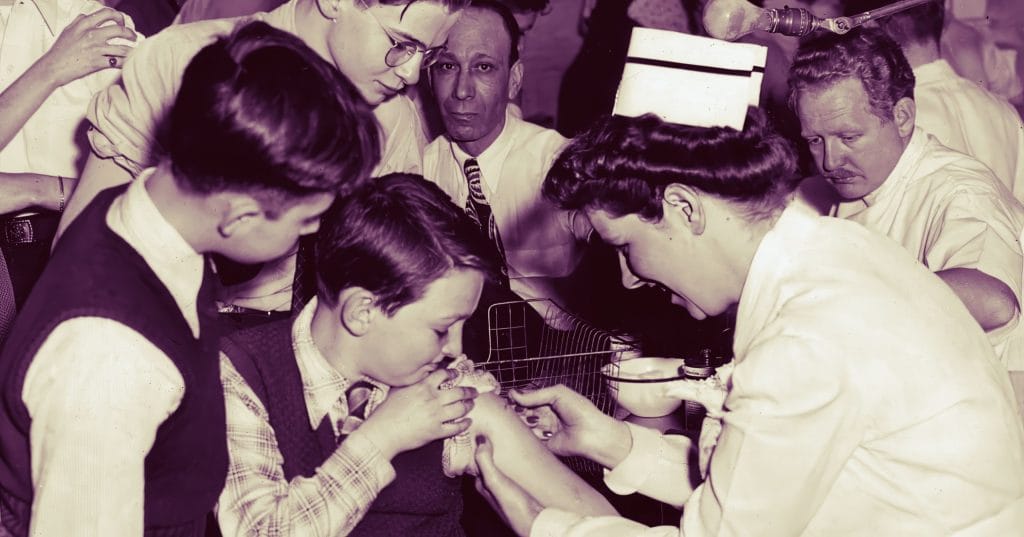
Immunization represented the greatest success story in that effort. By 1947, vaccination against smallpox had been practiced successfully for well over a century and had saved countless lives. More recent advances included vaccines against yellow fever, developed during the 1930s, and improved influenza vaccines introduced during World War II to protect military personnel. These accomplishments demonstrated that scientific research could transform deadly epidemics into preventable diseases, inspiring confidence that additional vaccines would eventually be developed.
Yet researchers also understood that every virus presented unique challenges. Influenza viruses constantly changed, making vaccine development difficult. The virus responsible for poliomyelitis remained elusive despite years of intensive study. Scientists debated how the disease spread, why only some infected individuals developed paralysis, and whether an effective vaccine could realistically be produced. Such questions were likely central to the 1947 discussion, since the search for a polio vaccine had become one of America’s highest medical priorities. Within less than a decade, those efforts would culminate in the successful vaccines developed by Jonas Salk and Albert Sabin, although that achievement still lay in the future.
The wartime experience had accelerated medical research in unprecedented ways. Government agencies, universities, hospitals, and private foundations increasingly collaborated on large-scale research projects. Organizations such as the National Foundation for Infantile Paralysis encouraged public participation by raising funds that directly supported laboratory investigations. This new partnership between science and the public became an important feature of postwar medicine, emphasizing that advances in health depended upon both scientific expertise and sustained public support.
Public education also formed an essential part of disease prevention. Radio programs such as The Northwestern Reviewing Stand played a valuable role by explaining complex medical developments to ordinary citizens. Rather than sensationalizing disease, these broadcasts encouraged listeners to understand the importance of vaccination, hygiene, early diagnosis, and scientific research. They also reassured the public that medicine was making measurable progress against illnesses that had once seemed inevitable.
Looking back, the September 1947 discussion captures a pivotal moment in medical history. Researchers stood on the threshold of revolutionary discoveries that would soon produce vaccines against polio and dramatically expand humanity’s ability to control viral disease. Although many uncertainties remained, the optimism expressed by physicians and scientists was well founded. Their work helped establish the foundations of modern virology and immunology, demonstrating that careful scientific research, combined with effective public health measures and widespread immunization, could dramatically improve both individual health and the well-being of society as a whole.
Here is that episode of Mutual’s Northwestern Reviewing Stand broadcast for September 14, 1947.
Editor’s Caveat: Since news and public affairs radio programs of the 1940’s and 1950s were often subjected to harsh storage conditions and neglect, this program suffers from very bad deterioration of the original transcription discs – the second part borders on the unplayable – but with a considerable amount of restoration work, it is at least listenable, bearing in mind the historic importance a document like this represents. So I beg your indulgence and offer apologies ahead of playing this broadcast.