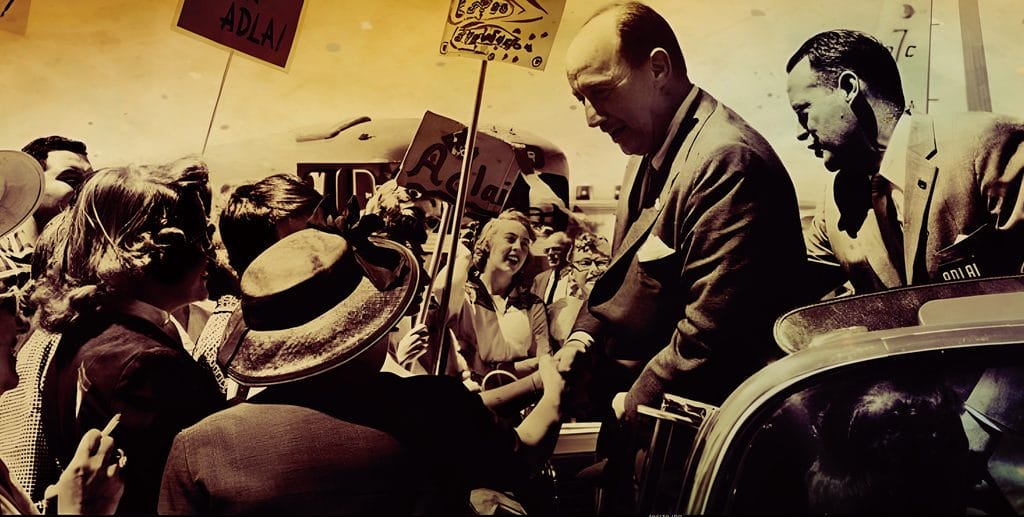
A Campaign speech delivered by Democratic Presidential candidate Adlai Stevenson at a rally in New York at Madison Square Garden on October 23, 1956 and carried by the CBS Radio Network.
Adlai Stevenson: I am honored by the presence here tonight of men and women whose lives personify the noblest traditions of the Democratic Party. Eleanor Roosevelt. [crowd cheering] Herbert Lehman. [crowd cheering] Averell Harriman.
[crowd cheering] Bob Wagner. [crowd cheering] And so many others that my limited time will not permit me to enumerate. These are people to whom politics has meant the fight to win a better break in life for the poor and for the helpless, for the harassed immigrant and the child of misfortune, for the victims of greed and intolerance. They have been denounced, each one of them, as idealists and as dreamers.
But by their fidelity to these ideals, they have lived to see their dreams come true. [crowd cheering] Now, as we Democrats point the road toward the great new frontiers of progress in an age that could be the most abundant that has ever blessed mankind, we are assaulted by an old Republican whale once more. This time, it is not creeping socialism. This time, it’s pie in the sky. [crowd laughing] Well, we all know, we all should know, that everything is pie in the sky from the Republican point of view until the Democrats bring it down to Earth. [crowd cheering] They called Social Security pie in the sky. A fair break for farmers was pie in the sky. Minimum wages was called pie in the sky. The whole New Deal was pie in the sky. But how things have somehow changed. Now, President Eisenhower even implies that all of these things were invented by the Republicans. [crowd laughing] So, we must disregard these alarms. We must push ahead, serene in the knowledge that the Democratic program of 1956 will be the Republican declaration of principles of 1976. [crowd cheering] The decisive days of this great campaign lie just ahead. The administration had hoped to make this election just a public exercise of a personality cult, but we have turned it into a debate on principles and on policies. We have- [crowd cheering] We have, we have forced great questions into the daylight of free discussion, and we have done so in the face of an unprecedented effort to suppress and bury the urgent issues of our day under an avalanche of slogans and of propaganda.
We are told that everything is fine, that we are enjoying unprecedented peace and prosperity and progress. Progress. When the richest country in the world doesn’t have schools and teachers enough for its children. When it doesn’t- When it doesn’t have hospitals for its sick. When there is widespread need among our older citizens. When ugly slums deface our cities and offend human dignity. When millions of Americans are still denied opportunities because of race or color. Now- Prosperity? Yes. But can we be content? What about the farmer? What about the small businessman, the distressed areas, the great pockets of unemployment, and the 30 million Americans who live in families with incomes of less than $2,000 a year?
And finally, peace?
When our erratic foreign policy has brought us repeatedly to the brink of war. When the Middle East is smoldering. When the Earth is a trail of gunpowder from Korea to Suez to Cyprus. When all humanity lives in the grim shadow of the hydrogen bomb.
I say to you that in a free democracy, there is no place for the notion that the president can do no wrong. And- And we reject, too, the notion that this president is somehow not responsible for the deeds of his government.
In all too many instances, he has abdicated the responsibilities of office without abdicating the office itself.
And nowhere has this abdication been more total than in the difficult process of transition towards seg– desegregation of our schools. In many areas of the progress achieved has been great. Men and women of both races have worked hard, have risked much, have dared much, so that America might offer the world a model of democracy in action. But they have looked to the White House in vain for moral leadership and encouragement in support of this great readjustment.
The president has even declined to express his views on the decision of the Supreme Court. Now, indeed, indeed, one seems to detect a hint of resentment at the whole idea of the president’s accountability. But who’s in charge anyway?
We know- We know that, [clears throat] we know that this is a businessman’s administration, but what we want to know is who’s running the store. And- And the even more important question is, if the Republicans were to win this fall, who would be running the store for the next four years?
The key man of the Republican future is President Eisenhower’s handpicked heir, Vice President Nixon. [booing]
Now, now we all know, we all know that in recent months, the vice president has been subjected to a remarkable process of face-lifting and hand-laundering.
If the stakes, if the stakes were less urgent, if the issues of our time were less cruel, less ominous, this public rehabilitation of the vice president of the United States might be amusing.
But what is at stake is not only progress at home. What is at stake is peace in the world.
We Americans- We Americans want, we Americans are determined to have, not the press agent’s peace the administration seems content to offer us, but a genuine peace founded on freedom and on justice.
But- But we know we cannot win that peace when our government will not face the facts itself or tell us the facts, tell the people the truth. When it deludes itself and us by fatuous optimism, when it presents defeats as victories and finds in each new Soviet advance fresh evidence of Soviet weakness, when it systematically declines challenges and refuses opportunities, we know we cannot win the great struggle of our century under a leadership whose only hope, so far as I can see, is that communism may at last be exhausted by success.
Are we- We have all been stirred these days by the struggle in Poland against Soviet domination. [crowd cheering] I say to you that independence from foreign communist control is at least a step toward independence from domestic communist control, so that we must help if we can. And I believe that we should be prepared to join other nations in offering economic assistance to a free government in Poland. [crowd cheering] I wish, I wish, my friends, and I wish it very much, that there were more good news to report, that there were better news elsewhere. I have kept my peace in spite of our blundering vacillation in the Middle East and Mr. Dulles’ succession of appeasements and of provocations which preceded the Egyptian dictator’s seizure of the Suez Canal. [crowd booing] But the, but the Republican candidate himself has introduced this matter into the campaign. He announced a few days ago on a political television show paid for by the Republican Party that he had good news about Suez. [crowd booing] My friends, mark my words and mark them well. There is no good news about Suez. [crowd cheering] There i- there is no good news about the Middle East. It is not good news. In fact, it is very, very bad news that the Soviets have, in a few months, penetrated the Middle East as the czars couldn’t do in 300 years of persistent effort. [crowd cheering] And, and it is not good news that never in history has Russia had such influence in the Middle East. It is not good news that the Western oil interests, so vital to Western Europe, are threatened by the rising fires of Arab nationalism. And it is not good news, indeed it is very bad and very sad news, that our relations with our oldest and our strongest allies, Britain and France, are more fragile than they have been in a generation. [crowd cheering] The United States has a compelling interest in peace in the Middle East, the oil tank of Europe and of Asia, and the great bridge between East and West. And we have a natural interest in the nation of Israel, a nation- [crowd cheering] A nation in whose creation in 1947 I had a proud part. [crowd cheering] Israel is not a cause to be cynically remembered by the administration in late October of an election year. It is the symbol, rather, of man’s triumph over one of the darkest sorrows in human history, the attempt of Adolf Hitler to destroy a whole people. [clears throat] And I say that the first premise of any Middle Eastern policy is that Israel is here to stay. [crowd cheering] And, that, that she must have the arms, the economic support, and the diplomatic guarantees necessary to, uh, assure her independence and integrity. I could go on. [crowd cheering] It is not good news that Korea is still divided by an uneasy armistice, that the richest half of Indochina has become a new communist satellite, that communism and neutralism have made important gains in Ceylon, in Burma, in Afghanistan, in Indonesia, that the Soviets have even challenged us politically and e- to economic and political competition everywhere on Earth, that the coalition of free nations has never been in worse shape. Yet, the Republican candidate says that all is well, that the American prestige has never been higher, that aggression has been stopped and peace restored around the world. Why don’t they at least tell us the truth about the world in which we live? [crowd cheering] And, and I would ask you, how much longer can we afford the bungling which precipitated the Suez Crisis?
Do we want four more years of John Foster Dulles? [crowd booing] And, and I say it is time and past time for truth and not advertisements from Washington. In many ways, this election- [crowd cheering] In many ways, this election will determine the kind of tomorrow that we and our children may enjoy. But the transcending question before humanity is whether there will be a tomorrow at all.
This- [crowd cheering] Now, let me say to you that this hydrogen bomb discussion is not- … a political controversy. This is a matter of national security and of moral responsibility to our citizens and to our fellow inhabitants of the whole globe. [audience cheering] In his Christmas message last year, His Holiness Pope Pius vividly described the consequences of hydrogen war. Let me quote some of his words. “Entire cities, even the largest and richest in art and history, wiped out. A pall of death over the pulverized ruins, covering countless victims with limbs burned, twisted, scattered, while others groan in death agony. There will be no song of victory, only the weeping of humanity, which in desolation will gaze upon the cas- catastrophe brought on [clears throat] by its own folly.” These are the solemn words of the pope. His views are shared by many. They are backed by the cold proof of scientists. It is for these reasons that I proposed long before this campaign that we take the lead in curbing this ghastly killer. [audience cheering] The only question is, seems to me, is whether we can do so without endangering our national defense, because we must have a defense establishment second to none until that day when our enemies come to their senses and agree on a safe and sane disarmament. Yet the hard scientific fact seems to me that we can safely stop hydrogen explosions without inspection, because if Russia or anyone else should violate an agreement and explode a big bomb, we would immediately detect it. So here, my friends, is… [audience cheering] Here is one place where we can break out of the deadly vice of this catastrophic arms race, and we can break out at the most important place of all. I think that we must make this effort. I think that we must make it in the name of humanity. America’s military… [audience cheering] America’s military strength is the single greatest deterrent to war and the first bastion of freedom. It must not be weakened. But America’s moral, intellectual, productive strength can be more than a deterrent. It can lead the way to peace. [audience cheering] We must… We must ask ourselves two questions. One, will the peace and the health of the world be advanced if all nations stop exploding these weapons? The answer is yes. We must ask ourselves, would an agreement weaken the relative m- military position of the United States? And the answer is no. We would be deprived of none of our ability to retaliate. We could continue to improve the means of delivery. We would continue our research and development and our preparations for tests. Our arsenal of hydrogen bombs and other weapons is enough to deface the Earth. Our stockpile continues to grow. By entering such an agreement, we lose none of our war power, and we gain peace power.
And… [audience cheering] And the point to remember is that there can be no security for anyone so long as this elemental fire is loose in the world, so long as the furies that we have unleashed are unchained.
I reject the idea of throwing up our hands and refusing to try. This is one time that we can’t take no for an answer. [audience cheering] And I don’t think that this nation wants the great decisions about the H-bomb entrusted to Richard M. Nixon. [audience booing] Nor has such power, such responsibility rested in the hands of so few.
We regret that the time scheduled for this broadcast has now elapsed and that we must terminate the broadcast of Adlai E. Stevenson, candidate of the Democratic Party for office of the President of the United States. This is the CBS Radio Network.