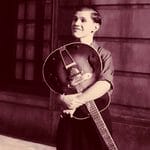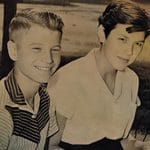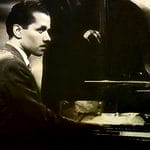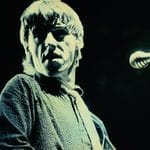
The George Barnes Octette recorded in Hollywood for the ABC Radio Network on September 22, 1946.
Diving into something a bit different tonight. A fifteen minute radio program featuring the music of the legendary guitarist George Barnes.
George Barnes’s style took shape before the development of bebop, and he remained a swing stylist throughout his career. His lines were usually short, melodic, bluesy and “inside” (i.e., diatonic), compared to the chromaticism and long lines of bop-era guitarists. His improvisations often employed call and response phrases, and his tone was clearer, cleaner and brighter than many other jazz guitarists (such as Joe Pass or Jim Hall) and reflected his “happy” approach to music. His playing was noted for its bright quality and melodic style.[2]
The single note lines in his solos never strayed far from the tune that was being played. He often made use of blues phrases, string bends and vibrato. His use of vibrato was developed from watching violinists and would start slowly, then the speed increased.[31] When creating vibrato he did it across the fingerboard, rather than in line with it.[12]
He played a right-handed guitar, but George Barnes was left handed, seeing it as an advantage to use the strongest hand for work on the fretboard.[31]
Claiming that it gave him more control, Barnes held the pick between his thumb and middle finger playing mainly with downstrokes. He only used alternate picking when picking very rapid notes on the fretboard. By tightening or loosening his grip on the pick, Barnes could change the volume and dynamics of his guitar sound. Believing that it helped to give him good tone, he always used the thickest picks, and the heaviest gauge strings possible.
Not long before his death, Barnes recorded three live albums—two produced from an April 17, 1977, concert at the San Francisco club Bimbo’s 365, the other at the Willows Theatre in Concord, California. The albums are good examples of his swinging, happy and often mischievous style. The albums also include his banter with the audience and his introductions of tunes and his band, giving the listener a glimpse of his sense of humour.
In a review of the album Don’t Get Around Much Anymore (material from a 1977 concert in Concord, California, recorded a little more than a month before Barnes’s death at the age of 56), Jim Ferguson wrote, “Often overlooked in a sea of more modern-sounding, bebop-oriented guitarists, George Barnes could swing like mad and spin out intricate, frequently bluesy phrases with awesome precision and musicality…From start to finish, this well-recorded performance demonstrates the qualities that qualify Barnes for a position among the most elite players in the annals of jazz guitar.”
In 1942, Barnes wrote the first electric guitar method book, The George Barnes Electric Guitar Method, published by Wm. J. Smith. In 1961, he wrote and recorded George Barnes’ Living Guitar Method: The Easy Way to Learn All the Chords and Rhythms and Ten Duets for Two Guitars (recorded with his partner Carl Kress) for Music Minus One. In 1965, he wrote How to Arrange for Solo Guitar, published by Peermusic. He also produced the first guitar course offered on cassette tape, The Great George Barnes Guitar Course, published in 1970 by Prentice Hall.
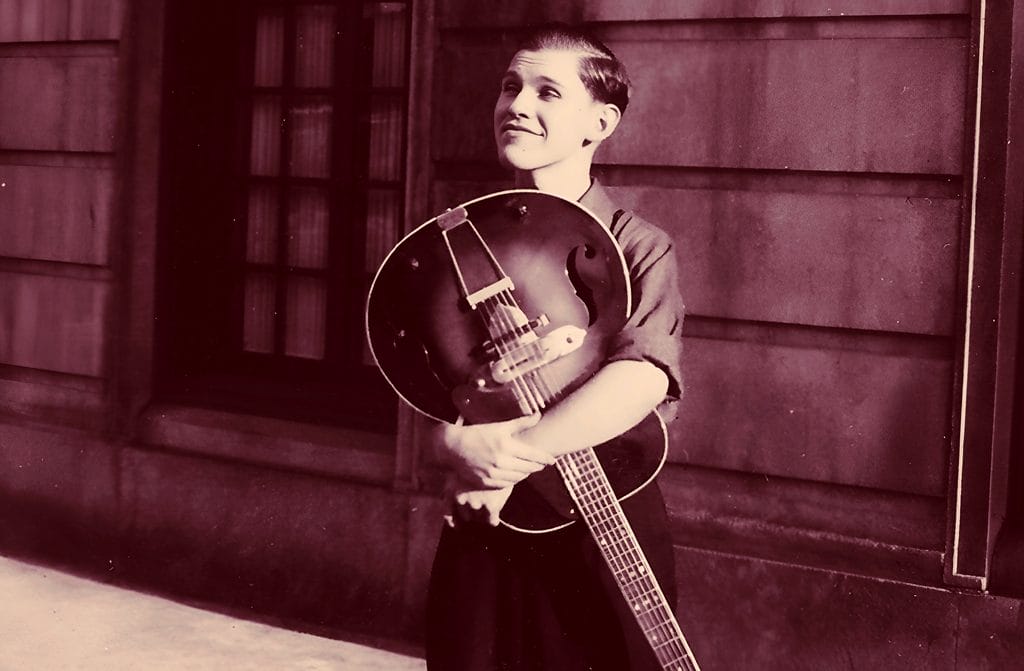
George Barnes was born in South Chicago Heights, United States. He had first started to play the piano at the age of five. When George was ten, the family were forced to sell the instrument along with the home because of the great depression. There was an old Sears Roebuck Silvertone guitar left over, which George picked up and his father who was a guitarist began to teach him to play. In 1931, Barnes’s older brother made a pickup and amplifier for him because he knew that George wanted to play solo lines that could be heard in a band. He believed he might have been the first person to ever play an electric guitar.
To get an idea, here is one of those 15 minute shows Barnes did for the fledgling ABC Radio network.