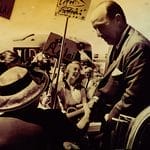
The interview with Vickie Rovere and Bob Eaton, conducted by Mitchell Krause for the Newsfront program of the Eastern Educational Television Network on October 7, 1968, takes place at a remarkable moment in modern political history. The world of 1968 was a world in revolt. Students, workers, intellectuals and ordinary citizens were challenging established authority, questioning political orthodoxies and demanding a greater voice in determining their own futures. Yet the meaning of protest differed dramatically depending on where it occurred, who was being challenged, and how much freedom demonstrators had to express their opposition.
In August 1968, Soviet tanks and troops entered Czechoslovakia to crush the reform movement known as the Prague Spring. For Vickie Rovere and Bob Eaton, protesting the invasion in Moscow and Budapest offered a firsthand encounter with the limits of political dissent behind the Iron Curtain. Their experiences, and the reactions they encountered from Russians and Hungarians, provide a revealing starting point for considering the international protest movements that had transformed the political landscape during the preceding months.
Czechoslovakia had attempted something extraordinary within the Soviet-dominated Eastern European bloc. Under Alexander Dubček, the country’s Communist leadership sought to introduce greater freedom of expression, loosen censorship and reform the political system without abandoning socialism altogether. The experiment raised hopes that a more humane form of communism might be possible. For the Soviet leadership under Leonid Brezhnev, however, these developments threatened the cohesion of the Eastern bloc and the authority of Moscow itself.
The invasion on August 20–21 abruptly ended those hopes. It also exposed a fundamental contradiction within the Soviet claim to represent a progressive political alternative: a movement that spoke in the name of workers and popular liberation was prepared to use military force against a socialist country whose citizens were demanding greater freedom.
The invasion provoked protests internationally, including in the Soviet Union itself. In Moscow, demonstrators faced a government that regarded public opposition to Soviet policy as a direct political challenge. Even a small gathering could carry enormous significance. The Soviet authorities had little tolerance for demonstrations that contradicted the official position, and participants risked arrest, interrogation and other forms of intimidation. Publicly challenging the invasion meant challenging not merely a particular military operation but the legitimacy of the political system that had ordered it.
Budapest offered another perspective. Hungary had its own history of resistance to Soviet domination, most dramatically during the 1956 uprising, when a popular revolt was crushed by Soviet military intervention. By 1968, the Hungarian government had introduced limited economic reforms, but political expression remained tightly controlled. The memory of 1956 was still powerful, and the invasion of Czechoslovakia raised uncomfortable questions about the limits of national independence within the Soviet sphere.
For Hungarians, the events in neighboring Czechoslovakia could not easily be separated from their own recent history. A country might possess its own government and national identity, yet remain vulnerable when its political choices conflicted with Moscow’s strategic interests. Protesting the invasion therefore meant confronting a larger question: how much sovereignty could any Eastern European nation exercise when the Soviet Union reserved the right to intervene?
Across the Atlantic, the situation was different, but the underlying challenge to authority was equally profound. In the United States, opposition to the Vietnam War had become one of the defining political movements of the decade. Students, clergy, civil rights activists, veterans and ordinary citizens questioned the morality of American intervention, the mounting casualties and the government’s explanations for continuing the war. The Tet Offensive in early 1968 had further shaken public confidence in official assurances that victory was approaching.
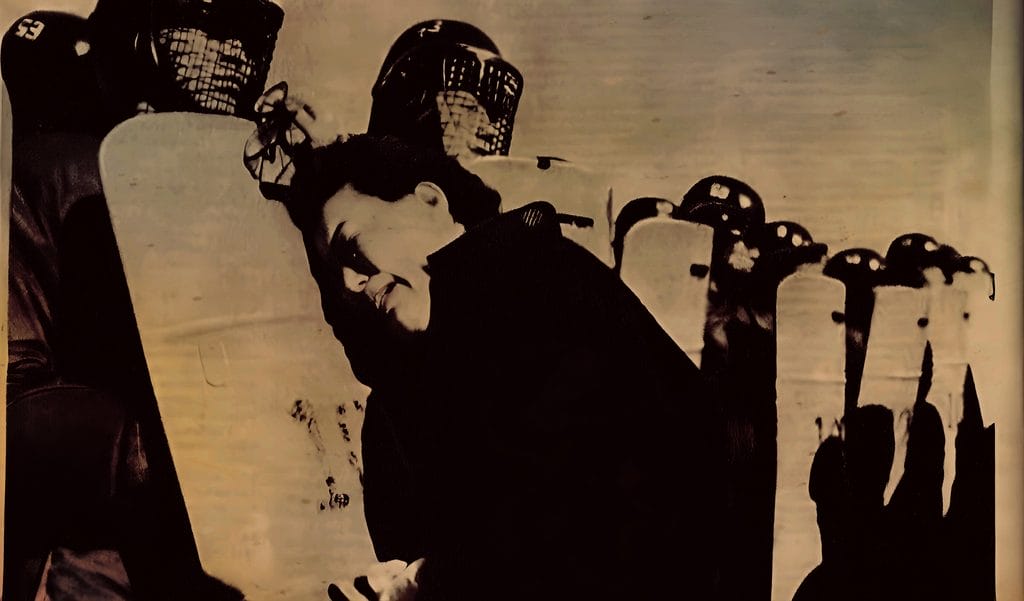
American protesters possessed constitutional protections unavailable to their counterparts in Moscow, although those rights did not prevent confrontations with police, arrests or government surveillance. The violence surrounding the Democratic National Convention in Chicago in August demonstrated how quickly a protest in a democratic society could become a confrontation between citizens and the forces of public order. As demonstrators challenged the war and the political establishment, police responded with tear gas and clubs. The scenes exposed a bitter contradiction: a country that presented itself as a defender of freedom abroad was struggling to accommodate dissent at home
The French protests of May 1968 had raised a different but equally unsettling challenge. What began with student demonstrations over university conditions and opposition to established social authority expanded into a nationwide crisis. Workers joined the movement, factories were occupied, transportation was disrupted and millions participated in a general strike. President Charles de Gaulle’s government faced the possibility that a movement initially associated with students could undermine the functioning of the entire country. Yet the French upheaval was not simply a protest against one government or one policy. It expressed a wider dissatisfaction with hierarchy, consumer society, traditional institutions and the limited opportunities for younger generations to influence the world they were inheriting.
The French movement also existed alongside opposition to the Vietnam War and international solidarity with Czechoslovakia. These connections did not mean that every protester shared the same political objectives. American antiwar activists, French students, striking French workers and Soviet dissidents operated within very different circumstances. What connected them was a growing conviction that established authorities could no longer assume unquestioning obedience.
By October 1968, however, the results remained uncertain. The French general strike had subsided without producing the revolutionary transformation some participants desired. The Vietnam War continued, and the American political establishment remained deeply divided over its future. In Czechoslovakia, Soviet military power had prevailed, despite widespread resistance and international condemnation. The Moscow demonstrators had made their protest at considerable personal risk, but their government continued to suppress public dissent.
The Newsfront interview with Vickie Rovere and Bob Eaton therefore offers more than an account of individual encounters with Soviet and Hungarian reactions to political protest. It opens a window onto a year in which people across national boundaries confronted a common question: who possessed the right to determine the direction of a society?
The answers varied from country to country. In some places, demonstrators demanded political freedom; elsewhere, they opposed war, economic inequality, educational restrictions or entrenched social conventions. Their methods and objectives differed, as did the risks they faced. Yet the events of 1968 revealed a generation increasingly unwilling to accept that governments, political parties or established institutions should have the final word.
In October, the international protest movement was neither a unified revolution nor a settled political force. It was something less organized but potentially more consequential: a worldwide challenge to authority whose ultimate meaning had yet to be determined.
Here is that interview with Vickie Rovere and Bob Eaton from Newsfront for October 7, 1968