
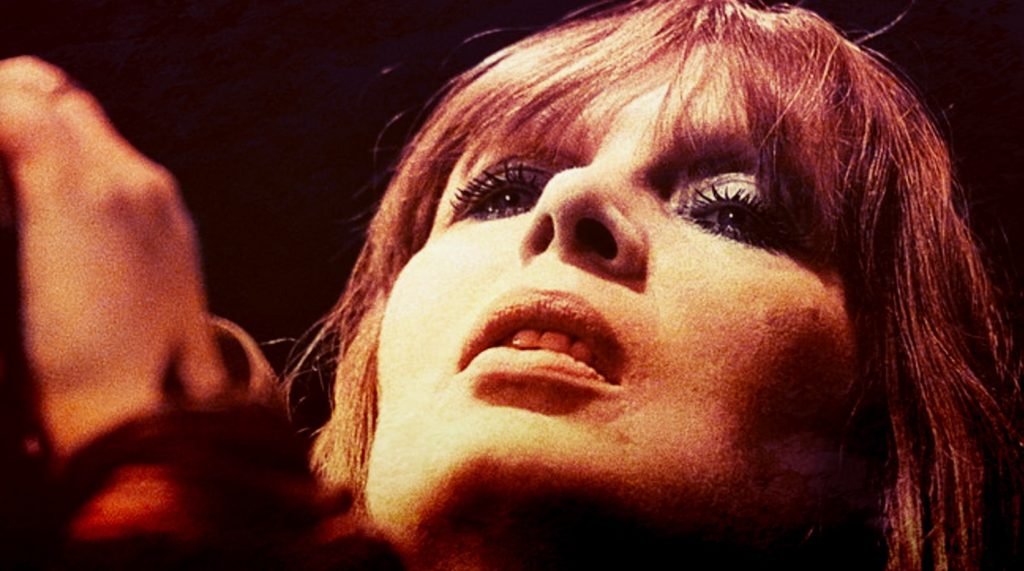
Nico – Another universe entirely.
Nico tonight – in session for John Peel and recorded on February 2, 1971.
Nico was a presence – going back to the early 60s as an actress in such films as Fellini’s La Dolce Vita and then for Andy Warhol in Chelsea Girl – but most contemporary references are Nico as singer, Nico as singer-muse, Nico as haunting voice and larger-than life icon.
Nico, originally known as Christa Päffgen, who was born in Cologne to Wilhelm and Margarete “Grete” Päffgen (née Schulz, 1910–1970). Wilhelm was born into the wealthy Päffgen Kölsch master brewer family dynasty in Cologne and was Catholic, while Grete came from a lower-class background and was Protestant. Richard Witts notes in his book Nico: The Life and Lies of an Icon that Nico has given differing accounts about her background.
Nico was discovered at 16 by photographer Herbert Tobias while both were working at a KaDeWe fashion show in Berlin. He gave her the name “Nico” after a man he had fallen in love with, filmmaker Nikos Papatakis, and she used it for the rest of her life. She moved to Paris and began working for Vogue, Tempo, Vie Nuove, Mascotte Spettacolo, Camera, Elle, and other fashion magazines. Around this time, she dyed her brown hair blonde, later claiming she was inspired to do so by Ernest Hemingway. At age 17, she was contracted by Coco Chanel to promote their products, but she fled to New York City and abandoned the job. Through her travels, she learned to speak English, Spanish, and French.
In 1965, Nico met the Rolling Stones guitarist Brian Jones and recorded her first single, “I’m Not Sayin’“, with the B-side “The Last Mile”, produced by Jimmy Page for Andrew Loog Oldham‘s Immediate label. Actor Ben Carruthers introduced her to Bob Dylan in Paris that summer. In 1967, Nico recorded his song “I’ll Keep It with Mine” for her first album, Chelsea Girl.
After being introduced by Brian Jones, she began working in New York with Andy Warhol and Paul Morrissey on their experimental films, including Chelsea Girls, The Closet, Sunset and Imitation of Christ. Warhol began managing the Velvet Underground, a New York City rock band and he proposed that the group take on Nico as a “chanteuse“, an idea to which they consented, reluctantly for both personal and musical reasons.
The group became the centerpiece of Warhol’s Exploding Plastic Inevitable, a multimedia performance featuring music, lighting, film and dance. Nico sang lead vocals on three songs (“Femme Fatale“, “All Tomorrow’s Parties“, “I’ll Be Your Mirror“), and backing vocal on “Sunday Morning“, on the band’s debut album, The Velvet Underground & Nico (1967). Reviewer Richard Goldstein describes Nico as “half goddess, half icicle” and writes that her Velvet Underground vocal “sounds something like a cello getting up in the morning”.
Nico’s tenure with the Velvet Underground was marked by personal and musical difficulties. Multi-instrumentalist John Cale wrote that Nico’s long dressing room preparations, and pre-performance ritual of burning a candle, often held up performances, which especially irritated songwriter Lou Reed. Nico’s partial deafness sometimes caused her to veer off key, for which she was ridiculed by other band members. The album became a classic, ranked 13th on Rolling Stone‘s 500 Greatest Albums of All Time, though it was poorly received at the time of its release.
Nico directly inspired many musicians, including Siouxsie and the Banshees, the Cure, Morrissey, Elliott Smith, and Björk. Siouxsie and the Banshees invited her as special guest on their first major UK tour in 1978; they also later covered “All Tomorrow’s Parties”. The Cure’s leader Robert Smith has cited Desertshore as one of his favourite records, as has Björk. Joy Division and New Order‘s Peter Hook cited Chelsea Girl as one of his favourite albums. Bauhaus singer, Peter Murphy, considered that “Nico recorded the first truly Gothic album, Marble lndex or The End. Nico was Gothic, but she was Mary Shelley to everyone else’s Hammer Horror. They both did Frankenstein, but Nico’s was real.”
On 18 July 1988, during a holiday with Ari on the Spanish island of Ibiza, Nico hit her head when she fell off her bicycle. A passing taxi driver found her unconscious, but had difficulty getting her admitted to local hospitals. She was misdiagnosed as suffering from heat exposure and was declared dead at 20:00. X-rays later revealed a severe cerebral hemorrhage as the cause of death.
If you aren’t already familiar, this 1971 session gives a good idea of where she was during that period of time.
Have a listen and go exploring.
And while you’re doing that . . .