In the autumn of 1960, the Cold War was at a crossroads. The United States and the Soviet Union possessed the means to destroy one another in a nuclear confrontation, yet both governments understood that another world war could have consequences beyond anything humanity had previously experienced. Against this backdrop, Soviet Premier Nikita Khrushchev arrived in New York in September 1960 to attend the Fifteenth Session of the United Nations General Assembly. His presence offered another opportunity to discuss peaceful coexistence, but it also exposed the deep suspicions and political antagonisms that continued to divide East and West.
This was Khrushchev’s second visit to the United States in little more than a year. His 1959 journey, undertaken at President Dwight D. Eisenhower’s invitation, had generated considerable public curiosity and raised hopes that personal diplomacy might help ease international tensions. The subsequent collapse of the planned Paris summit in May 1960, following the American U-2 reconnaissance aircraft incident, had badly damaged those hopes. By the time Khrushchev returned in September, the atmosphere had changed considerably. He was no longer arriving as a visiting head of government welcomed by the American president, but as the leader of a major power attending an international gathering on United Nations territory.
The distinction was important. Washington sought to emphasize that Khrushchev was visiting the United Nations, not the United States itself. Security restrictions limited his movements, while the administration was concerned that the Soviet leader would turn the General Assembly into a platform for Communist propaganda. Khrushchev, meanwhile, wanted to transform the gathering into an opportunity for summit-level diplomacy, disarmament negotiations, and a renewed discussion of relations between the superpowers.
The American press greeted his arrival with a mixture of fascination, apprehension, hostility, and professional obligation. Khrushchev was unquestionably news, and his appearances commanded attention. But the press was not uniformly sympathetic to his arguments. Some newspapers and columnists openly condemned him and the Soviet system. Others attempted to report his statements and the reactions they provoked, recognizing that his presence represented an important moment in international affairs.
The spectacle surrounding the visit frequently threatened to overwhelm its diplomatic purpose. Demonstrators protested the Soviet leader’s presence, while public officials worried about security and the possibility of disorder. Khrushchev’s personality, with its unpredictable mixture of humor, bluster, irritation, and theatrical gesture, made him an irresistible subject for reporters. Yet the attention he attracted did not necessarily translate into greater understanding between the countries he represented.
At the United Nations, the disagreements became increasingly serious. Khrushchev promoted the concept of peaceful coexistence, arguing that ideological competition between capitalism and communism need not inevitably lead to war. He called for disarmament and insisted that international disputes could be resolved through negotiation. At the same time, he continued to proclaim the eventual victory of communism and demanded changes in the international order that Western governments considered unacceptable.
His attacks on United Nations Secretary-General Dag Hammarskjöld and his proposal to replace the office of Secretary-General with a three-person executive representing different world blocs provoked substantial opposition. Rather than strengthening the organization’s ability to mediate international disputes, Khrushchev’s confrontational approach threatened to deepen existing divisions.
By October, the prospect of an American-Soviet rapprochement had become increasingly remote. President Eisenhower rejected a proposal for a meeting with Khrushchev supported by several nonaligned leaders, and the two governments exchanged increasingly acrimonious statements. Khrushchev continued to press his case at the General Assembly, but his increasingly combative interventions—including the notorious shoe-banging episodes—often diverted attention from the substantive questions under discussion.
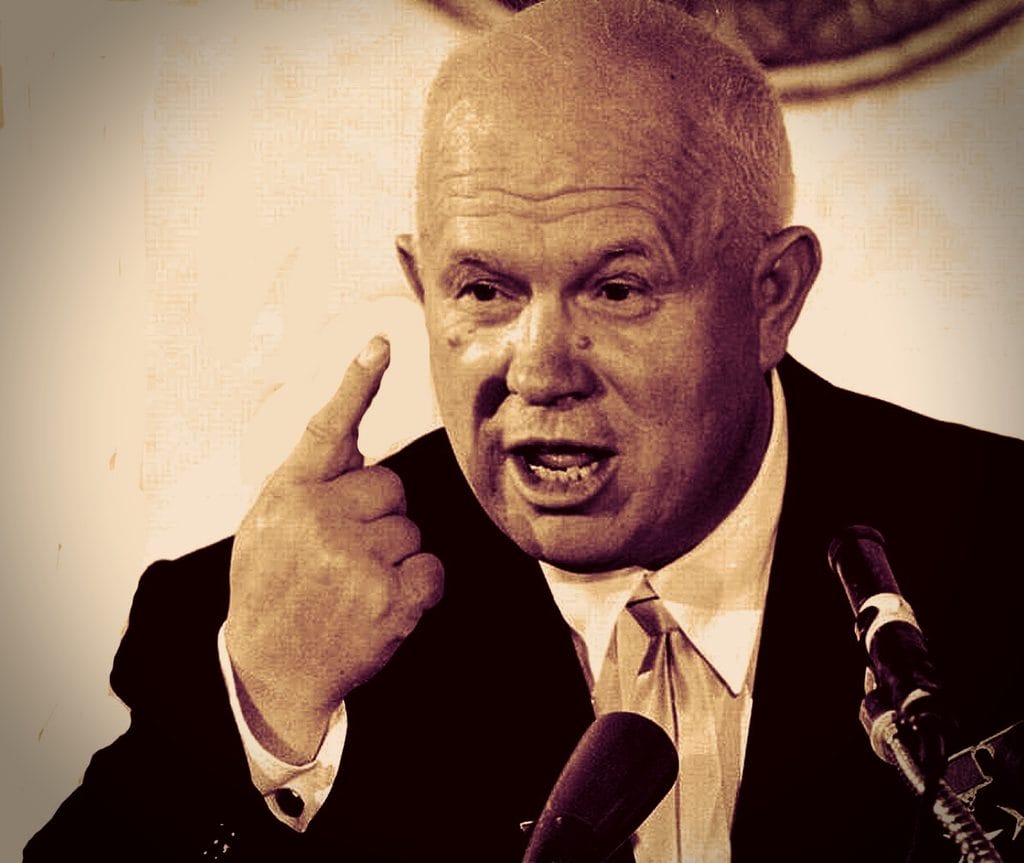
On October 7, Khrushchev held a press conference at the United Nations. A surviving recording preserves his opening statement and the subsequent question-and-answer session. The conference provides a useful opportunity to hear the Soviet leader addressing journalists directly, rather than relying exclusively on newspaper accounts or later interpretations of his remarks.
The date is significant because it places the press conference within the final, increasingly turbulent phase of his stay in New York. Khrushchev would remain until October 13, when he departed for the Soviet Union. The encounter therefore belongs to the diplomatic drama of his 1960 United Nations appearance, rather than to his earlier, more carefully managed American tour of 1959.
The larger question raised by Khrushchev’s presence in America remains relevant to any understanding of the Cold War. Could leaders who regarded one another’s political and economic systems as fundamentally incompatible nevertheless negotiate a more stable international order? Khrushchev argued that peaceful coexistence was necessary, but his confrontational style and uncompromising political demands repeatedly undermined the message. American officials and much of the press, meanwhile, viewed his initiatives through the lens of Soviet expansionism and propaganda.
The visit did not produce the breakthrough its advocates had hoped for. Instead, it demonstrated how difficult it was to separate the genuine need for peace from the competing ambitions, fears, and political calculations of the two superpowers. The possibility of a thaw had not disappeared, but in October 1960 it remained elusive.
Here is the press conference as it was presented on October 7, 1960.