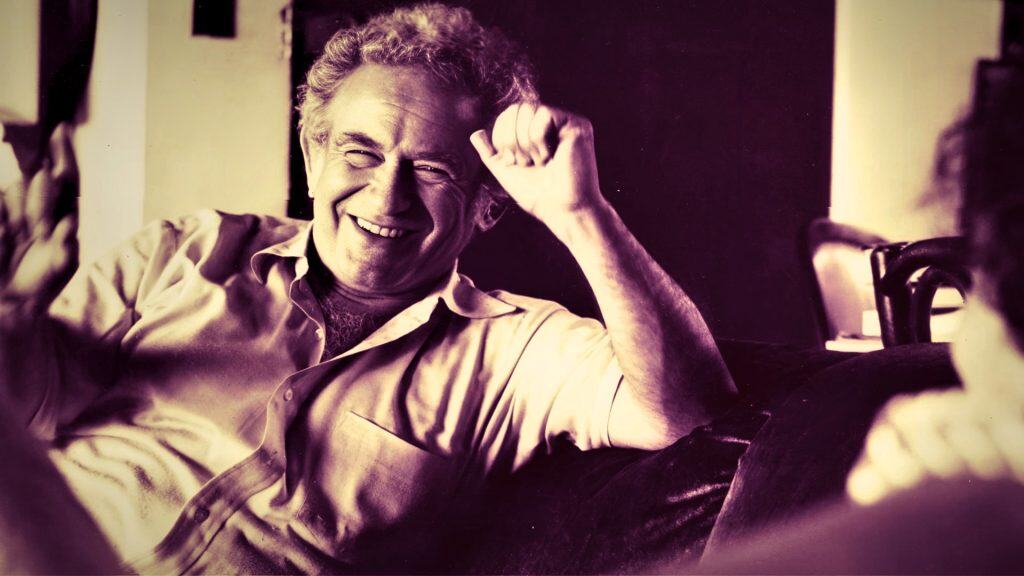
Novelist/biographer/journalist/filmmaker Norman Mailer, discussing his latest film project Maidstone at a screening in London in 1971 and broadcast by the CBC in Canada.
One of the more visible literary figures of the 1950s and 1960s, Norman Mailer’s reputation and creative output scanned several decades during his life. As a novelist he is credited with over 13 books as well as a substantial number of essays, biographies, short stories and articles as well as peace activist during the Vietnam War and writer/director and producer of a number of films.
The film which this Q&A session occurs was for his third of three underground films, Maidstone which was being shown in London in early 1971. Below is a capsule background via Wikipedia (thanks Wikipedia).
Maidstone is the final of three underground films written and directed by Norman Mailer in the late 1960s and was his largest production in terms of capital expenses and physical and emotional expenditures. The film began production in 1968 and was not completed until 1970. Production occurred over five days at various East Hampton estates, and “[t]he actors worked without a script, without a net, and often, without any idea what they were doing.” Mailer relied on his own acting as a method of directing while prodding cast members to react on film rather than reading from a script. Conservative commentator William F. Buckley Jr. was offered but declined a small role in the film.
The original footage was 45 hours long, but after the editing process the producers came up with a 110-minute film. It took them three weeks to watch the 45 hours of film, then about six months to cut it into 7.5 hours. According to Mailer, the crew worked a long time before they could get down to the 3.5-hour version, which no longer exists. “At that point, down from 7 ½ hours, it’s a totally different film. It was endlessly long and slow and had all sorts of interesting corners, pursued all sorts of angles, that never quite got developed enough.”
In 1971, Mailer published the screenplay (from the transcript of the finished movie), along with accounts of the filming, film stills, and his essay “A Course in Filmmaking”.
Mailer pointed to his lack of experience as an inadvertent film producer as the main factor for inflated spending on his films Wild 90, Beyond the Law and Maidstone.[12] The film cost $200,000 to produce, causing Mailer to sell part of his interest in The Village Voice. The film would eventually bankrupt Mailer before completion.
Produced during the media height of The Armies of the Night and leading to the writing of Miami and the Siege of Chicago, Maidstone was created during a politically and culturally changing era of American history. Although released in 1970-1971, Maidstone was produced just one month after the assassination of Robert Kennedy and three months after Martin Luther King, Jr.’s assassination. John D’Amico couples Maidstone with chants of “The whole world is watching!” on the American political timeline of the 1960s and along a year of “nerve-wracked” cinema “desperately grasping for a new way of living.” D’Amico credits the totalitarian-littered world in which these filmmakers were born as fuel in their rage against the politically oppressive utilization of perfect order, considering these factors to be more important than the experimentation with illegal drugs which were also associated with counter-cultural film production.
According to Mailer, Maidstone never received “the one great review we were hoping for.”
Vincent Canby of The New York Times lauded Mailer’s creativity and ambition, but his review remained negative:
Maidstone is a sometimes hilarious, often boring, but always adventurous ego trip, a very expensive, 110-minute home movie that has been edited, rather fancily, out of something like 45 hours of original footage. That, in turn, prompts the thought that almost anybody should be able to get 110 minutes of something out of 45 hours of anything, even if it’s simply the filmed record of a chic, chaotic, seven-day brawl in East Hampton, which is the raw, not-so-base material of Maidstone.
Like many viewers, he found the Raoul Ray O’Houlihan (Rip Torn) hammer attack scene to be the only intriguing moment:
Nothing else in Maidstone is as interesting, not the satire of the news media, not the soft-core sex scenes, not Mailer’s put-downs of actresses auditioning for Norman T. Kingsley … not even Mailer’s flights of fancy about politics, Presidents, blacks and whatnots.
Sam Adams of the Los Angeles Times calls the Rey/Kingsley fight “the greatest scene in Norman Mailer’s filming career” and states that “watching the film doesn’t lack for force. It is indeed like being attacked, and it is Mailer that is doing the attacking.”
The film is now famous for the improvised fight between Mailer and Torn. As the camera rolled, Torn struck Mailer in the head with a hammer, intending to “kill his character.” Mailer’s scalp opened up, and a vicious fight ensued. With the camera still rolling, Torn energetically strangled Mailer until the fight was broken up by Mailer’s wife Beverly Bentley and their wailing children. During the melee, Mailer bit off a small chunk of Torn’s ear. The fight, in which the actors called each other by their real names, made it into the film.
The fight was later used as evidence in Torn’s case against Dennis Hopper, who claimed that Torn attacked him with a knife after being replaced by Jack Nicholson in Easy Rider. Torn won his case on the claim that “he could not have possibly killed Hopper as he was, at the time, on the set of Maidstone trying to kill Norman Mailer.”
In his essay “Overexposed: My First Taste of Film-Making”, Michael Mailer recounts this final scene as his first experience with trauma. Shortly before Norman Mailer’s death, he spoke with his son about the final scene of Maidstone and its impact as the “clear” force that drove Michael into the film business.
Here is the Question and Answer period from the CBC.