As reported by Associated Press:
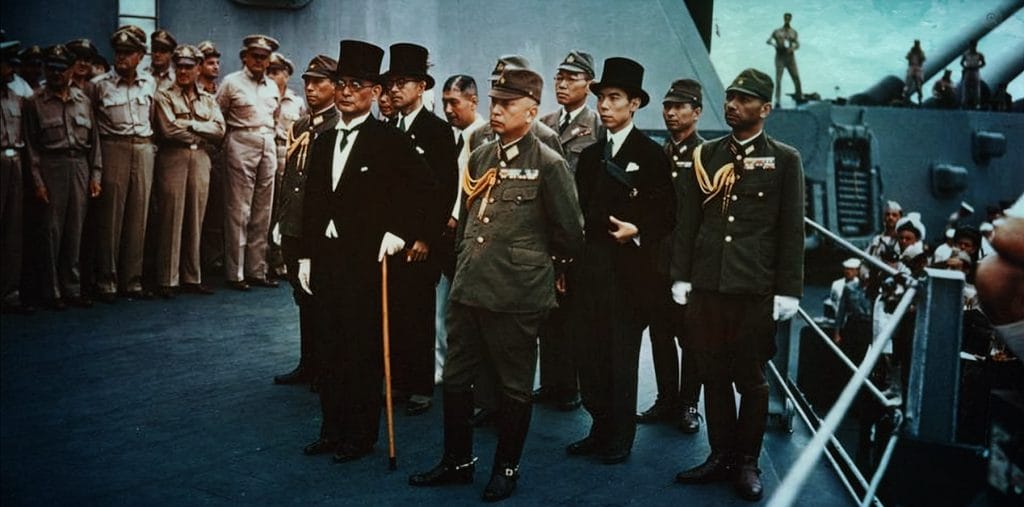
U.S.S. MISSOURI, Tokyo Bay, Sunday, Sept. 2 -Two all nervous remnants of their smashed empire to the Allies Japanese formally and unconditionally surrendered Sunday, restoring peace to a war-battered world. Surrender hour was cold and cloudy, but the sun broke through the overcast 20 minutes later as General MacArthur intoned “these proceedings are closed.” Foreign Minister Mamoru Shigemitsu, who signed for the Japanese government, doffed his top hat and nervously fingered his fountain pen before he firmly signed the two copies of the surrender document-one for Japan, one for the Allies. Shigemitsu penned his name in English on one document.
Gen. Yoshijiro Umezu, for the imperial staff, also nervous, signed hurriedly; quickly stepped aside. A Japanese colonel wiped his eyes. All of the Nipponese present were tense and drawn. Then MacArthur signed, deliberately, using five pens.
The first two- silverplated especially for the occasion -he handed in turn to Jonathan M. Wainwright and to British Gen. Arthur Ernest Percival, who were forced to surrender Corregidor and Singapore, respectively, in the war’s darkest hours. Wainwright and Percival smiled; saluted snappily. They had been rescued only a few days ago from Japanese prisoner of war camps.
“It is my earnest hope and indeed the hope of all mankind that from this solemn occasion a better world shall emerge out of the blood and carnage of the past,” MacArthur said. The historic signing took place on a long table on the gallery deck.
TRUMAN BROADCASTS TALK.
Minutes later, from the White House, where Japanese warlords once asserted they would dictate their own peace terms, President Truman broadcast: “We shall not forget Pearl Harbor. The Japanese militarists will not forget the U.S.S. Missouri.” The 45,000-ton Missouri, which less than a month ago was blasting, Japanese war industries with her 16-inch guns. had those rifles pointed skyward and her bow pointed toward the heart of Japan for the ceremony. Flags of the United States, the United Kingdom, China and Russia fluttered from the spic veranda deck. Once there was a slight delay when it appeared someone had signed on the wrong line. Gen.
Sir Thomas Blamey, representing Australia, signed the Japanese document first -by -then shrugged as if it really made no difference, now. All Allied representatives were sober-faced, but obviously glad it’s over. Soldiers, sailors and marines, some of whom had fought their way across the Pacific, hardly could hide a trace of exuberance on their serious faces.
MACARTHUR FULL OF EMOTION.
MacArthur’s hand shook slightly as he reached “Dou-” in his first signature. His face twitched but his voice was strong although he appeared to be under great emotional strain. After the Japanese signed, he said dramatically, “will General Wainwright and General Percival step forward while I sign?” Wainwright, by his own request, was accompanied by his chief of staff, Brig. Gen. Lewis Beebe; his aides, Col. John Pugh and Lt. Col. Thomas Dooley, and his orderly chauffeur, Sgt. Herbert Carroll. Percival was accompanied his orderly. Among United States naval officers present were Admiral Nimitz who signed for his country: his chief of staff, Vice Adm. Forrest C. Sherman; Admiral Halsey; Vice Adm. John A. Towers, commander of naval air in the Pacific; Vice Adm. Theodore C. Wilkinson, who directed many amphibious landings under both Halsey and Adm. Thomas C. Kinkaid, commander of the 7th Fleet; Rear Adm. Oscar C.Badger, commander of the task force which landed occupation troops, and Commander Maher, recently liberated officer of the cruiser Houston, lost early in 1942.
MARINE COMMANDER IS GUEST.
Lt. Gen. Robert E. Geiger, commander of Marine forces in the Pacific, represented the Marine Corps, as Nimitz’ guest. Among U. S. Army officers present were Generals Stilwell, Spaatz and Kenney; Lt. Gen.
Robert L. Eichelberger and Walter Krueger, commanders of the U. S. 8th and 6th Armies; and Lt. Gen.
Robert C. Richardson Jr., commander of the U.S. Army forces in the Central Pacific. Several Americans recently liberated from Japanese prisoner of war camps also viewed the ceremonies. Clouds and fog limited visibility to about 1,500 feet.
Near by mountains were hidden. Super Forts scheduled to fly overhead during the ceremonies were obscured by the overcast. Only one B-29 appeared, ducking low under the clouds. But when the clouds parted as MacArthur concluded the formalities, many planes roared through the sunlight overhead. The departing delegation looked up at them.
Here is the complete ceremony, as it was broadcast by the Mutual Network on September 2,1945.