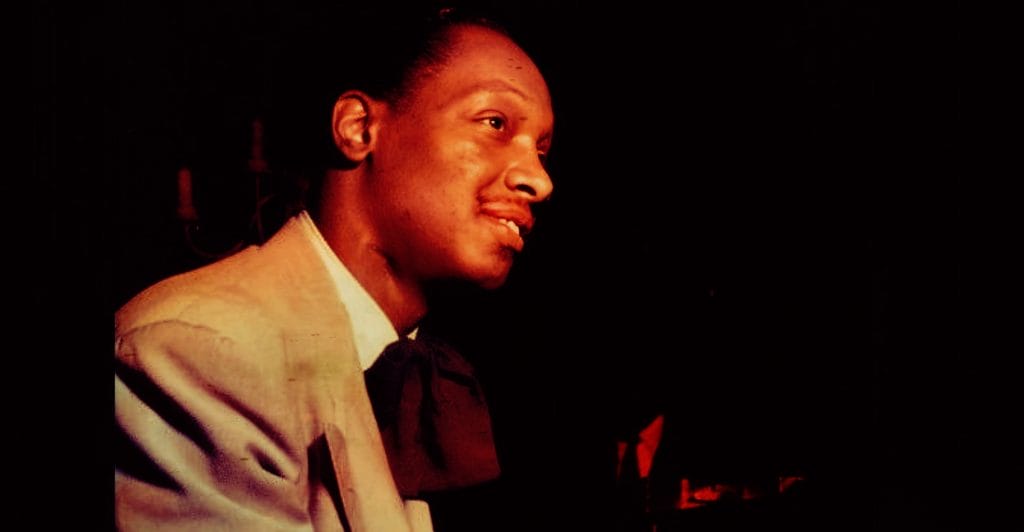
The legendary Tadd Dameron this weekend. Recorded for WMCA-AM in New York, live from The Royal Roost on August 29, 1948.
He’s joined by – Fats Navarro, trumpet – Allen Eager, Tenor Sax – Curly Russell, bass – Kenny Clarke, drums and “Pancho” Hagood on vocals. Symphony Sid acts as MC.
All About Jazz says:
Tadd Dameron as a composer and arranger was the man who in the 1940s and ‘50s was among the first to use the sometimes raw and undisciplined devices of the then- new style of jazz called bebop in well-developed arrangements for big bands and small groups. Perhaps more than any other musician, Dameron added form to the then-emerging style of bop.
He began to experiment with a few new ideas while writing arrangements for the Jimmie Lunceford Orchestra. He was soaking up all the new bebop he was hearing and was beginning to use some of the new style in his big band arrangements. Dameron recalled, “I started writing in my own style when I got on Count Basie’s band.” In 1942, Trummy Young, a trombonist Dameron had known on the Lunceford band, introduced Tadd to Dizzy Gillespie. Arranging for Gillespie’s big band, Dameron took the long phrases, powerful upbeat rhythms and chord changes of bop that Dizzy and Charlie Parker were pioneering, and used them in big band arrangements. Among his early compositions for Gillespie was “Good Bait.”
Dameron was honored by Esquire magazine in 1947 as “The Best New Jazz Arranger.” That same year, he formed his own small group that featured Fats Navarro, an amazing young trumpet player. They recorded some classic sides for Blue Note and Capitol. After Navarro died in 1950 at the age of 26, Dameron found another young trumpeter who would become a jazz legend. Dameron was preparing for a recording session and later recalled he had decided to hire a relative unknown, Clifford Brown. On June 11, 1953, they went into the recording studio in New York City. Clifford Brown’s trumpet soared brilliantly above the chanting nine-piece ensemble. By 1956, only three years after Dameron had introduced him on record, Clifford Brown had become one of the most respected trumpeters in jazz. Dameron continued to write and arrange, including his best known composition, “If You Could See Me Now,” recorded by Sarah Vaughan and Dameron’s old boyhood buddy Freddie Webster. After recording a couple of albums as “Mating Call,” with John Coltrane in ’58, he spent much of 1959-61 in jail, on narcotics charges. After he was released, Dameron wrote for Sonny Stitt, Blue Mitchell, Milt Jackson, and Benny Goodman.
Tadd Dameron’s last session recording was “The Magic Touch of Tadd Dameron,” (1962) a definitive set that sums up much of his career. The record showcases all originals as; “On a Misty Night,” “Fontainebleau,” “If You Could See Me Now,” and “Our Delight.” Recorded with a large group of all-stars, Bill Evans on piano, tenor saxophonist Johnny Griffin; trumpeters Charlie Shavers, Joe Wilder, and Clark Terry; trombonist Jimmy Cleveland; Julius Watkins on French horn; and drummer Philly Joe Jones. Barbara Winfield was the vocalist on two of the selections. This record is an appropriate farewell from be-bops finest arranger, whose time was cut much too short.
Tadd Dameron died in 1965.
You got the picture – now Press Play and get the notes.