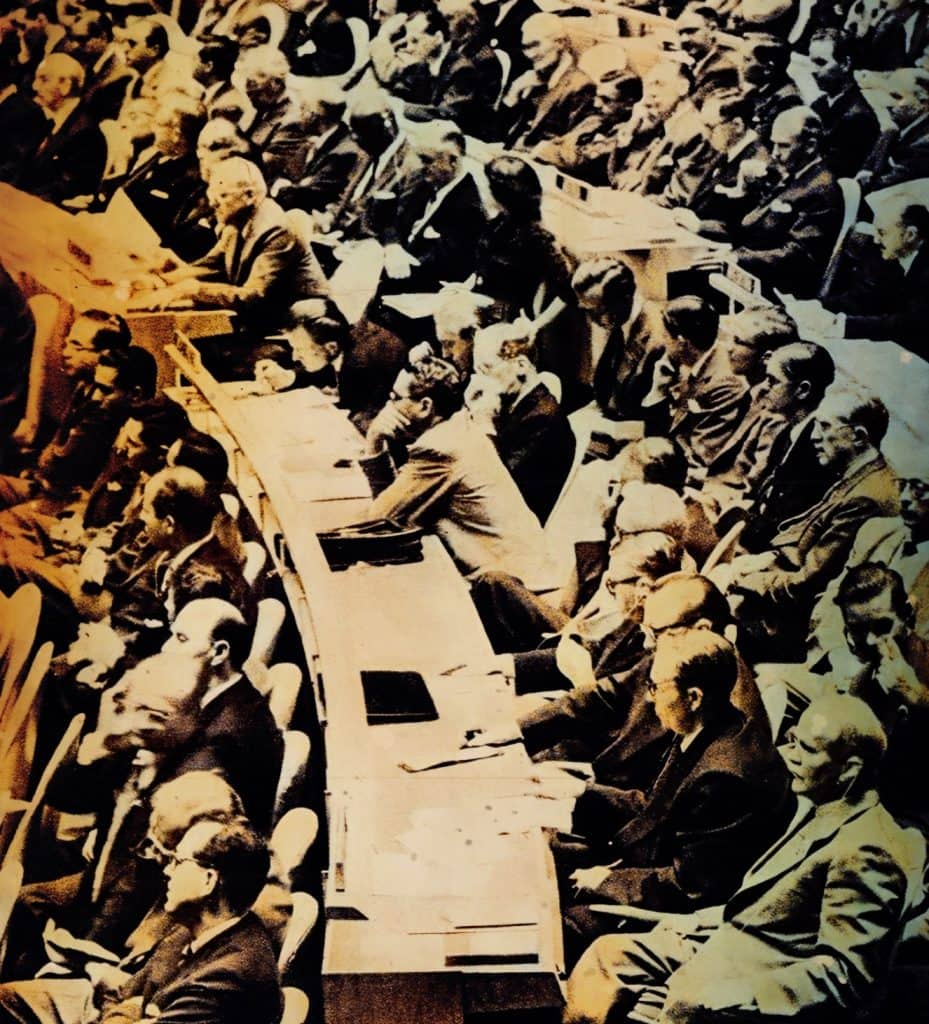
UN General Assembly – Caught up in the Cold War And Wonders about relevance.
In January 1955, Washington’s view of the United Nations was defined by cautious endorsement tempered by deep strategic anxiety, a balance brought into sharp relief by Secretary-General Dag Hammarskjöld’s visit to Beijing (then Peiping). While the Eisenhower administration continued to affirm the UN’s importance as an instrument of peace, it regarded the organization less as a decision-making authority and more as a diplomatic forum whose actions required careful supervision—particularly when Communist China was involved.
By this point in the Cold War, U.S. officials had abandoned any lingering expectation that the United Nations could resolve fundamental East–West conflicts. Instead, Washington viewed the UN as a stage on which restraint, legality, and moral leadership could be demonstrated to a global audience. This was especially important in early 1955, as American policymakers sought to reassure allies and newly independent nations that U.S. power was exercised within an international framework, even when outcomes were constrained by ideological division and veto politics.
Hammarskjöld’s Beijing visit tested this framework. Publicly, Washington supported the Secretary-General’s humanitarian mission, which focused on the release of American airmen held by the Chinese Communist government following the Korean War. U.S. statements emphasized the neutrality and independence of the UN Secretariat, presenting Hammarskjöld’s actions as consistent with the organization’s charter rather than as a political negotiation. This posture allowed Washington to appear cooperative without signaling any change in its refusal to recognize the People’s Republic of China.
Privately, however, the visit provoked unease. Any contact between the UN and Communist China risked conferring a degree of legitimacy that Washington had worked strenuously to deny. The United States remained adamant that the Republic of China on Taiwan was the sole lawful representative of China at the United Nations, and officials were alert to the possibility that Beijing might exploit Hammarskjöld’s presence for propaganda purposes. American caution was not directed at Hammarskjöld personally, whose professionalism was widely respected, but at the political symbolism inherent in the visit.
NBC’s Keys to the Capitol captured this Washington mood by framing the episode as a diplomatic necessity rather than a policy shift. Commentary stressed that Hammarskjöld was acting independently, not as an agent of U.S. diplomacy, and that his efforts did not alter American positions on recognition or UN representation. The program reflected a broader consensus inside Washington: the UN Secretary-General could serve as a useful intermediary, but only so long as his actions did not erode established lines of containment.
In January 1955, Washington thus viewed the United Nations as a carefully managed instrument—valuable for humanitarian initiatives and diplomatic signaling, but dangerous if allowed to drift into political accommodation with Communist regimes. Hammarskjöld’s Beijing visit underscored both the utility and the limits of the UN in U.S. strategy: it could relieve tensions at the margins, but it could not—and must not—reshape the fundamental Cold War balance.
Here is that episode of Keys To The Capitol from NBC Radio on January 15, 1955.