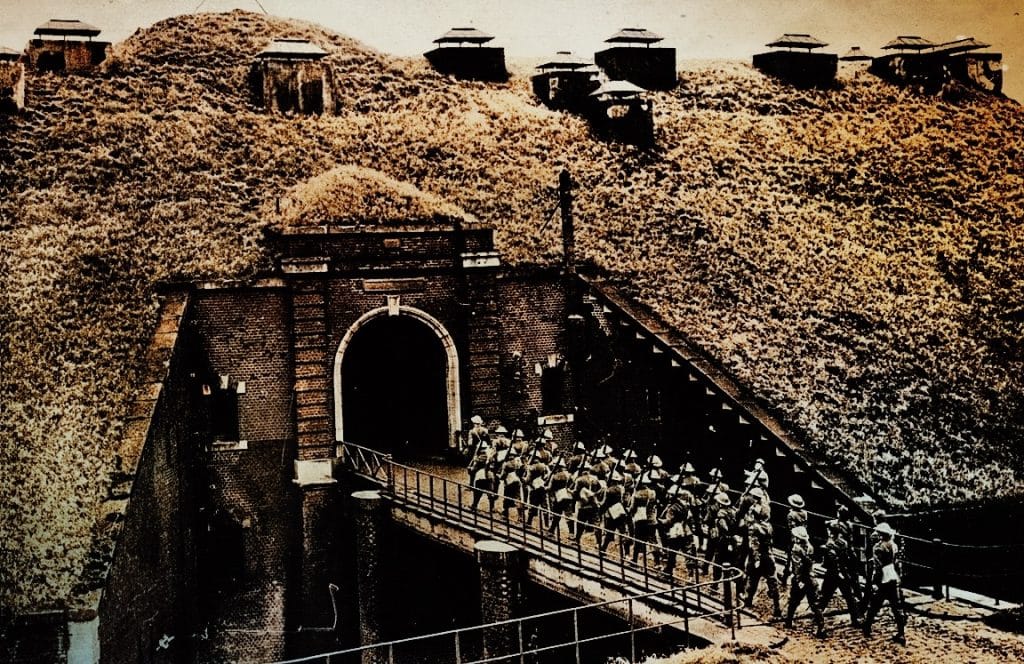
British Troops entering The Maginot Line – The Formidable faillure.
News for this day featured a special report from Arthur Mann of Mutual Broadcasting, reporting from The Maginot Line in France.
The Maginot Line, named after the French Minister of War André Maginot, was a line of concrete fortifications, obstacles and weapon installations built by France in the 1930s. The line was to deter invasion by Nazi Germany and force them to move around the fortifications through Belgium. It was impervious to most forms of attack and in 1940 the Germans invaded through the Low Countries, passing it to the north. The line, which was supposed to be extended further towards the west to avoid such an occurrence, was not built in response to demands from Belgium. Belgium feared it would be sacrificed in the event of another German invasion. The line has since become a metaphor for expensive efforts that offer a false sense of security.
Constructed on the French side of its borders with Italy, Switzerland, Germany, Luxembourg and Belgium, the line did not extend to the English Channel. French strategy was to move into Belgium to counter a German assault. Based on France’s experience with trench warfare during World War I, the massive Maginot Line was built before the Second World War, after the Locarno Conference in 1925 gave rise to a fanciful and optimistic “Locarno spirit”. French military experts believed the line would deter German aggression because it would slow an invasion force long enough for French forces to mobilise and counter-attack.
The Maginot Line was invulnerable to aerial bombings and tank fire and used underground railways for movement. It had modern living conditions for the garrison, with air conditioning and eating areas for their comfort. French and British officers had anticipated the geographical limits of the Maginot Line; when Germany invaded the Netherlands and Belgium, they carried out the Dyle Plan to form a front along the Dyle in Belgium to connect with the Maginot Line.
This report from Arthur Mann describes the vast and seemingly impregnable nature of this underground city – how it was, without question a virtually impossible set of defenses for the German Army to breach. However, history proved a bit different. But on this day in 1939, with the war only weeks old it was about preparedness and how Germany would be defeated early on. Many were of the mindset that this war was going to be like the last one; fought in trenches along designated fronts to the point of attrition, just like 1914.
When history doesn’t repeat it is often cruel and daunting with costly results. This was going to be no ordinary war.
Here is that report.