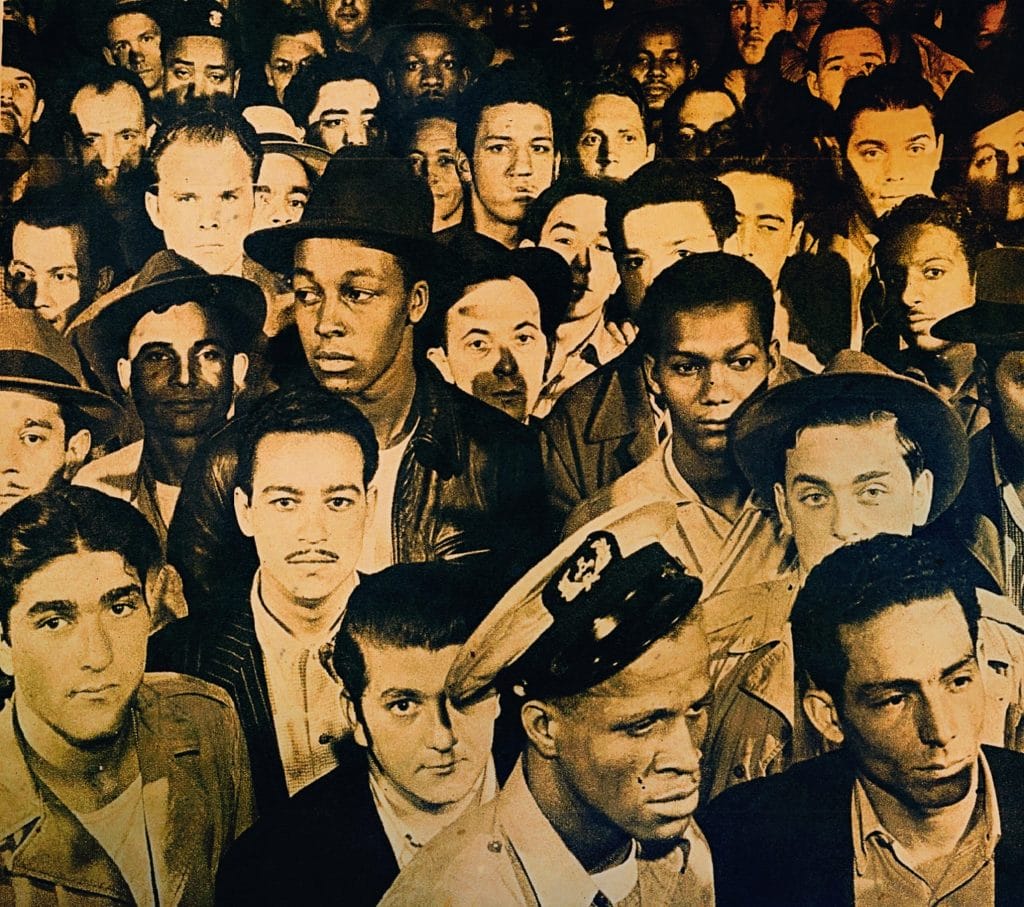
Portrait of your average law-abiding citizens
In the summer of 1948, as Americans gathered to celebrate Independence Day, the radio discussion program Northwestern Reviewing Stand turned to a question that had become increasingly urgent in the early Cold War era: “Just what is a democracy?” The discussion reflected a growing awareness that the word “democracy” had become one of the most contested political terms in the world. Both the United States and the Soviet Union claimed to represent true democracy, yet the systems they defended were profoundly different in philosophy, structure, and practice.
For Americans in 1948, democracy was generally understood as a political system grounded in individual liberty, free elections, constitutional protections, and the right of citizens to criticize their government openly. The American model emphasized pluralism — the idea that many viewpoints, parties, religions, and social groups could coexist within a political framework protected by law. Democracy was not seen as perfect, but as a continuing process of debate, compromise, and reform. Citizens voted for competing candidates, newspapers criticized public officials freely, and political opposition was considered legitimate rather than dangerous.
Yet Americans also recognized that democracy in the United States remained incomplete. Segregation still dominated much of the South, voting rights for African Americans were often suppressed, and economic inequality remained widespread. In many ways, the discussion of democracy in 1948 forced Americans to confront contradictions between the nation’s ideals and its realities. The United States promoted freedom abroad while still struggling to extend equal rights fully at home. This tension became especially important during the Cold War, because Soviet critics regularly pointed to racial discrimination and labor unrest as evidence that American democracy was hypocritical.
The Soviet Union, meanwhile, described itself as a “people’s democracy,” though its interpretation of the term differed sharply from the Western understanding. Soviet leaders argued that democracy was not simply about elections or competing political parties, but about economic power and social equality. According to Marxist-Leninist theory, capitalist democracies such as the United States were ultimately controlled by wealthy elites and corporations. Soviet officials claimed that true democracy could only exist when economic exploitation had been eliminated and when the state represented workers and peasants rather than private business interests.
In practice, however, the Soviet political system allowed little room for dissent or opposition. The Communist Party controlled elections, the press, labor organizations, and nearly every major institution of public life. Opposition parties did not exist, criticism of the government could lead to imprisonment, and political power was concentrated around the leadership of Joseph Stalin. To many Americans listening in 1948, the Soviet claim of democracy seemed deeply contradictory. The absence of civil liberties, independent courts, and a free press appeared incompatible with the democratic tradition Americans associated with figures such as Thomas Jefferson and Abraham Lincoln.
The debate was not limited simply to the United States and the Soviet Union. Across Europe and Asia in the aftermath of World War II, nations were rebuilding governments amid economic devastation and political uncertainty. Western European democracies such as Britain and France retained parliamentary systems with competitive elections, though many adopted stronger social welfare programs than Americans were accustomed to. Meanwhile, Eastern European nations increasingly fell under Soviet influence, with Communist governments consolidating power in countries such as Poland, Hungary, and Czechoslovakia. These developments intensified fears in the United States that democracy itself was under global challenge.
The July 4, 1948 broadcast likely reflected the larger anxiety of the age: whether democracy could survive in a world increasingly divided between rival ideologies. Americans generally viewed democracy as inseparable from personal freedom, while the Soviet Union defined democracy in terms of collective economic control and centralized authority. The conflict between these competing definitions would shape international politics for decades.
Ultimately, the discussion demonstrated that democracy was more than a system of government; it was an argument about human nature, freedom, and power. In 1948, Americans were defending not only their political institutions but also a broader belief that individuals should have the right to think, speak, worship, and vote freely. At the same time, the program underscored an uncomfortable truth: democracies must constantly work to live up to their own principles if they hope to remain credible both at home and abroad.
Here is that episode of Northwestern Reviewing Stand from the Mutual Network, as it was broadcast on July 4, 1948