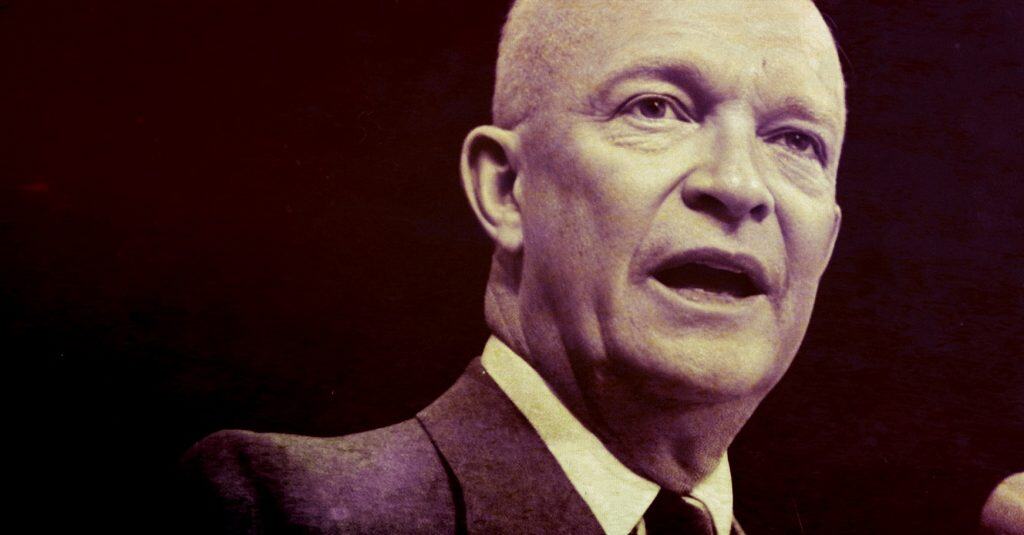
President Eisenhower – Knowledge and an Education were key to America’s leadership in the world.
President Eisenhower – Address to Students and Faculty at Columbia University on the occasion of the college’s Bicentennial anniversary – May 31, 1954.
A reminder that we lived in different times in 1954 and we had a different President – here is an extended excerpt of the address he gave at Columbia:
President Eisenhower: This occasion has for me particular significance because, for a time, I was intimately associated with those whose life-work is the education of America’s youth. I am very proud that, through a brief span in Columbia’s two hundred year history, my name was closely joined with that of this great institution. For such expression of personal pride in an association with a home of learning, I have illustrious predecessors.
Thomas Jefferson, for one, at the end of his long life, preferred that posterity should think of him, not as the holder of high office, but for his relationship to the University of Virginia.
He held that the free flow of information was indispensable to the maintenance of liberty. He wrote that if he had to make a choice between a society without newspapers or newspapers without a government, he would prefer the latter. And, of the diffusion of knowledge among the people through schools, he said: “No other sure foundation can be devised for the preservation of freedom and of happiness.”
A relentless foe of tyranny in every guise, Jefferson throughout his life was steadfast to a fundamental tenet of Western Society, proclaimed two thousand years ago in the treasury of the Temple at Jerusalem, that the truth will make men free.
The pursuit of truth, its preservation and wide dissemination; the achievement of freedom, its defense and propagation; these purposes are woven into the American concept of education. The American university–neither the property of a favored class, nor an ivory tower where visionaries are sheltered from the test of practice–every American university fundamentally is dedicated to Columbia’s Bicentennial theme-“Man’s right to knowledge and the free use thereof.”
Those who chose the theme of this Bicentennial could not have found a more American one. I say this with apology to scholars of all countries, lest they think that I might be deliberately narrowing a universal principle to a provincial application. But from the very beginning of the Republic, education of the people, freedom for the people–these interdependent purposes have been the core of the American Dream.
Far from being fearful of ideas, the founders of the Republic feared only misguided efforts to suppress ideas.
No less profound was their faith in man’s ability to use freedom, for the achievement of his own and his country’s good. In the freedom of the individual, they saw an energy that could hurdle mountains, harness rivers, clear the wilderness, transform a continent.
So convinced, they proclaimed to all the world the revolutionary doctrine of the Divine Rights of the Common Man. That doctrine has ever since been the heart of the American faith. Emphatic rejection of this faith is the cardinal characteristic of the materialistic despotisms of our time.
Here is Eisenhower’s complete address, as it was broadcast nationwide by combined networks.
And while you’re at it: