Since it is a holiday (unless you’re a bank worker – postal worker or government paper-pusher you would never know) and since a steady diet of current events is getting on everyone’s nerves, I thought I would dive into pop culture as purely distraction and stay away from real life, at least for a bit.
Soap operas have been a staple in the diet of many American’s listening habits for almost a hundred years now. Looking at life through an imaginary lens of trials and tribulations plaguing people with seemingly perfect lives – usually wildly rich, wildly glamorous, insanely successful people who just can’t get up in the morning without some life-or-death drama biting at their heels.
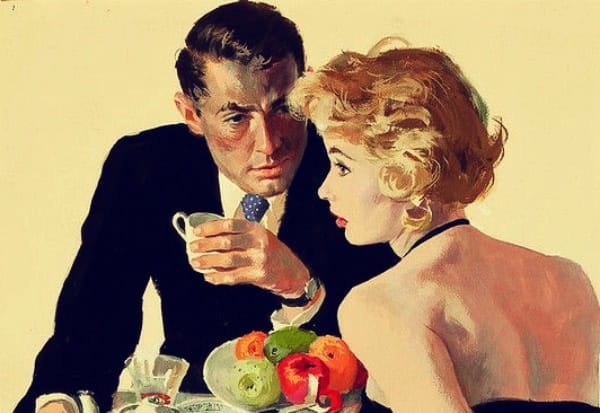
It’s the stuff of Romance Novels, only condensed into 15 minute slices with a cliff-hanger of maddening improbability pressing all the buttons of ghoulish curiosity and teary-eyed angst, just to make sure all those perfect people had lives much worse than your own at the end of each episode.
It was a big distraction for a lot of people who started getting hooked on Radio soap operas in the 1930s because the Depression was the perfect opportunity to forget your own misfortunes. In the 40s it was the war and all the uncertainty that went with it. In the 50s it was the Cold War and The Atomic Bomb with the possibilities we’d be reduced to radioactive dust at almost any moment. We also had social changes bubbling up.
This particular Soap Opera, The Romance Of Helen Trent, turned the Beat Generation into one huge stereotype because the vast majority of Americans had no idea who the Beat Generation were aside from the occasional parody on TV, but in true Soap Opera fashion, they were fodder for tilling the soil of misfortune and ideal candidates for ruining perfectly respectable peoples lives.
Radio Soap operas were losing favor to the televised ones in the 1950s, finally gasping their last in 1960 while TV marched on, spreading misfortune, hysteria, lust, jealousy, envy and dollops of morality to an ever increasing audience.
But because Radio was (and still is) the medium of imagination, it was easier to imagine impossible opulence and improbable good looks better than seeing it laid out for you on TV.
To give you some idea of the social climate of the time and media’s handling of the changes that climate brought with it, here is an episode from September 17, 1959 as it was heard over the CBS Radio Network.
You may laugh, but . . .