
American Forum Of The Air – November 2, 1950 – Gordon Skene Sound Collection.
When Alexander P. de Seversky published Air Power: Key to Survival in 1950, the United States stood at the dawn of the Cold War and at the threshold of the nuclear age. A decorated Russian-born aviator, aircraft designer, and outspoken advocate of strategic bombing, de Seversky argued that future wars would be won primarily through overwhelming air power. He believed that long-range bombers, armed with increasingly destructive weapons, had rendered large standing armies and traditional naval forces increasingly obsolete. His book, particularly after Reader’s Digest published a condensed version, sparked a national debate over America’s military priorities at precisely the moment when events in Korea were beginning to challenge many of his assumptions.
The controversy reached a wide audience during the November 2, 1950 broadcast of American Forum of the Air, where de Seversky debated Rear Admiral John G. Cromelin. Their disagreement reflected two competing schools of military thought. De Seversky insisted that the United States should devote the bulk of its defense resources to maintaining unquestioned air superiority and strategic bombing capability. Cromelin countered that no single branch of the military could guarantee victory and that wars ultimately demanded cooperation between air, land, and sea forces. His argument proved especially persuasive as American troops were engaged in difficult combat on the Korean peninsula.
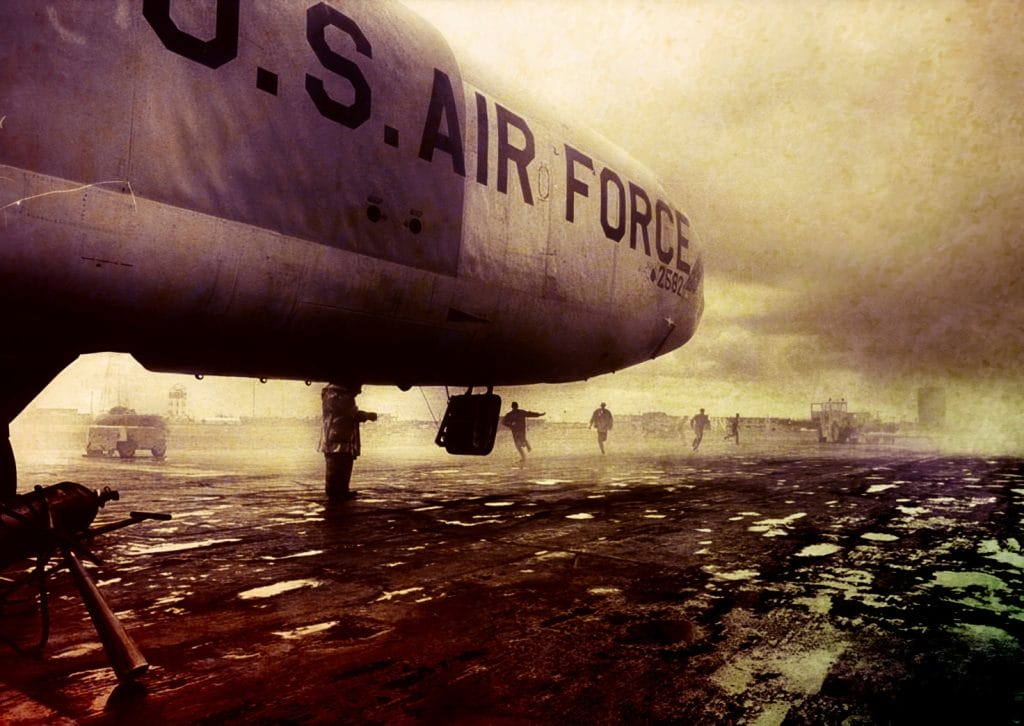
The Korean War quickly exposed the limitations of relying solely on air power. The United States Air Force dominated the skies, destroying bridges, supply depots, transportation networks, and industrial targets. Yet despite this overwhelming aerial superiority, United Nations forces still found themselves locked in a costly ground war. Chinese intervention in late 1950 demonstrated that determined infantry forces could absorb extensive aerial bombardment while continuing to fight. The rugged Korean terrain, dispersed troop movements, and the political limitations placed upon American bombing further underscored that aircraft alone could not seize or hold territory. Victory—or even stalemate—required soldiers, Marines, sailors, and airmen working together.
History since 1950 has largely validated Cromelin’s broader view while simultaneously proving that de Seversky recognized an important long-term trend. Every major American conflict since Korea has demonstrated the extraordinary value of air superiority. During the Gulf War in 1991, coalition air forces devastated Iraqi command centers and armored formations before ground troops crossed into Kuwait. Precision-guided munitions, stealth aircraft, and satellite navigation transformed aerial warfare far beyond anything de Seversky could have imagined. Air power became an indispensable component of modern military operations.
Yet the greatest evolution has come not through manned bombers, but through unmanned aircraft—drones. By 2026, drones have fundamentally altered military strategy in much the same way that de Seversky believed bombers would in 1950. Unmanned aerial vehicles now conduct reconnaissance, surveillance, electronic warfare, precision strikes, logistics support, and increasingly autonomous missions. They allow commanders to gather intelligence continuously while reducing risks to pilots. Small, inexpensive drones can destroy tanks, artillery, or command posts that once required costly aircraft or large formations of troops.
The ongoing conflicts in Ukraine and the Middle East have demonstrated both the promise and limitations of drone warfare. Swarms of inexpensive drones can overwhelm sophisticated defenses, while first-person-view drones have changed battlefield tactics down to the squad level. Artificial intelligence is beginning to assist in identifying targets and coordinating drone operations, making unmanned systems even more effective. At the same time, electronic jamming, cyber warfare, and anti-drone technologies have become equally important, illustrating that every military innovation eventually produces countermeasures.
Nevertheless, the central lesson remains remarkably similar to the one learned in Korea. Drones, like bombers before them, cannot permanently occupy cities, secure populations, deliver humanitarian assistance, or enforce political settlements. Ground forces continue to perform missions that technology alone cannot accomplish. Naval power remains essential for protecting trade routes and projecting force across the globe, while space and cyber operations have become entirely new domains of warfare unimaginable in 1950.
Looking back from 2026, the debate between Alexander de Seversky and Rear Admiral Cromelin appears less like a contest with a single winner than a discussion between two men who each grasped part of the future. De Seversky correctly foresaw that air power would become increasingly dominant through advancing technology. Cromelin correctly argued that successful military strategy would always depend upon integrating every branch of the armed forces. Today’s battlefield—where drones, satellites, cyber warfare, naval forces, aircraft, Marines, soldiers, and special operations units operate as one interconnected system—demonstrates that modern warfare has become a synthesis of both men’s visions rather than a triumph of either one alone.