
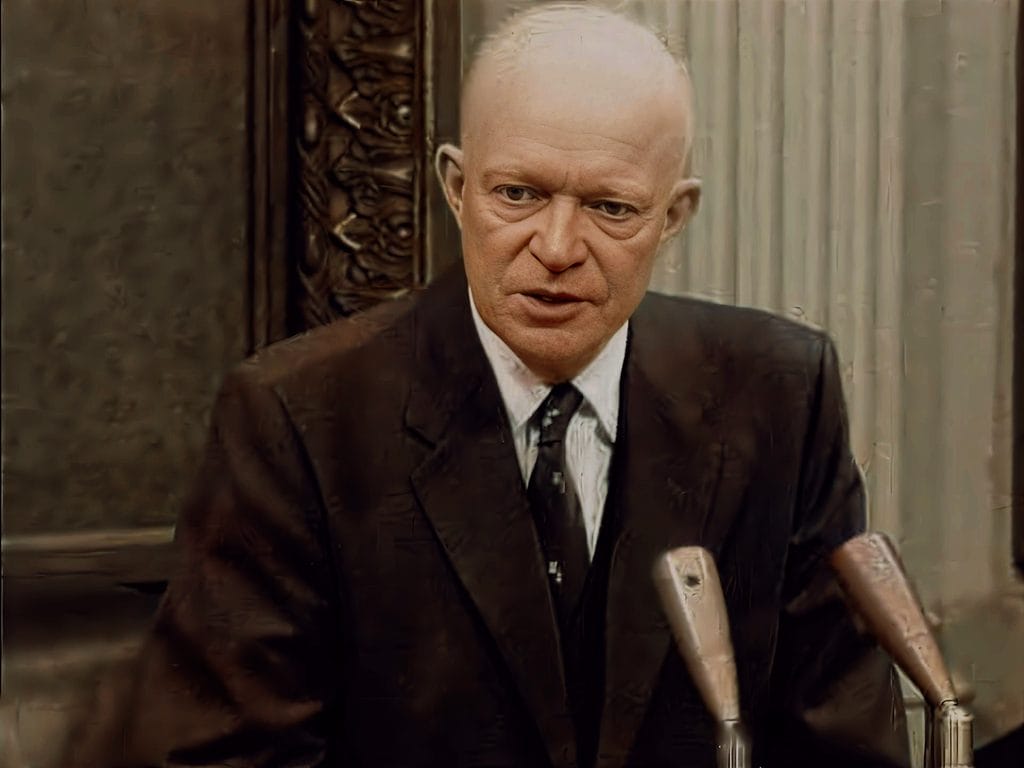
On this day in 1954, President Eisenhower was in Evanston Illinois on the occasion of the 2nd Assembly of the WorldCouncil Of Churches. Here is his address:
President Eisenhower: There are many good reasons why I am so delighted to meet with this assembly of the World Council of Churches on this beautiful campus in this charming city. I think it is very fitting that one of the great universities of our country should be the host of this wonderful body of world representatives.
Now I should like to enumerate a few of the reasons why I believe that I speak for the American people in saying that we are proud that this assembly has chosen to meet here. First of all, the citizens of the United States feel highly honored that you have chosen this country in which to hold your Second Assembly of the World Churches, because you are a world body of spiritual leaders. Here in this land, we sometimes are thought to be too ready to adhere to and to place our trust in material values. Now it is true that in today’s world of risks and alarms, we must and we will remain strong, and seek to make our good friends strong in all those scientific, material, and military means that ensure or enhance our safety, and discourage aggression against us or against our friends. But we know that there is no true and lasting cure for world tensions in guns and bombs. We know that only the spirit and mind of man, dedicated to justice and right, can in the long term enable us to live in the confident tranquility that should be every man’s heritage.
We are likewise delighted that your conference representing 48 nations and 163 church groups, virtually brings the world to the center of the North American continent. However fervent the citizens of this land may be about our own country–and we are–all of us realize that the problems and hopes before us today are world problems and world hopes. More and more we understand the prophetic wisdom of John Wesley’s statement: the world is my parish.
Again, you call yourselves a council. The term suggests that you accept the injunction “Come, let us reason together.” Deliberation such as yours, involving long-term as well as immediate objectives, can lend depth and distance to our own thinking. International political conferences deal habitually with crises, and its results often are little more than a series of improvisations. Indeed, responsible officials have no opportunity to deal with the matter until it becomes a crisis.
Woodrow Wilson complained “By the time anything gets to me it is a problem.” We in Government today feel the same. In many respects, we envy the chance of the members of your great convocation to meet and plan on a positive basis for the world in the years to come. Still another reason for our gratification in your presence among us is that you are a council of churches. You represent a vast body of believers, of men and women, and you know the power of believing. You are custodians of a great faith, and this in an age of uncertainty and bewilderment. Many of you have what the Quakers call a concern. Your energies are pledged. You are committed to a program that involves personal responsibility for the general good. It therefore heartens us to have an assembly of this sort in the United States of America, and on our part we think it fitting that you meet here.
Almost anywhere you turn in this country you will find a confluence of religious forces producing a person or an institution with service to others as an objective. Moreover, we are a nation of many people, out of many lands; practically every national group is represented in all branches of our Government. With our diversity, if you could look at us from afar, we would be theoretically impossible. But we do exist. And in reasonable harmony. Thus we meet the variety of this great assembly with a variety of our own, and with the feeling that we can understand something of your hopes and aspirations.
So, even as you have announced your aims, we as a people have put our ideals on record. We have chosen to state these ideals for all the world to see.
At our national beginnings, now a century and three quarters gone, we announced what we intended to make out of this country. We proclaimed then the principles on which it was rounded, and toward which we continue to strive. We have fallen short, yes. But the ideals we have set forth, that we have blazoned on the record, stand always there to challenge us. Thus we shall view with the greatest of sympathy your own efforts here to set forth a steadily higher ideal toward which man in his growth must always move. We will watch with great interest what you do here, for another reason. We are essentially a religious people. We are not merely religious, we are inclined, more today than ever, to see the value of religion as a practical force in our affairs.
Contrary to what many people think, the percentage of our population belonging to churches steadily increases. In a hundred years, that percentage has multiplied more than three times. Recently, a great bible society announced that it had doubled the distribution of the Scriptures in the United States since 1948. Bible distribution in this country last year rose to almost 10 million volumes, published in 81 languages.
Now, these two facts are not in themselves proof, either of piety or of an approaching millennium. But they are signs–an indication–that our interest in religion is serious and genuine, not merely theoretical. A score of religious faiths, large and small, are represented in the membership of our present Congress, and it will interest you to know that a good many Members of our Congress periodically meet together outside of legislative hours, to consider how religious principles can be applied to the practical affairs of our Government. I think that you ought to feel at home here, and to know that you are among people who feel in harmony with your purposes. Believing as we do in the importance of religion, we shall expect much of this convocation. We hope that you will touch our imagination, and remind us again and again of the vision without which the people perish. Give us criticism in the light of religious ideals. Kindle anew in us a desire to strive for moral greatness, and to show us where we fall short. We shall listen, if you speak to us as the prophets spoke in the days of old.
We look to you for another thing, and that is for a practical demonstration of the Christian ethic. We hope you may show us additional and better ways in which it can be applied to all sorts of problems. This is what you might call the logistics of faith. We as a people have sought, however imperfectly, to carry out in this spirit programs that have been regional and even global in scope.
The war was scarcely over, may I remind you, when American hearts were digging cash out of American pockets to help restore the devastated regions, to relieve suffering. There was finally established the great system of CARE–CARE packages going everywhere in the world to feed the hungry, and to bring a moment of belief and of good feeling to millions who are in despair; the Marshall Plan, and its effort to restore to other nations something of the abilities they had to earn their own livings before the cataclysm of war struck them; the technical assistance that spread around the world from Peru to Pakistan, everywhere that people needed technical help to help themselves. And aside from all these, we have a great record of Red Cross and church and other groups doing their mightiest all the time, to help their brethren who are less fortunate.
Now admittedly, my friends, these programs always reflect our own enlightened self-interest, as well as humanitarian purposes. We know that no nation may live by itself alone. To preserve the individual freedoms we prize so highly, we must not only protect ourselves as a nation, but we must make certain that others with like devotion to liberty may also survive and prosper.”
Here is the complete address, as broadcast over NBC Radio on August 19, 1954.