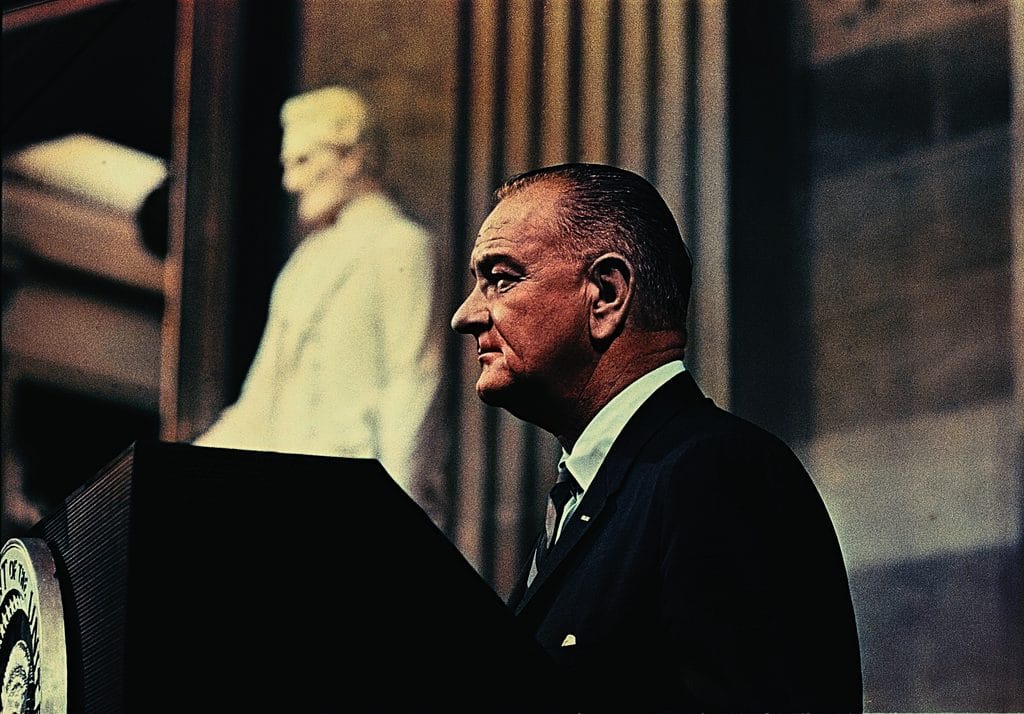
President Johnson – Facing a society becoming more complex each day.
August 20, 1966 – sixty years ago today – President Johnson accepted an honorary Degree at the University of Rhode Island and used the opportunity to address issues that were rising in America on this day:
President Johnson: I want to speak to you this morning about our society–about some of the stress that it is undergoing and about what I believe that we must do if we are to preserve civil peace and if we are to serve social justice.
If there is a single word that describes our form of society in America, it may be the word “voluntary.”
The American experience has been one long effort to open up new and better choices for our people. Generally, though not universally, we have succeeded. Most men are free to pursue any calling they choose, to do with their lives and their properties what they will.
The results are mixed, but the tremendous prosperity that we enjoy, and the personal liberty that we cherish, are at least good evidence that the American system seems to work.
Yet, that prosperity would soon collapse, and liberty would become a hollow word, if our people did not understand in their hearts that personal responsibility is forever bound to personal rights.
Most of us know this, believe it, prefer it, and practice it.
Most of us know that our own safety and our own well-being depend upon a fabric of responsibility woven between man and man. And where it is torn by violence or avarice or carelessness, each of us suffers-not the least him who failed in his responsibility toward the rest of us.
Because most people are fair and do not, as n moral matter, want to do harm or to take unfair advantage, the fabric of private responsibility holds fast.
Yet, our society grows more and more complex and the fabric is sometimes strained. Great forces are released that threaten to destroy it–forces of technology, of population growth, of immense and anonymous institutions. And as the prosperity of the majority becomes more evident, the poverty of the minority becomes more unbearable.
People who have been denied basic human rights for centuries begin to demand a share in the society. And the gap between what they want and what they have is boldly revealed. The proud assertions of our democracy are then challenged.
To many more fortunate people, the call of the poor minority for justice is the occasion for fear. They believe that it cannot be answered without depriving them of what they possess by birth or hard work. They see political rights and economic well-being as a cake whose size is constant. If the poor minority is granted a piece of it, the share of the affluent majority will be diminished.
In a sense, they are right. If one man-one king or dictator–holds all of the political power in a country, granting five people the right to vote and shape their destiny does reduce his power considerably. Granting that right to every man reduces it drastically.
Yet, we long ago decided that our concept of man’s integrity required this sharing of political power. The majority ought to determine the course of the state. We are working now to make that possible in every part of our land–and we are doing it for the first time since slaves set foot on our soil. And we shall succeed. No power on this earth can prevent us.
Far more difficult, because it is far more widespread and complex, is the question of economic rights. We decided long ago that our economic system should not be controlled by government decree. We chose freedom in the marketplace, just compensation for all, and for all a chance to share in the country’s wealth.
And if that share can be obtained through the free markets, so much the better. But where it is denied to some because of the wretched circumstances of their birth, or the poverty of their education, or the foul environment that surrounds them, the sickness that weakens and the despair that crushes them, we believe that the Nation should act.
We believe that just as a man has the right to choose those who shall govern the state, so does he have the right to live in a decent environment, so does he have the right to acquire the skills that useful work requires, and so does he have the right to secure and to hold a job despite the color of his skin, or the region of his birth, or the religion of his father.
There is a moral as well as a practical basis, I think, for this belief. One of the holy men of our years, Pope John XXIII, described it in a great message to mankind.
He wrote, “One may not take as the ultimate criteria in economic life the interests of individuals or organized groups, nor unregulated competition, nor excessive power on the part of the wealthy, nor the vain honor of the nation or its desire for domination, or anything of this sort. Rather, it is necessary that economic undertakings be governed by justice and charity as the principal laws of social life.”
Justice and charity both demand that political and economic rights be granted. But justice and charity demand also that political and economic responsibilities be accepted.
For our society cannot maintain itself or guarantee justice and fairness to any man where only rights are acknowledged.
Here is that complete address from President Johnson, as given by delayed broadcast from NBC Radio on August 20, 1966.
Chip in if you can – chip in what you can: