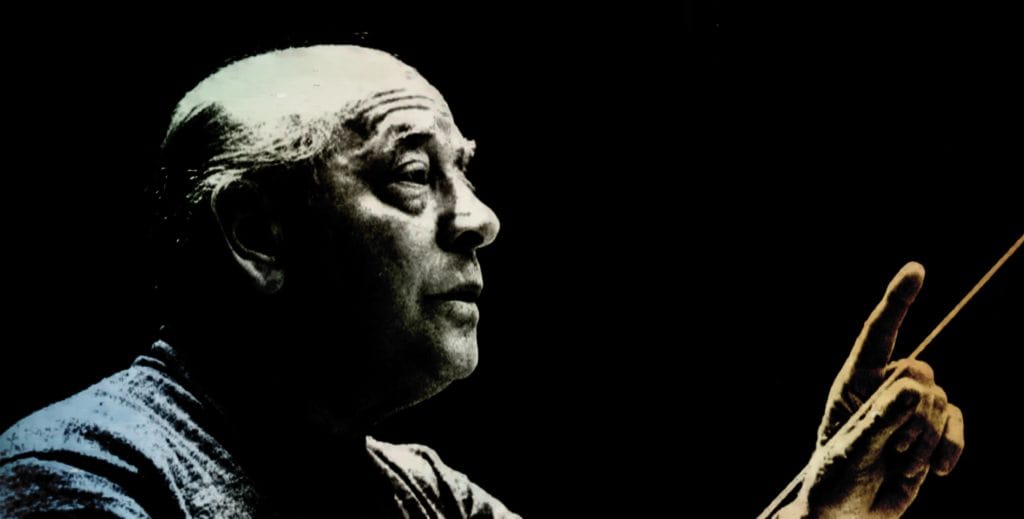
The Philadelphia Orchestra led by Eugene Ormandy this week. Recorded as part of the PBS Great Performances series, on April 4, 1979 and featuring three works: an Ormandy transcription of a work by Handel – Debussy’s La Mer and concluding with Stravinsky’s Firebird Suite.
There was a time that, even if you had no interest in Classical Music and had maybe two Classical Music albums in your record collection, one no doubt featured Eugene Ormandy and The Philadelphia Orchestra. The other most likely featured Leopold Stokowski. Those two conductors were the most recorded of just about any other major figure in Classical music from the 1920s up until the late 1960s and probably did more to further the cause of Classical Music than just about any other artist in America at the time.
Eugene Ormandy was Music Director of the Philadelphia Orchestra for a staggering 44 years. Ironically, it was a position he shared with Stokowski in much of that time. Both had become fixtures in the musical life of America and both were responsible for introducing a lot of new works to the American audience and many of their recordings were world-premiers.
Initially, Eugene Ormandy was music director of the Minneapolis Symphony Orchestra, a post he held from 1931 to 1936. In this post he became nationally known in the US through his recordings, which included the first versions on disc of Kodály’s Háry János suite and Schoenberg’s Verklärte Nacht.[4] In 1936 he went to Philadelphia as joint conductor with Leopold Stokowski. After two years he became the orchestra’s sole music director; he held the post for 42 years (1938–1980), before stepping down to be its conductor laureate. He took the Philadelphia Orchestra on several national and international tours, and appeared as a guest conductor with other orchestras in Europe, Australia, South America and East Asia. Ormandy built on what Grove’s Dictionary of Music and Musicians calls “Stokowski’s voluptuous ‘Philadelphia Sound'” and added further polish and precision. Despite, or even because of, this, among many music critics and others, as Harold C. Schonberg opined in a 1967 study, “there was a singular reluctance in musical circles to admit him into the ranks of great conductors”.[15] He was thought superficial; Toscanini dismissed him as “an ideal conductor of Johann Strauss” and a similar remark is attributed to Igor Stravinsky. Donald Peck, principal flute of the Chicago Symphony Orchestra, reports that a fellow flutist was won over when Ormandy conducted the Chicago in Beethoven‘s Ninth Symphony; he told Peck that it was the greatest Ninth he had ever heard. The conductor Kenneth Woods ranked Ormandy 14th of the “Real Top 20 of Conducting,” saying,
“Critics hate Ormandy. It must be the first “fact” they teach at critic school – always work in an Ormandy slam into every article you write. Record collectors hate him, too. I just don’t get it. The film of him looks pretty impressive – classical and classy conducting technique, not at all showy. His Philadelphia Orchestra was the only real rival to Karajan‘s Berlin for sonic beauty in the 50s–70s, but was also a tighter and more versatile band.”
Schonberg called Ormandy “an excellent technician with a technicolored approach”. Grove comments that Ormandy may have contributed to this image by concentrating on the late-Romantic and early 20th-century repertory that showed to advantage the lush sound he could command in works by composers such as Debussy, Ravel, Richard Strauss, Tchaikovsky, and Sergei Rachmaninoff. Schonberg commented that Ormandy programmed very little Haydn or Mozart and approached Beethoven “in a rather gingerly manner”. He conducted much less new music than his predecessor, Stokowski, had done, but did not ignore it, and gave the premieres of works including Rachmaninoff‘s Symphonic Dances, which is dedicated to him and the orchestra, Bartók’s Piano Concerto No.3, Britten’s Diversions for Piano Left Hand and Orchestra and music by Ginastera, Hindemith, Martinů, Milhaud, Villa-Lobos and Webern. He did not neglect American composers, and among premieres he gave were works by Samuel Barber, David Diamond, Walter Piston, Ned Rorem, William Schuman, Roger Sessions and Virgil Thomson.
Enjoy the concert.