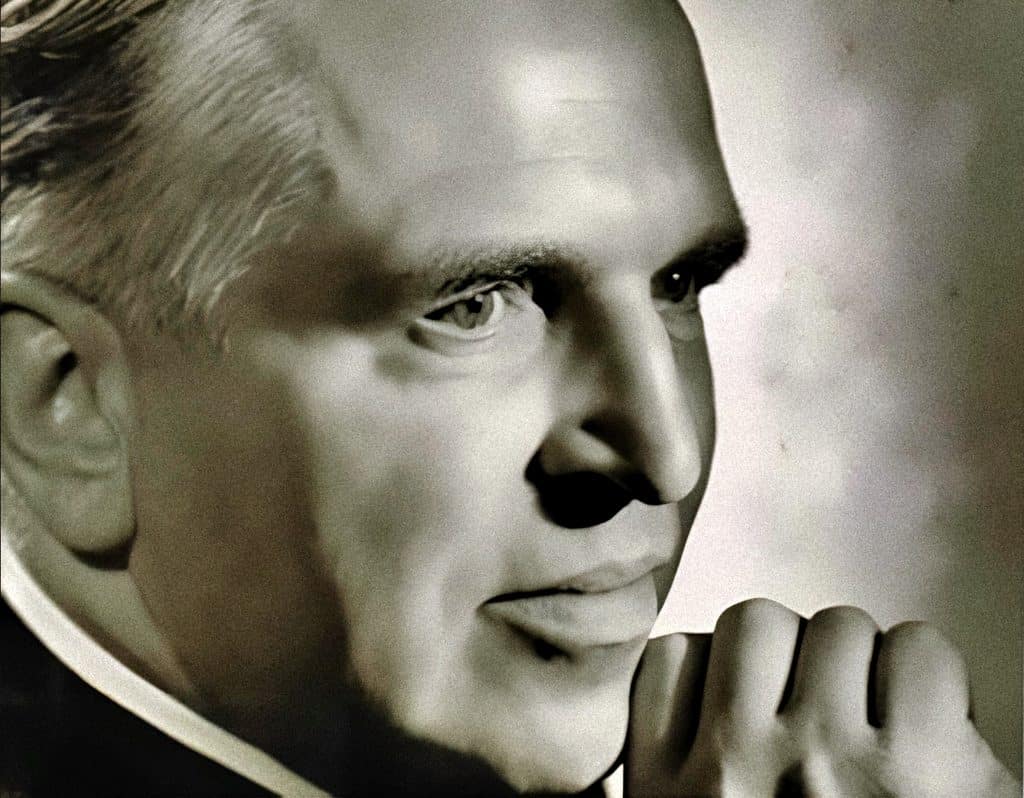
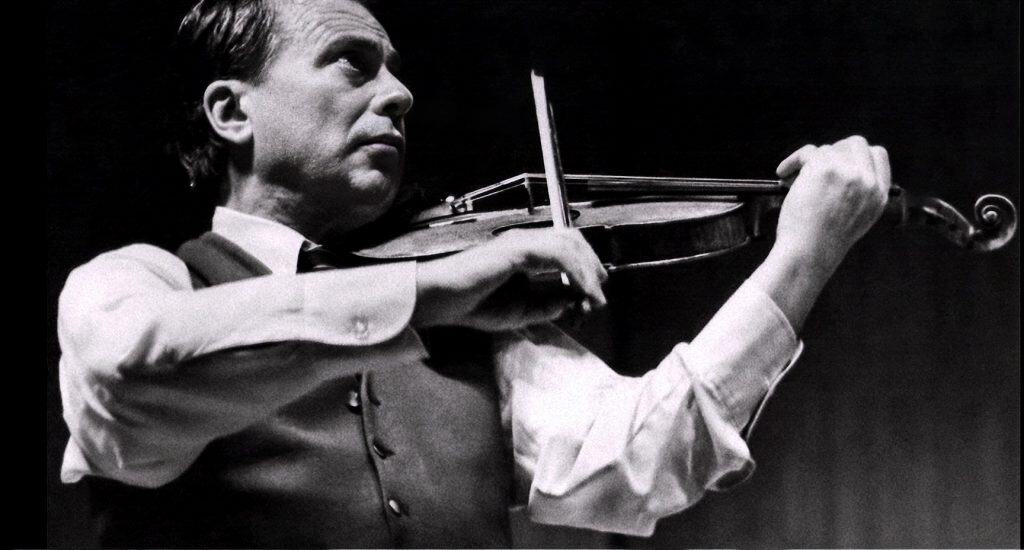
More history this weekend by way of Radio Cologne in this 1956 performance of the Kreutzer sonata for Violin and Piano featuring Hans Richter-Haaser, piano and Henryk Szeryng, violin – it was recorded on June 25, 1956 in the studios of Kölner Rundfunk.
Hans Richter-Haaser was born in Dresden in 1912, and studied at the Dresden Conservatory. He made his debut in 1928, aged 16. During World War II, while fighting for the Nazis with an anti-aircraft unit, he had no opportunity to play for years on end, and his technique slipped. However, he regained it after the war. He conducted the Detmold Orchestra from 1945 to 1947. He was Professor of Piano at the North-West German Music Academy from 1947 to 1962. He then made a number of international tours, including to the United Kingdom, North and South America, and Australia. His American debut in 1959 was hailed as “one of the biggest keyboard talents to hit Manhattan in years”. He appeared at the Salzburg Festival in 1963.
He played under over 200 conductors, including John Barbirolli, Ferenc Fricsay, Eugen Jochum, Rudolf Kempe, Wolfgang Sawallisch, Joseph Keilberth, Herbert von Karajan, Carlo Maria Giulini, István Kertész, Karl Böhm, Kurt Sanderling and Erich Leinsdorf.
Henryk Szeryng made his solo debut on 6 January 1933 playing the Brahms Violin Concerto with the Warsaw Philharmonic Orchestra under Romanian conductor George Georgescu. From 1933 to 1939 he studied composition in Paris with Nadia Boulanger.
When World War II broke out, Władysław Sikorski, the premier of the Polish government in exile, asked Szeryng, who was fluent in seven languages, to serve as his liaison officer and interpreter. Szeryng took these positions and discontinued his studies, although he continued to perform on the violin, giving over 300 concerts for Allied troops all over the world. When he accompanied Sikorski on a mission to Mexico in 1941 seeking a home for 4,000 Polish refugees, the positive reception moved Szeryng so deeply that he decided to become a Mexican naturalized citizen, and did so in 1946. In 1945 he accepted the request (made in 1943) that he head the string department of National University of Mexico.
In 1954, the pianist Arthur Rubinstein, also a Jewish refugee from Poland, gave a concert in Mexico City; Szeryng visited him backstage afterwards, and accepted Rubinstein’s invitation to come to his hotel to play music. Szeryng’s playing of solo violin music of Johann Sebastian Bach that night, said Rubinstein, “reduced me to tears….Real music lovers want emotion—great moments—which Szeryng’s playing gives them.” Rubinstein encouraged Szeryng to begin concertizing again, and introduced him to impresario Sol Hurok to help achieve this end. Rubinstein and Szeryng made music together regularly for the rest of their careers, and recorded much of the classic chamber music literature either as a duo or in a trio with cellist Pierre Fournier. Szeryng went on to win such major awards as six Grand prix du Disque awards, the Médaille d’Argent of the city of Paris, two Edison Awards, and was also made an Officer of the Ordre des Arts et Lettres in Paris in 1963, among many other honors received. In 1964 he began a collaborative partnership with the pianist Charles Reiner. Together they made 35 records and performed in more than 900 concerts internationally.
In this performance however, Henryk Szeryng is accompanied by Hans Richter-Haaser – but the concert is enjoyable just the same.
And so ends this tumultuous week – sit back and enjoy.