
If the first two installments of the CBC Radio series It’s a Nice Place to Visit But I Wouldn’t Want to Live There examined the problems of the modern city, Parts 3 and 4 begin to look for an answer somewhere else.
The answer was suburbia.
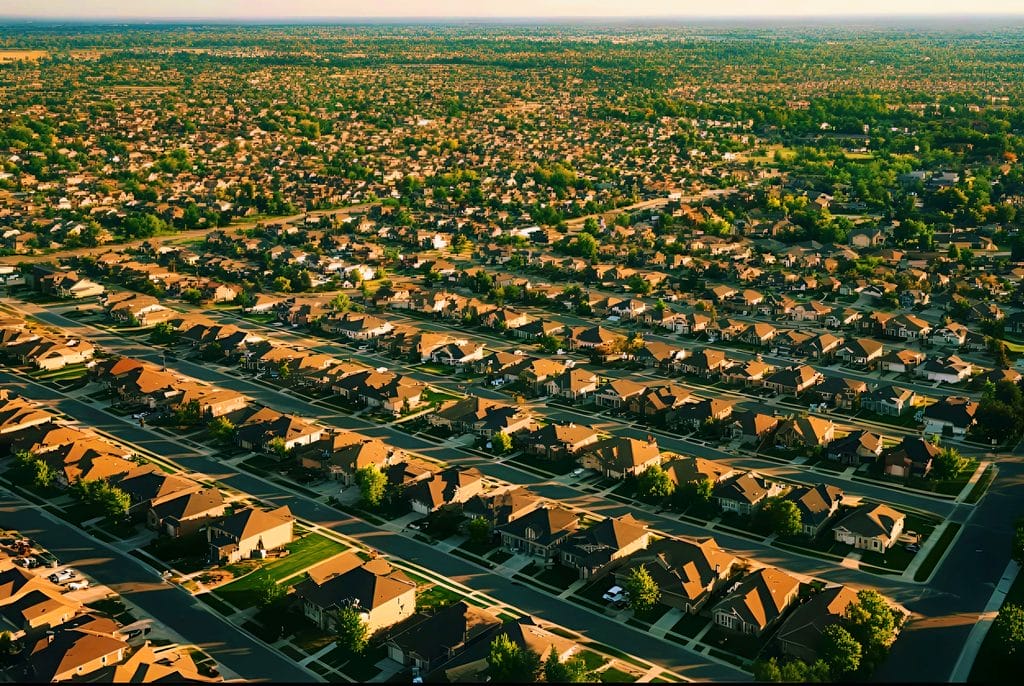
By the late 1960s and early 1970s, the great postwar migration out of the American and Canadian city was well underway. New subdivisions were appearing on what had only recently been farmland, woods or open countryside. Houses were being built by the hundreds and thousands, often nearly identical, on streets with names that suggested an older, more pastoral world: Oak Lane, Meadowbrook, Country Club, Green Acres.
For millions of families, it was the fulfillment of a dream.
There was a house. There was a yard. There was a garage. There was room for the children to play. There were fewer of the problems associated with the big city—less noise, less pollution, less congestion, and, many believed, less crime. Suburbia represented privacy, stability and the possibility of raising a family away from the pressures of urban life.
And yet, even at the time, the dream came with a warning label.
Parts 3 and 4 of the CBC series capture the divided opinion surrounding this great suburban migration. The very qualities that made suburbia attractive could also make it isolating. A family might have a larger house and more space, but suddenly almost everything required a car.
The supermarket was a drive away.
The shopping center was a drive away.
The doctor was a drive away.
And for the breadwinner commuting to the city, the office could be forty, fifty or even seventy-five miles away.
The automobile was therefore not simply a convenience. It was the essential piece of suburban infrastructure.
The city had been criticized for congestion, pollution and overcrowding. The suburban solution was to spread everything out—and then require the automobile to connect it all.
It was an extraordinary bargain, and one whose consequences were only gradually becoming apparent.
A suburban family could exchange a crowded urban apartment for a detached house and a lawn, but it also exchanged proximity for distance. A city resident might walk to a store, take a bus to work or encounter friends simply by stepping outside. The suburban resident increasingly had to plan a trip, get into the car and drive.
That difference went beyond transportation. It changed the nature of social life itself.
The city could be anonymous and impersonal, but it was also full of accidental encounters. Suburbia promised community while physically separating people from one another. Neighbors might live only a few yards apart yet have relatively little reason to interact.
For adults, particularly those who spent their days commuting or working in the city, the suburban lifestyle could become a strange combination of comfort and isolation.
For children, however, the calculation looked very different.
This was where suburbia made perhaps its most persuasive argument.
A child growing up in a suburban development had something that many city children did not: space. There were yards, sidewalks, vacant lots, playgrounds and other children nearby. The traffic might be less frightening than on an urban street. The family could have a garden. There was room for bicycles, baseball games and the endless, largely unsupervised exploration that characterized childhood in that era.
Suburbia was sold as a place where children could simply be children.
And for many families, that was enough.
The irony is that the suburban landscape was simultaneously being criticized for destroying the very environment it was intended to provide. Open land disappeared beneath houses, shopping centers and roads. The farther people moved from the city, the more infrastructure had to be constructed to support them. Roads had to reach the subdivisions. Utilities had to be extended. Schools had to be built. Cars had to carry people between all of these increasingly separated destinations.
The city was spreading into the countryside in order to escape the city.
That contradiction has become much easier to see from 2026.
The postwar suburb was built around a particular economic and social arrangement: relatively inexpensive land, inexpensive energy, expanding automobile ownership, rising household incomes and a family structure in which at least one adult could devote substantial time to commuting.
Much of that formula has changed.
Gasoline is no longer simply an afterthought in the suburban household budget. Long commutes have become an enormous investment of time as well as money. Environmental concerns have made automobile dependency more difficult to defend. And the suburban ideal itself has become considerably more expensive in many metropolitan areas.
Yet the fundamental appeal has survived.
People still want more space. They still want a yard. They still want good schools and safe streets. Families still make decisions about where to live partly on the basis of what kind of childhood they believe a neighborhood can provide.
What has changed is the meaning of distance.
In the 1970s, commuting forty or seventy-five miles to work was a daily physical reality for many suburban residents. In 2026, remote and hybrid work have made it possible for some workers to live farther from the traditional office without making that journey every day. The COVID-19 pandemic accelerated a transformation that had been developing for years: the office no longer necessarily determines where a person must spend Monday through Friday.
But remote work has not eliminated suburban dependence on automobiles, nor has it erased the geographic divisions created during the great postwar expansion. Many suburban communities remain difficult to navigate without a car. Public transportation often becomes less practical as development becomes less dense.
And there is another irony.
The suburbs that once represented an affordable escape from the city can themselves become extraordinarily expensive. In many metropolitan regions, the detached house on a generous lot that symbolized middle-class security in the 1950s and 1960s is now beyond the reach of many younger families.
The great suburban bargain has changed.
The question is no longer simply whether someone would rather live in the city or the suburbs. Increasingly, it is whether they can afford either one.
There is also a generational shift taking place. The children for whom suburbia was created have grown up. Many of them now live in cities. Others have remained in the suburbs but have discovered that the landscape designed around the nuclear family does not always work as well for single adults, older people or households without children.
The suburb is therefore having to reinvent itself.
Some communities are adding apartments, townhouses, accessory dwelling units, mixed-use developments, sidewalks and transit. What had once been a landscape of detached houses and shopping centers is slowly becoming more varied.
In that sense, the debate captured by the CBC programs was never really about whether suburbia was good or bad.
It was about what people were willing to trade for a particular definition of the good life.
The suburban family of 1970 traded proximity for space.
It traded public transportation for the automobile.
It traded urban anonymity for the possibility of neighborhood community.
It traded the excitement and unpredictability of the city for privacy and control.
And, for many parents, it traded the perceived risks of urban childhood for what seemed like the safer, healthier environment of the suburban street.
None of those choices was necessarily irrational. They were responses to the circumstances of the time.
But choices have consequences.
The suburban explosion helped produce enormous metropolitan regions in which home, work, school and shopping could be separated by miles. It contributed to traffic, infrastructure costs and automobile dependence. It consumed enormous amounts of land. And it helped establish a pattern of development that would be extraordinarily difficult to reverse.
Yet it would be equally simplistic to dismiss the suburban dream as a mistake.
Millions of people genuinely found happiness there.
They raised children there. They made friends there. They planted gardens, watched their children ride bicycles, held backyard barbecues and experienced a degree of privacy and personal space that the city could not easily provide.
That is precisely why the debate remains so fascinating.
The city and suburbia were never simply opposing landscapes. They were competing ideas about what life ought to be.
The city said: live close to everything.
The suburb said: have room to live.
More than half a century later, we are still negotiating between those two propositions.
And perhaps the most revealing thing about listening to the CBC programs today is realizing that the people being interviewed already understood the dilemma. They knew the price of the suburban dream. They knew that the house and the lawn came attached to a gasoline bill and a commute. They knew that privacy could become isolation. They knew that getting away from the city did not necessarily mean getting away from its problems.
They simply believed, as millions of people still do, that the trade might be worth it.
The question facing the city in the 1970s was, How do we save the urban environment?
The suburban answer was, Perhaps we should leave it.
More than fifty years later, we are discovering that you can leave the city behind—but you cannot entirely leave the city’s problems behind.
You simply take some of them with you.
And sometimes, you build them into the landscape along the way.
Here are Parts 3 and 4 of the 13 part documentary It’s A Nice Place To Visit But I Wouldn’t Want To Live There from CBC International