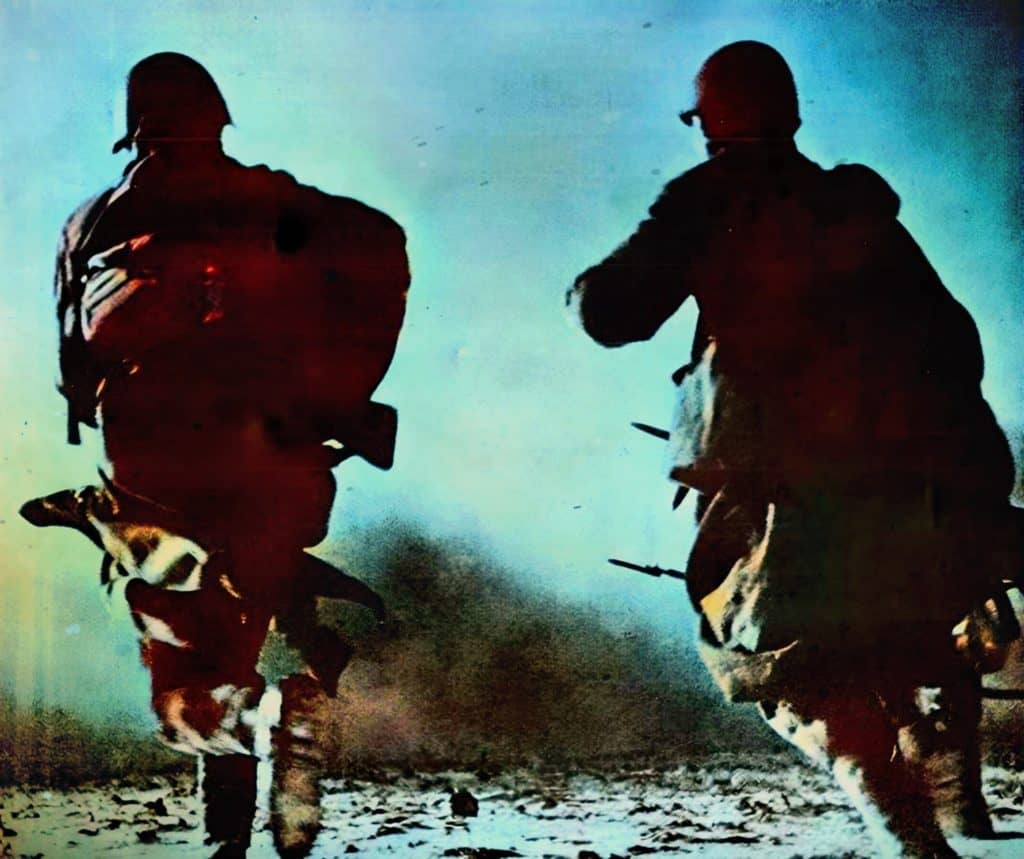
The Red Army drives West.
A day events moved quickly on this 25th of January in 1945.
Starting with Red Army troops battled to force the Oder River barrier in Silesia today and Marsnal Stalin in his third order of the day announced the capture of Oppeln, capital of Upper Silesia. Other troops flanking Breslau captured Trachenberg, 156 miles southeast of Berlin and 23 north and west of Breslau. Earlier in a second order of the day Stalin announced capture of the Polish hinge stronghold of Kalisz to the northeast after a four day tank battle, and in his first order of the day disclosed that a sixth Soviet Army group has entered the winter offensive, scoring a 25-mile wide breakthrough in Czechoslovakia. East Prussia in the north was being carved by two Red Army groups. In Silesia, Soviets battled in the streets of Gleiwitz, and gained ground near the Oder River towns of Brieg and Cosel, both below Breslau.
Kalisz, 61 miles northeast of Breslau and about the same distance southeast of Poznan, fell to Marshal Gregory Zhukov’s 1st White Russian Army. Other Zhukov forces struck through stubborn Nazi tank and infantry opposition toward Poznan, 137 miles from Berlin. Kalisz (pop. 68,000) guards approaches to both Breslau and Poznan. Stalin ordered a victory salute of 20 salvos from 324 guns to mark its fall.
It lies 56 miles west of Lodz. Gains in the Oder River battle were announced in a late Moscow dispatch.
And the fortieth (California) division with Clark field’s dozen airstrips and adjacent Fort Stotsenburg firmly its hands, rushed on to south today within 40 miles or less of Manila and 20 miles of Manila bay. (A Tokyo broadcast recorded by the FCC said today that the American command appeared to be planning “new developments in the Luzon situation with the massing of fresh troops.” The broadcast called attention to increased numbers of ships in the waters south of Luzon and an intensification of air attacks on the Manila area, including Corregidor island in Manila bay.) The division was expected to make rapid progress without a major battle at least as far as Calumpit on the Pampanga river, 24 miles southeast of Clark field and 26 miles northwest of Manila. The San Fernando river, half way between Clark field and Calumpit, offers a possible enemy defense line, but there were no indications of any large Japanese forces there and the fixed defenses were not too strong.
Destruction of bridges across the San Fernando may slow the advance, however. It appeared more likely that the Japanese would make their stand, if at all, at Calumpit, within easy striking distance of Manila. American planes destroyed a Japanese concentration of troops and vehicles at Calumpit soon after the invasion of Luzon Jan. 9
And finally – Secretary of War Henry L. Stimson announced that Gen. Joseph W. Stilwell, 61, former commander of American forces in the China-Burma-India theatre. had been named commander of U.S. Army Ground Forces, succeeding Lt. Gen. Ben Lear, who goes to the European theatre as deputy commander of U. S. forces. Stilwell, known as “Vinegar Joe” to his commanders and troops, was forced to relinquish his Asiatic command because of differences over disposition of war materials with Generalissimo Chiang Kaishek. He had been chief of staff to the Chinese President and Army leader.
And that’s just a small sample of what was going on, this January 25, 1945 as reported by NBC’s News Of The World.