
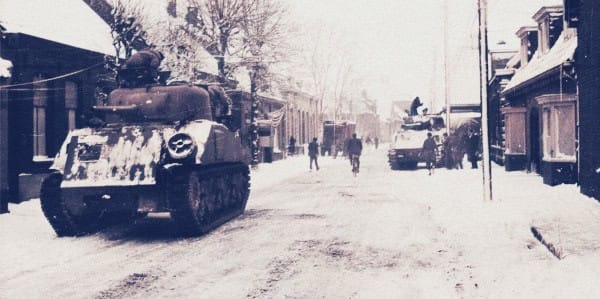
A very busy day on the European side of the war, this January 3, 1945. The German counter-attacks which flared up in many places along a 70-mile front in the Saar valley between Volklinger and Berg on the Rhine seem to have been contained, but the enemy are still exerting pressure in most places. In the area south of Bitche Rundstedt’s forces are still clinging to their two-mile gain across a five-mile front. In the area of the enemy counter-attack near Volklingen the Americans have pushed the Germans back 1,500 yards to Schauffhausen, two miles west of Volklingen, after clearing Werheln and generally restoring the situation. North-east of Sarreguemines an attempt to cross the Blies River between Habrichen and Bliesbrucken succeeded in one place. Elsewhere south of the River Blies American troops cleared the enemy from Bois de Bliesbrucken.
The German penetration, two miles at the most, remains under control. Fairly heavy movements of German troops and armor eastward along the southern flank of the Ardennes salient have added confusion to the uncertain picture in this sector as General Patton pushed forward another mile. Those movements in the face of General Patton’s push northward between Bastogne and St. Hubert, which have gained nine miles in some places since the beginning of his attacks seem to indicate German anxiety over future Allied progress and operations in the salient, and preparations to meet them. It could also indicate the withdrawal of armor after the substitution of infantry for refitting or action elsewhere.
North-east of Bastogne we have reached a point on the railway three miles beyond the town. Mageret is in our hands and we are in the immediate vicinity of Michamps. Heavy fighting is going on in the areas of Neffe and Wardin. We have made some gains east and south of Lutrebois, and are encountering heavy shelling in Honville.
The German radio said the allies had launched an “all out” offensive In the bulge from Stavelot to Marche. Whatever the outcome of the bulge battle in the heavily forested hills of the Ardennes where the allied winter campaign was slapped to a standstill it became Increasingly apparent that von Rundstedt intended to stay on the offensive. His lashing attacks all the way from the Saar to the Rhine moved up to four miles through American lines and forced the third and seventh armies to give up two of their three footholds on German soil there. His stabs below the Saarland and Palatinate threatened at any moment to burst into a new Nazi power drive. Only the bridgehead at Saarlautern remained in American hands. Von Rundstedt’s casualties in the bulge were estimated unofficially at 60,000 of which 20,000 were prisoners These are the manpower equivalent of five German divisions. Eleven divisions were said to have been mauled badly. But the German marshall still was estimated to have 20 divisions in the salient elements of three armies. About half his strength was armored. Headquarters withheld specific Information of the new first army offensive south of Grandmenil for security reasons except to report initial gains German positions were heavily mined and dug in all around the bulge.
And that’s just a sample of what went on this January 3, 1945 as reported by NBC’s News Of The World.



