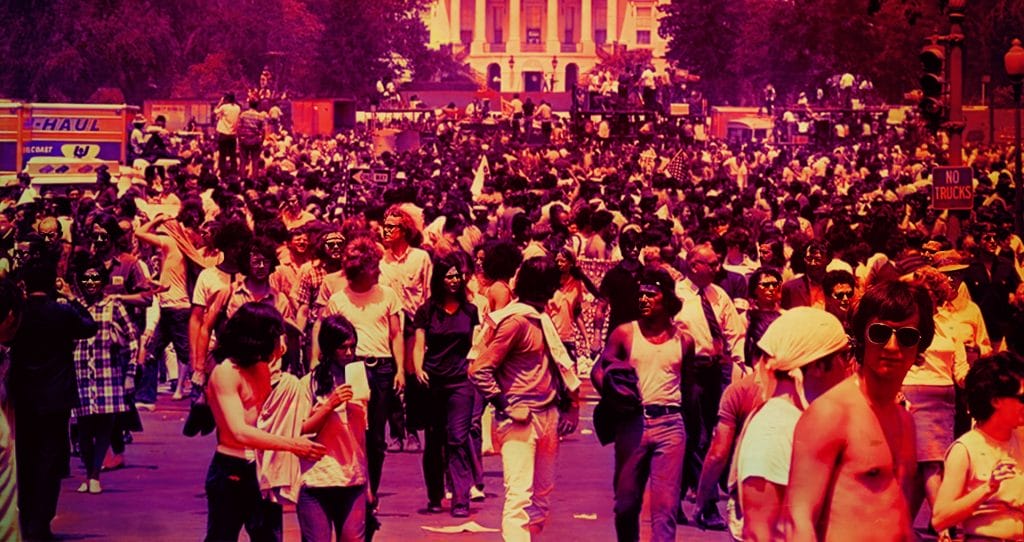
With the horror of Kent State only five days earlier still fresh in everyone’s mind, the protests continued and grew.
President Nixon defended his Southeast Asia policy as the road to the quick peace his critics demand, while indicating a willingness to listen to the demonstrators gathered by the thousands near the White House to day to protest U.S. involvement in Indochina.
The President pledged in a nationally broadcast news conference Friday night his first since Jan. 30-to spend all of today in the White House ringed by antiwar demonstrators and security forces. He raised the possibility of a face to-face meeting with some o the mostly student dissidents.
Violence marred some demonstrations as protests of President Nixon’s Southeast Asia policy continued at colleges across the nation and at Washington, D.C., where thousands rallied for a march today on the White House.
At the University of New Mexico in Albuquerque, 11 persons were hospitalized with stab wounds after National Guardsmen with fixed bayonets advanced on 200 student peace protesters. The confrontation followed the arrest by police of 140 sit-in demonstrators who had offered no resistance. Violent confrontations also occurred in Carbondale, Ill., between police and students from Southern Illinois University; and in Buffalo, N.Y., where 12 youths were wounded by birdshot during a demonstration. Student Subdued A student from the University of Iowa at Iowa City was subdued by a chemical agent when he tried to wrench shotguns from police officers during policestudent scuffles.
Two battalions of the National Guard were placed on standby alert. Two students were arrested. In New York City, about 70 persons were injured when a roving band of 1,000 construction workers, some wielding clubs and crowbars, attacked peace demonstrators in the vicinity of City Hall. Cambridge, Mass., police chased some 500 rampaging protestors through Harvard Square after a peaceful antiwar rally by 30,000 persons. The rampaging youths broke windows and blocked traffic.
Mr. Nixon chose conciliatory words to discuss the protest, expected to bring 100,000 or more to Washington. The vanguard of dissenters paraded along Pennsylvania Avenue, outside the White House itself, many carrying lighted candles, during his broadcast news conference. “They’re trying to say that they want peace, they’re trying to say that they want to stop the killing, they’re trying to say that we ought to get out of Vietnam,” Mr. Nixon said of the young dissenters. “Everything I stand for is what they want . . . ” he said. The President spoke slowly and solemnly, reminding the nation it was not he who first sent Americans to Vietnam. But he in no way altered the policy decision he already has announced. “Only history will record whether it was worthwile,” he said of the U.S. commitment to South Vietnam. “But I do know this. Now that America is there if we do what many of our very sincere critics think we should do, if we withdraw from Vietnam and allow the enemy to come into Vietnam and massacre the civilians there by the millions, as they would, if we do that, then let me say that America is finished as far as the peacekeeper in the Asian world is concerned.”.
So the news for this May 9, 1970 was almost entirely taken up with news of the sweeping protests as reported by The Huntley-Brinkley Report for NBC.