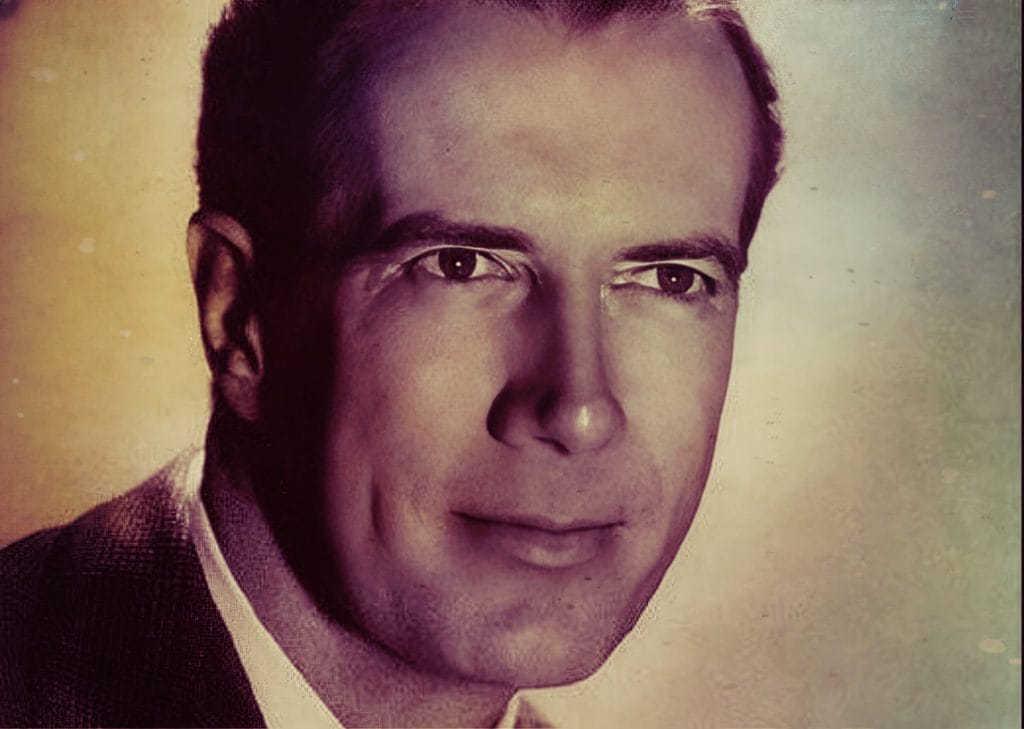
Jerome Hines – epitomized American Opera in the last half of the20th century.
Seventy-one years ago yesterday, on August 15, 1955, NBC Radio via their then-new weekend service Monitor dedicated part of their evening programming to a blast of culture. The Bell Telephone Hour. Initially running from April l29, 1940 – to June 30, 1958, before switching over to television, provided the American listener a chance to become acquainted with Classical Music. Something that was a hard sell in the 1950s, though not nearly as hard a sell as it is today.
Sponsored by Bell Telephone, it showcased the best in classical and Broadway music, reaching eight to nine million listeners each week. Broadcast from the stage of the fabled Carnegie Hall, a place the majority of Americans outside of New York City had heard about, but never been to.
After early shows featuring James Melton and Francia White as soloists, producer Wallace Magill restructured the format on April 27, 1942, into the “Great Artists Series” of concert and opera performers, beginning with Jascha Heifetz. The list of talents heard over the years includes Marian Anderson, Bing Crosby, Margaret Daum, Nelson Eddy, Benny Goodman, Josef Hofmann, José Iturbi, Fritz Kreisler, Gregor Piatigorsky, Oscar Levant, Ezio Pinza, Lily Pons, Gladys Swarthout, and Helen Traubel.
In September, 1959, the Bell Telephone Hour made its television debut as a monthly musical special. It remained a regular television program until April 26, 1968. Broadcasts chiefly originated from New York City at Carnegie Hall.
This broadcast is dedicated to Jerome Hines, who performed at the Metropolitan Opera from 1946 to 1987. Standing 6’6½”, his stage presence and stentorian voice made him ideal for such roles as Sarastro in The Magic Flute, Mephistopheles in Faust, Ramfis in Aida, the Grand Inquisitor in Don Carlos, the title role of Boris Godunov and King Mark in Tristan und Isolde.
Hines made his operatic debut at the San Francisco Opera in 1941 as Monterone in Rigoletto. He changed his surname to Hines at the suggestion of his manager Sol Hurok to avoid the anti-German feelings prevalent during World War II.
In 1946, Hines made his debut at the Metropolitan Opera as the Sergeant in Boris Godunov. He went on to sing for a record 41 seasons there, including becoming the first US-born singer to tackle the title role of Boris Godunov in 1954. In 1953, he made his European debut with Glyndebourne Festival as Nick Shadow at the Edinburgh Festival in the first British performances of Stravinsky‘s The Rake’s Progress. In 1958, he made his debut at La Scala in the title role of George Frideric Handel‘s Hercules. From 1958 to 1963, he sang at Bayreuth in the roles of Gurnemanz, King Mark and Wotan.
In 1961, he first appeared at the San Carlo in the title role of Arrigo Boito‘s Mefistofele. In 1962, he sang Boris Godunov at the Bolshoi in Moscow, famously for Soviet leader Nikita Khrushchev on the eve of the resolution of the Cuban Missile Crisis. He turned to coaching later in his career, founding the Opera-Music Theatre Institute of New Jersey in 1987, but he continued performing virtually until the end of his life; among his last appearances was a concert performance as the Grand Inquisitor with the Boston Bel Canto Opera in 2001 at the age of 79.
Here is The Bell Telephone Hour, as it was heard over NBC Radio’s Monitor series on August 15, 1955.
Do what you can. We’ve hit a speed bump.