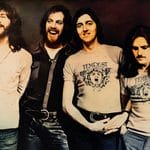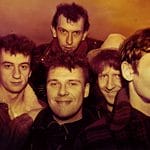
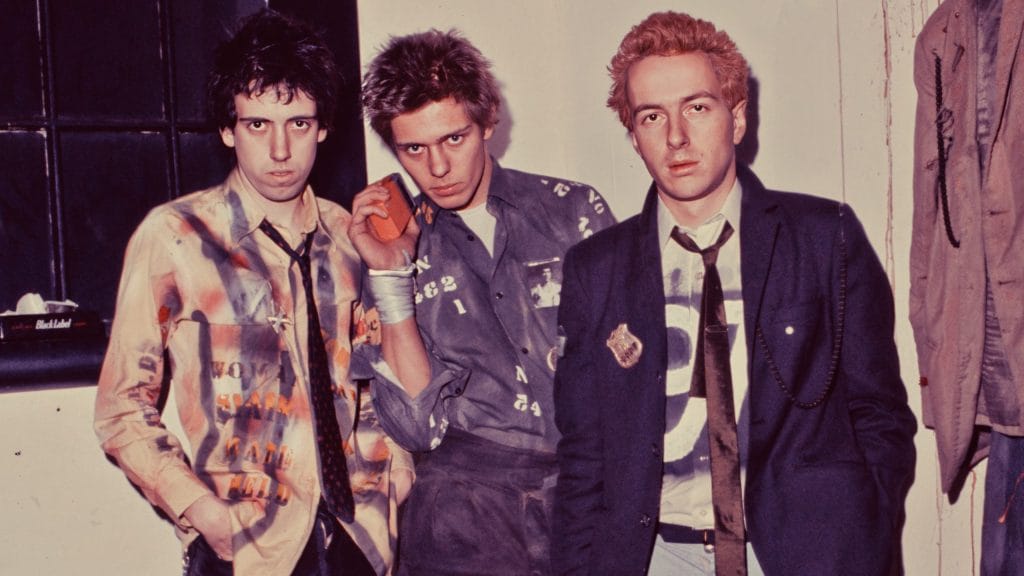
The Clash – according to many reliable sources, the only band you needed to know about.
Kicking off the week with a short set from The Clash – recorded on May 28, 1977 at De Montfort Hall in Leicester, UK and presumably broadcast by Capital Radio.
This set comes literally a month after the release of The Clash, their debut album and recorded only in February of that year. No messing around.
Ironically, it wouldn’t come out in the U.S. until 1979. But even then, the reactions and reviews were enthusiastic, if not overboard.
Here’s a sampling of what has been said about The Clash’s debut:
The Clash received critical acclaim and peaked at number 12 in the UK charts.
When the album was released in April 1977, Tony Parsons wrote in the New Musical Express: “Jones and Strummer write with graphic perception about contemporary Great British urban reality as though it’s suffocating them … Their songs don’t lie … The Clash have made an album that consists of some of the most exciting rock’n’roll in contemporary music.” Mark Perry declared in Sniffin’ Glue: “The Clash album is like a mirror. It reflects all the shit. It shows us the truth. To me, it is the most important album ever released.” The review by Kris Needs in April 1977’s Zigzag announced: “This is the most exciting album I’ve heard in years … it’s one of the most important records ever made.”
In his 1979 consumer guide for The Village Voice, critic Robert Christgau gave the album’s US release an “A” grade and stated, “Cut for cut, this may be the greatest rock and roll album (plus limited-edition bonus single) ever manufactured in the U.S. It offers 10 of the 14 titles on the band’s British debut as well as 7 of the 13 available only on 45. […] The U.K. version of The Clash is the greatest rock and roll album ever manufactured anywhere”. In his decade-end list for the newspaper, he ranked the UK version as the best album of the 1970s.
In 1993, the New Musical Express ranked the album number 13 on its list of the greatest albums of all time. NME also ranked The Clash number three on its list of the Greatest Albums of the ’70s, and wrote in the review that “the speed-freaked brain of punk set to the tinniest, most frantic guitars ever trapped on vinyl. Lives were changed beyond recognition by it”.
In 1999, Q magazine wrote that the Clash “would never sound so punk as they did on 1977’s self-titled debut”, calling it a “lyrically intricate” album that “still howled with anger”.[19] In 2000, Alternative Press described The Clash as “the eternal punk album” and “a blueprint for the pantomime of ‘punkier’ rock acts”, concluding that “for all of its forced politics and angst, The Clash continues to sound crucial.”
The Clash was voted number 180 in Colin Larkin‘s All Time Top 1000 Albums (2000). Q placed The Clash at number 48 on its list of the “100 Greatest British Albums Ever” in 2000, and included the album in its “100 Best Punk Albums of All Time” list in 2002. Spin ranked the album at number three on its 2001 list of the “50 Most Essential Punk Records”, calling it “punk as alienated rage, as anticorporate blather, as joyous racial confusion, as evangelic outreach and white knuckles and haywire impulses”. In 2003, Mojo ranked The Clash at second place on its list of the “Top 50 Punk Albums”, deeming it “the ultimate punk protest album”. The same year, the US version was ranked number 77 on Rolling Stone‘s list of the 500 greatest albums of all time. The album was re-ranked at number 81 in 2012, and at number 102 in the 2020 update. The album was included in Robert Dimery’s 1001 Albums You Must Hear Before You Die.
Needless to say, nothing ambivalent – if, for some reason, you don’t have this album in your collection (!) and would like to get your copy by tomorrow – click on the link ( https://amzn.to/4drAL5T) and grab your copy – perfect background for the days we’re in.
In the meantime, crank it up and enjoy lunch.