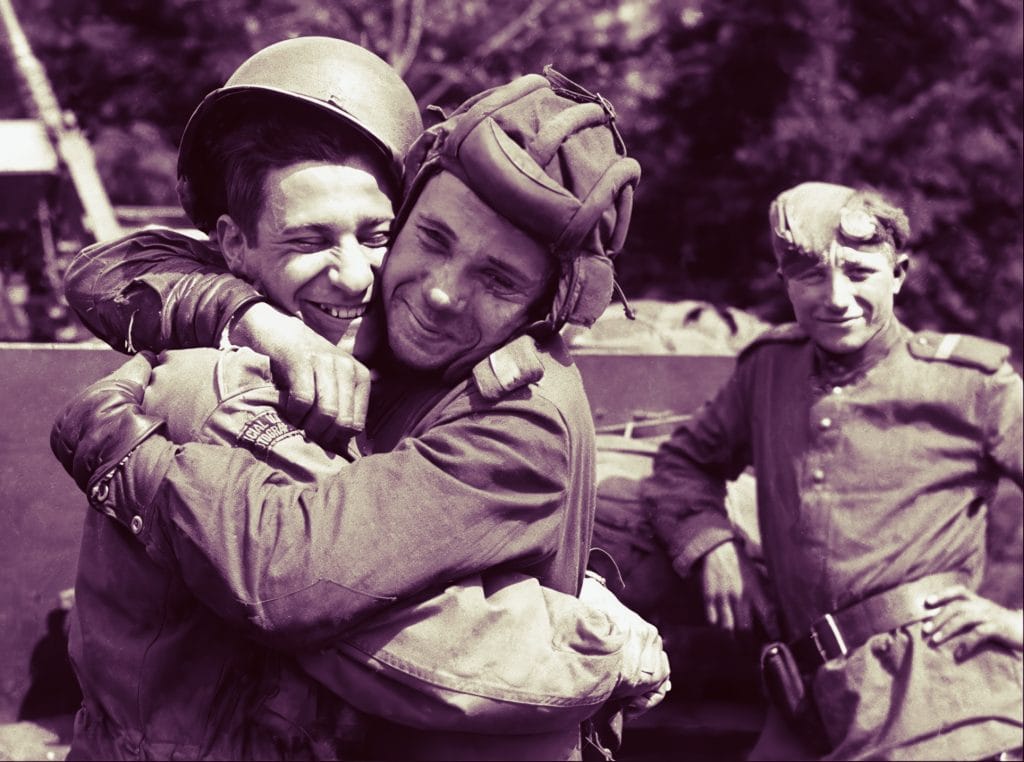
An historic news day, this April 27, 1945.
There was singing and dancing and music on the banks of the Elbe today as troops of the United States 1st Army and jubilant troops of Marshal Ivan Konev’s 1st Ukrainian Army celebrated historic junction symbolizing the defeat of Nazi Germany. Americans and Russians slapped each other on the back, gave each other bear hugs, and sat in the warm sunshine drinking champagne from beer mugs and toasting| the great occasion of the meeting of the two armies. Not in all this long war have there been scenes such as those enacted in the town of Torgau on the west bank of the Elbe and across the river in the Red Army encampment where Russian and American troops saw each other for the first time, and began to get acquainted despite the handicaps of language. It was enough that they were allies and had whipped the enemy to open the way for this joining armies in weird Torgau. Parts of the city were deserted and ghostly. In other sections Russian and American troops whooped; sang and formed friendships within a few minutes of meeting. An American infantry officer and a Russian private squirmed across a girder of a blown bridge in the Elbe, pounded each other on the back and shook hands to seal an historic meeting. “Put it there,” the first words 2nd Lieut. William D. Robertson of Los Angeles, called to his Red Army friend in the bizarre meeting at 4.40 p.m. over the waters of the Elbe at Torgau, 28 miles northeast of Leipzig. It was one of at least three contacts with the Russians made by men, of the 69th Division.
Still another American-Russian link-up appeared imminent in the Bavarian foothills bordering Hitler’s Berchtesgaden retreat, where Gen. George S. Patton’s Third army established radio contact with a Red army force apparently only 30 to 40 miles away. The Danubian stronghold of Regensburg also fell to Patton’s army.
Doughboys of the U. S. First army’s 69th infantry division pushed out from the Mulde river, 30 miles from the Elbe, to join up with the 173rd Russian Guards regiment in Torgau, on the west bank of the Elbe. As they went forward, hundreds of war-wearied German prisoners lined the roadsides to watch the parade of American power that foretold the death of nazidom and the final destruction of Germany’s military might.
The electrifying news of the juncture on the Elbe was announced simultaneously in Washington, London and Moscow. Leaders of the big three hailed the event as the decisive triumph of the European war. “This is not the hour of final victory but the hour draws near . . …” President Truman declared in a brief White House statement. “The last faint, desperate hope of Hitler and his gangster government has been extinguished.” Patrols from the two armies met for the first time on the Elbe Wednesday evening at 8:40 p. m. (2:40 p. m., EWT) but the first junction in force was not effected until 8 p. m. (2 p. m., EWT) yesterday when the 69th and the Soviet Guards regiment joined hands in Torgau.
Maj. Gen. E. F. Reinhardt, commander of the 69th, led his division into the battered river town where almost two centuries ago another Russian army joined its Austrian allies to fight Frederick the Great of Prussia, their common enemy in the Seven Years’ war.
Here is a special program from NBC Radio as it was broadcast on April 27,1945