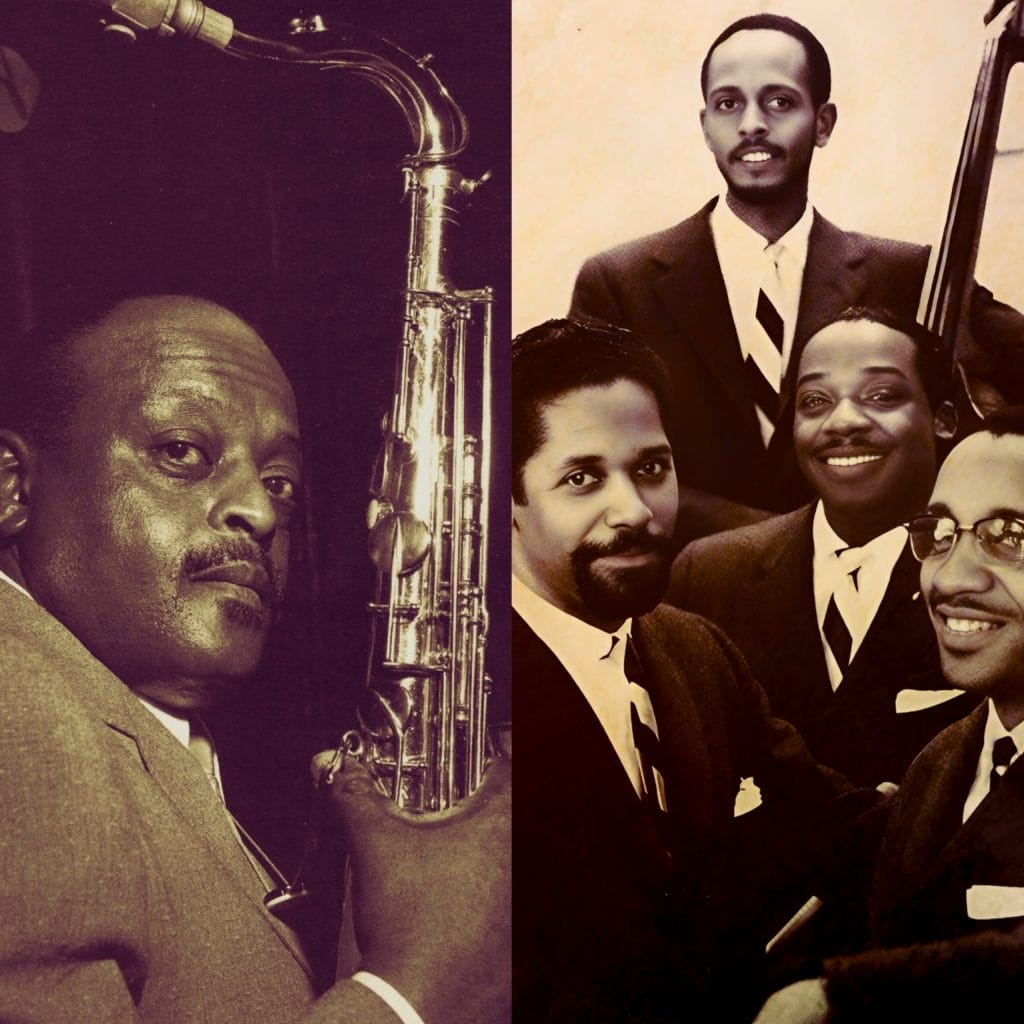
Ben Webster (L) – Modern Jazz Quartet – (R) – High level Summit meeting.
Historic summits this Sunday – the legendary Ben Webster with the equally legendary Modern Jazz Quartet gathering for a sit-down and exchange of ideas at Birdland in New York on February 21, 1953.
Needless to say, the crowd is ecstatic – and the notes are sensational. Historic, to put it mildly.
Ben Webster, one of the “big three” of swing tenors along with Coleman Hawkins (his main influence) and Lester Young. He had a tough, raspy, and brutal tone on stomps (with his own distinctive growls) yet on ballads he would turn into a pussy cat and play with warmth and sentiment.
In 1940 (after short stints in 1935 and 1936), Ben Webster became Duke Ellington’s first major tenor soloist. During the next three years he was on many famous recordings, including “Cotton Tail” (which in addition to his memorable solo had a saxophone ensemble arranged by Webster) and “All Too Soon.” After leaving Ellington in 1943 (he would return for a time in 1948-1949), Webster worked on 52nd Street; recorded frequently as both a leader and a sideman; had short periods with Raymond Scott, John Kirby, and Sid Catlett; and toured with Jazz at the Philharmonic during several seasons in the 1950s. Although his sound was considered out-of-style by that decade, Webster’s work on ballads became quite popular and Norman Granz recorded him on many memorable sessions.
MJQ was formed in 1952, evolving from the rhythm section of Dizzy Gillespie’s big band, which featured pianist John Lewis, vibraphonist Milt Jackson, bassist Ray Brown, and drummer Kenny Clarke. After Brown’s departure, Percy Heath joined on bass, and in 1955, Connie Kay replaced Clarke on drums. The group became known for their refined presentation—performing in tuxedos and concert halls—and for their disciplined professionalism, a stark contrast to the prevailing jazz stereotypes of the era.
MJQ’s music was a sophisticated blend of jazz and classical influences, with John Lewis’s interest in baroque forms leading to compositions that incorporated fugues and counterpoint. Their repertoire included original works like “Django” and “Concorde,” jazz standards, and classical-inspired pieces such as ‘The Comedy’ and the film score ‘No Sun in Venice.’ The group’s sound was marked by Lewis’s sparse, bluesy piano, Jackson’s soulful vibraphone, Heath’s melodic bass, and Kay’s subtle drumming, creating an elegant and distinctive style that bridged bebop, cool jazz, and the so-called ‘third stream’ movement.
Over their 43-year career (with a brief hiatus), the MJQ became a major jazz institution, influencing generations of musicians and expanding the possibilities for jazz ensembles. Their legacy is one of innovation, discipline, and a unique fusion of jazz improvisation with classical structure, making them one of the most respected and enduring groups in jazz history.
Press Play and dive in – puts Sunday in proper perspective.