News for the week ending on September 28, 1985 from ABC World News This Week.
A week where seemingly everything was happening, all at once.
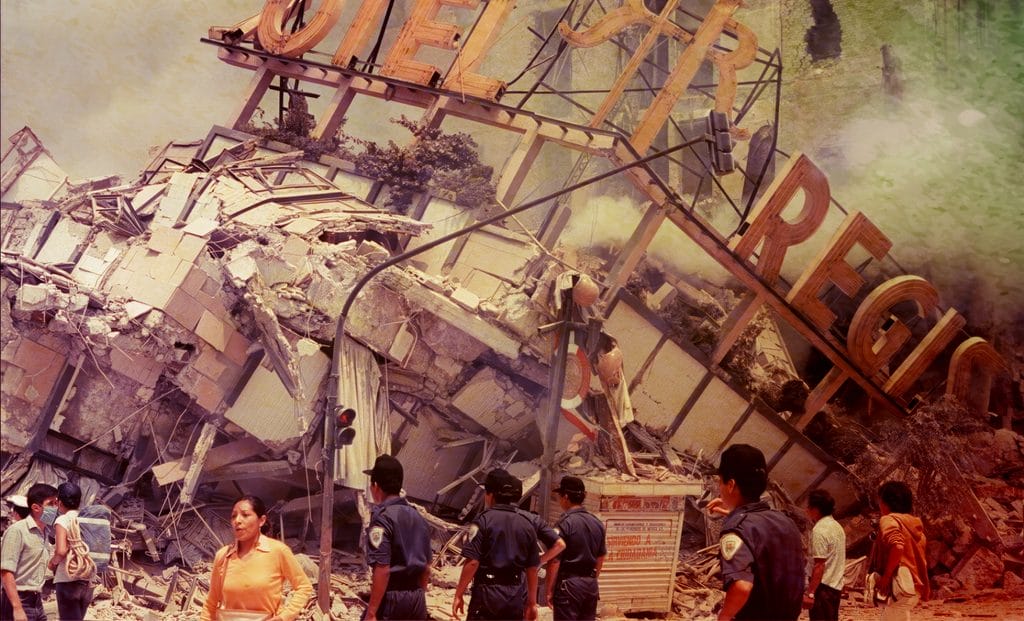
From Mexico – A second earthquake hit the Mexico City area Friday night some 36 hours after the first quake that, according to the latest government estimates, left 2,000 people dead. The U.S. National Earthquake Center at Golden, Colo., said the new tremor measured 7.3 on the Richter Scale, almost as powerful as Thursday’s quake that registered 7.8 on the Richter scale. It was centered at about the same place as Thursday’s quake, 250 miles west of Mexico City. An earthquake measured at seven is defined as “major,” capable of widespread heavy damage; eight is a “great” quake, capable of tremendous damage.
The Pacific Tsumani Warning Center in Honolulu said the earthquake occurred at 7:37 p.m. (9:37 p.m. Detroit time), with the epicenter about 150 miles northwest of Acapulco, Mexico. Frank Kemper, a ham operator in La Jolla, Calif., was monitoring a radio conversation between Los Angeles and Mexico City when he heard the ham operator in Mexico say: “Oh no! It’s another one. It’s a big one.” Then he went off the air.
There were no immediate reports of more casualties. But the Mexican government raised the official toll from Thursday morning’s devastating tremor to 2,000, and unofficial estimates ranged up to 3,000. Ham radio operators in Dallas reported conversations with people in Mexico City who said more buildings had collapsed: in the capital. Details were sketchy. When the second quake hit Friday, panicky residents in Mexico City raced out of their homes into the street. Lights went out in many sections of the capital and, according to radio reports, the smell of gas was present again in the hard-hit Roma neighborhood.
RADIO REPORTS SAID the Cafe Havana, a popular businessman’s restaurant in the central city, had collapsed. It was believed empty at the time. “Less than 10 minutes ago, I was sitting in my hotel room and it began to shake,” said Associated Press photographer David Breslauer from Queretaro, 125 miles northwest of the capital. “The chandelier began to swing.” Ham radio operator Dave Downing in Wausau, Wis., said he heard a station in Veracruz, about 300 miles east of Mexico City, report the new quake and then go off the air, possibly indicating that the quake covered an area larger than the Mexico City region. Earlier Friday, stunned Mexicans counted the dead and searched for the living, struggling to recover from Thursday’s quake that turned the world’s biggest metropolis into a dustshrouded city of terror and tragedy.
“I WOULD NOT dare give a number,” said a grim-faced Mayor Ramon Aguirre. Reports from the surrounding countryside were even sketchier, but hundreds were said to have been killed in those areas, closer to the epicenter of the quake. Late Thursday, officials estimaed more than 1,000 people were buried in scores of collapsed buildings in Mexico City, and hour-by-hour on Friday bodies were being pulled from the rubble. Five thousand people were treated for injuries, Aguirre said. Even as the second quake hit, fires flickered and embers smoldered in the ruins of destroyed buildings, pouring smoke into the dust raised by the quake. Crying children, calling for their parents, wandered through the streets. THE CASUALTIES from the first tremor apparently included at least two Americans. Embassy spokesman Vince Hovanec said the two were guests at a hotel that was severely damaged. “There is the probability that they may be dead,” he said.
I He did not release their names. The first earthquake, centered on the Pacific Coast about 250 miles southwest of Mexico City, struck at 7:18 a.m. (9:18 a.m. Detroit time) Thursday in the capital, which is at an altitude of 7,347 feet. Mexico City’s 18 million people make it the world’s most populous urban area, according to United Nations figures.
The heaving movement brought down hotels, hospitals, schools and churches. The city Emergency Relief Council said 250 buildings were destroyed. More collapsed in the second earthquake. The disaster also struck the nearby states of Colima, Guerrero, Jalisco and Michoacan. Between 110 and 150 people were killed and 1,500 were injured in Jalisco, said Juan Manuel Sanchez, a fire lieutenant there.
Mexican television said 25 worshippers were killed in the Jalisco city of Guzman when a cathedral collapsed. In Michoacan, 30 people were reported killed when two hotels collapsed at the beach resort Playa Azul. COMMUNICATIONS OFFICIALS said at least 60 percent of the nation’s 167 major telephone exchanges were damaged in the first quake. Mexico City’s international communications links remained cut. Water supplies were expected to be irregular for several days.
Half of Mexico City was blacked out late Thursday, but power was being restored gradually Friday. Three large areas of the capital were hardest hit – the historic downtown area around the vast Zocalo square, the east side Tlatelolco district and a southern district around the national medical center. Multistory buildings became heaps of masonry, the collapsed floors stacked like pancakes.
In other news – Hurricane Gloria’s arrival at low tide on a course that kept its most severe winds over the ocean allowed the East Coast to escape widespread damage, but forecasters say Gloria could be part of a new hurricane cycle that would bring more such storms to the Northeast. “The big hurricanes tend to hit in certain geographical areas for up to 20 years at a time and then shift,” Paul Hebert, a forecaster at the National Hurricane Center in Miami, said Friday. “Diana was a near miss last year, and here’s one that is certainly a major hurricane.” said it is too soon to tell whether such a new cycle has begun, but he noted that a flurry of hurricanes in the Northeast in the 1950s and 1960s has been followed by a period of relative calm. The Northeast is likely to be safe for the rest of this hurricane season, which ends Nov. 30, he said. “From a practical point of view, very few places are affected by hurricanes after the first week or two of October, except for Florida.” Forecasters said Gloria’s path skirting the East Coast allowed only its weaker western side to touch land. Gloria’s fiercest winds, on its eastern edge, remained over the ocean until they crossed Long Island and hit Connecticut.
By that time, the storm’s strength had been partly sapped by its passage along the land.
And finally; Soviet Foreign Minister Eduard Shevardnadze urged the United Nations Tuesday to reject Washington’s “sinister plans of Star Wars” and endorse a Soviet “Star Peace” proposal for space exploration. On the eve of high-level meetings with U.S. officials, the new Soviet foreign minister in his first address to the U.N. General Assembly accused Washington of seeking military superiority by spreading the arms race to space. Shevardnadze focused on arms control issues — particularly the U.S. testing of anti-satellite weapons and on the Strategic Defense Initiative, also known as “Star Wars,” which is aimed at developing a weapon that could destroy attacking incoming nuclear missiles. “We perceive the greatest peril in the fact that the nuclear arms race has taken, so to say, a fresh start and is forging ahead. Added to this is the threat of the arms race spreading to outer space. The possibility of the arms race acquiring an uncontrollable and irreversible character is becoming real,” the Soviet foreign minister said. “To counter the sinister plans of Star Wars, the U.S.S.R. is putting before the international community a concept of ‘Star Peace,’ ” he said. The proposal calls for the peaceful exploration of space under U.N. auspices. Contrary to the impression that the Soviet foreign minister gave in his address, where he talked of past Soviet arms control proposals, U.S. officials said the Soviets have so far brought no new ideas to the arms talks, which opened in Geneva last week.
All that and a lot more for this week ending September 28, 1985 as reported by ABC Radio News.