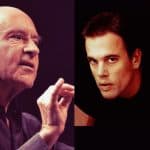

– Gunther Schuller In conversation – Pantechnicon – Eastern Educational Radio – April 4, 1975 – Gordon Skene Sound Collection –
We (Americans, mostly) do love to pigeon-hole. If it isn’t easily defined as one thing then it should’t be relevant in the grand scheme of things. Case in point; in the 1950s, Jazz horn player Gunther Schuller and Jazz pianist John Lewis (of The Modern Jazz Quartet), teamed up to found The Modern Jazz Society. Later the name would change to The Jazz and Classical Music Society. Although its primary emphasis was Jazz, Schuller was making discoveries of music by then-contemporary Classical Composers that utilized many principles of Jazz, but which neither were recognized by either the Classical or Jazz communities. During one of his lectures at Brandeis University in 1957, Schuller coined the phrase Third Stream Music, and it signaled a sudden freedom in the area of musical expression. It also signaled an okay to go exploring – that discovering other genres yielded a rich vein of creative possibilities. Third Stream was an apt description and was adopted by a number of musicians and it continues to yield positive results.
But Gunther Schuller wasn’t just about Third Stream Music – he was also passionate about a lot of music in several genres, most notably that music which was popular during the late 19th and early 20th century which fell out of favor over the passage of time. One of those almost forgotten genres was Ragtime, and its most notable practitioner Scott Joplin. In the late 1960s, Schuller founded the New England Ragtime Ensemble, during his tenure at The New England Conservatory. Reintroducing this music, and its most prolific creator to the world was probably Gunther Schuller’s most notable contribution to the re-evaluation of American Music, especially during the period leading up to the Bicentennial.
This interview, from early 1975 covers the area of Ragtime and how it was having a positive affect on American audiences and indeed the world. But more importantly, it made the case that American Classical music was something to take seriously and that all the significant steps weren’t necessarily being made in Europe anymore. The world was indeed becoming smaller and the archives were overflowing with music going back to the late 19th century just waiting to be discovered.
Here is that interview with Gunther Schuller as heard on Panthechnicon from April 4, 1975 over the Eastern Educational Radio Network.