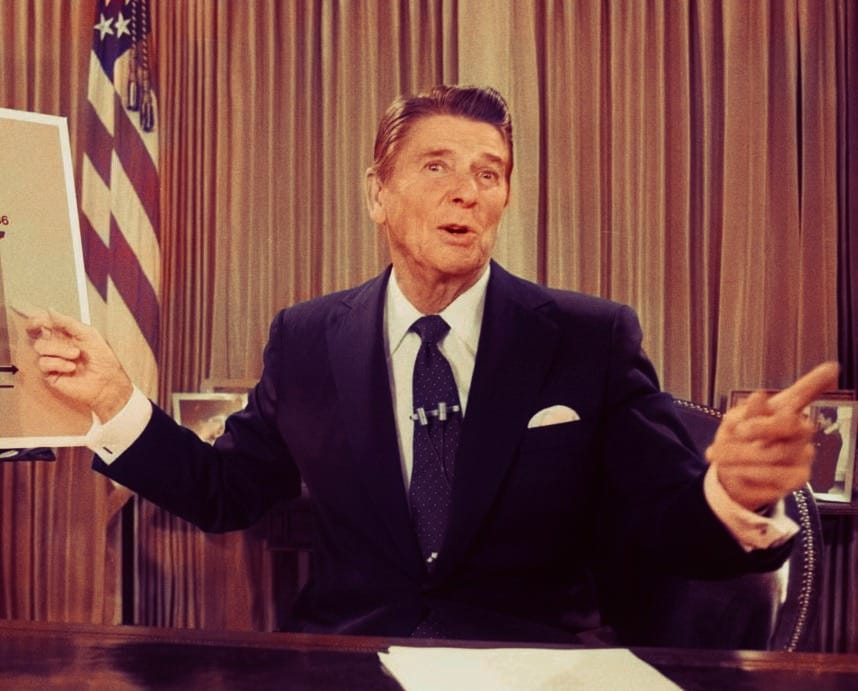
This day in 1981 President Reagan went before cameras and microphones and presented his plan:
“I’d intended to make some remarks about the problem of social security tonight, but the immediacy of congressional action on the tax program, a key component of our economic package, has to take priority. Let me just say, however, I’ve been deeply disturbed by the way those of you who are dependent on social security have been needlessly frightened by some of the inaccuracies which have been given wide circulation. It’s true that the social security system has financial problems. It’s also true that these financial problems have been building for more than 20 years, and nothing has been done. I hope to address you on this entire subject in the near future.
In the meantime, let me just say this: I stated during the campaign and I repeat now, I will not stand by and see those of you who are dependent on social security deprived of the benefits you’ve worked so hard to earn. I make that pledge to you as your President. You have no reason to be frightened. You will continue to receive your checks in the full amount due you. In any plan to restore fiscal integrity of social security, I personally will see that the plan will not be at the expense of you who are now dependent on your monthly social security checks.
Now, let us turn to the business at hand. It’s been nearly 6 months since I first reported to you on the state of the nation’s economy. I’m afraid my message that night was grim and disturbing. I remember telling you we were in the worst economic mess since the Great Depression. Prices were continuing to spiral upward, unemployment was reaching intolerable levels, and all because government was too big and spent too much of our money.
We’re still not out of the woods, but we’ve made a start. And we’ve certainly surprised those longtime and somewhat cynical observers of the Washington scene, who looked, listened, and said, “It can never be done; Washington will never change its spending habits.” Well, something very exciting has been happening here in Washington, and you’re responsible.
Your voices have been heard—millions of you, Democrats, Republicans, and Independents, from every profession, trade and line of work, and from every part of this land. You sent a message that you wanted a new beginning. You wanted to change one little, two little word—two letter word, I should say. It doesn’t sound like much, but it sure can make a difference changing “by government,” “control by government” to “control of government.”
In that earlier broadcast, you’ll recall I proposed a program to drastically cut back government spending in the 1982 budget, which begins October 1st, and to continue cutting in the ’83 and ’84 budgets. Along with this I suggested an across-the-board tax cut, spread over those same 3 years, and the elimination of unnecessary regulations which were adding billions to the cost of things we buy.
All the lobbying, the organized demonstrations, and the cries of protest by those whose way of life depends on maintaining government’s wasteful ways were no match for your voices, which were heard loud and clear in these marble halls of government. And you made history with your telegrams, your letters, your phone calls and, yes, personal visits to talk to your elected representatives. You reaffirmed the mandate you delivered in the election last November—a mandate that called for an end to government policies that sent prices and mortgage rates skyrocketing while millions of Americans went jobless.
Because of what you did, Republicans and Democrats in the Congress came together and passed the most sweeping cutbacks in the history of the Federal budget. Right now, Members of the House and Senate are meeting in a conference committee to reconcile the differences between the two budget-cutting bills passed by the House and Senate. When they finish, all Americans will benefit from savings of approximately $140 billion in reduced government costs over just the next 3 years. And that doesn’t include the additional savings from the hundreds of burdensome regulations already cancelled or facing cancellation.
For 19 out of the last 20 years, the Federal Government has spent more than it took in. There will be another large deficit in this present year which ends September 30th, but with our program in place, it won’t be quite as big as it might have been. And starting next year, the deficits will get smaller until in just a few years the budget can be balanced. And we hope we can begin whittling at that almost $1 trillion debt that hangs over the future of our children.
Now, so far, I’ve been talking about only one part of our program for economic recovery-the budget-cutting part. I don’t minimize its importance. Just the fact that Democrats and Republicans could work together as they have, proving the strength of our system, has created an optimism in our land. The rate of inflation is no longer in double-digit figures. The dollar has regained strength in the international money markets, and businessmen and investors are making decisions with regard to industrial development, modernization and expansion-all of this based on anticipation of our program being adopted and put into operation.
A recent poll shows that where a year and a half ago only 24 percent of our people believed things would get better, today 46 percent believe they will. To justify their faith, we must deliver the other part of our program. Our economic package is a closely knit, carefully constructed plan to restore America’s economic strength and put our nation back on the road to prosperity.
Each part of this package is vital. It cannot be considered piecemeal. It was proposed as a package, and it has been supported as such by the American people. Only if the Congress passes all of its major components does it have any real chance of success. This is absolutely essential if we are to provide incentives and make capital available for the increased productivity required to provide real, permanent jobs for our people.
And let us not forget that the rest of the world is watching America carefully to see how we’ll act at this critical moment.
I have recently returned from a summit meeting with world leaders in Ottawa, Canada, and the message I heard from them was quite clear. Our allies depend on a strong and economically sound America. And they’re watching events in this country, particularly those surrounding our program for economic recovery, with close attention and great hopes. In short, the best way to have a strong foreign policy abroad is to have a strong economy at home.
The day after tomorrow, Wednesday, the House of Representatives will begin debate on two tax bills. And once again, they need to hear from you. I know that doesn’t give you much time, but a great deal is at stake. A few days ago I was visited here in the office by a Democratic Congressman from one of our southern States. He’d been back in his district. And one day one of his constituents asked him where he stood on our economic recovery program—I outlined that program in an earlier broadcast-particularly the tax cut. Well, the Congressman, who happens to be a strong leader in support of our program, replied at some length with a discussion of the technical points involved, but he also mentioned a few reservations he had on certain points. The constituent, a farmer, listened politely until he’d finished, and then he said, “Don’t give me an essay. What I want to know is are you for ‘im or agin ‘im?”
Here is the complete address, along with rebuttal by Dan Rostenkowski and some analysis from NPR on July 27, 1981.