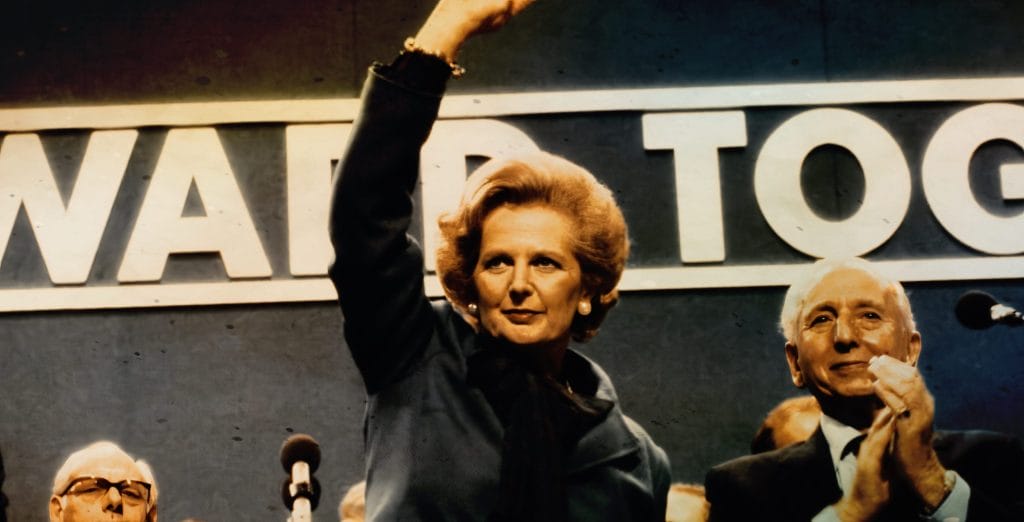
Margaret Thatcher – AKA: Attila The Hen.
News for this day in 1983 started off in Britain and the election.
Conservative Prime Minister Margaret Thatcher, strongly favored to win a second term, asked for a landslide victory in British national elections today to “banish forever’ extreme left-wing socialism Mrs Thatcher ran on right-wing policies of strong defense and tight fiscal control, while the main opposition Labor Party fumbled attempts to forge a unified policy on nuclear disarmament For the first time in 60 years, there was a strong challenge from a third political force — the alliance of the Social Democratic Party and the Liberal Party A final flurry of opinion polls gave Mrs Thatcher’s Conservatives a commanding lead of 16 to 21 points over the opposition, with Labor and the alliance jostling for second place Some forecasts said this could give her more than 400 seats in the 650-seat House of Commons, the biggest landslide in 50 years.
Meanwhile – Nicaragua denounced the expulsion of 21 Nicaraguan consular officials from the United States, calling it an “act of hostility” intended as punishment for kicking out three American diplomats. In Washington, meanwhile, the State Department Wednesday denied it plans a full break in diplomatic relations with Nicaragua and said a special U.S. envoy will visit the country as scheduled despite the quarrel with the Nicaraguans over alleged -assassination plots and spying. At the same time, 21 Nicaraguan diplomats and their dependents – a total of some 60 persons prepared to obey the U.S. order expelling them and shutting down all six of Nicaragua’s consulates, which U.S.officials have branded: as centers of intelligence gathering. 0 0 E As his consulate closed, Augustin Alfaro, the Nicaraguan consul general in New Orleans said Wednesday the would seek political asylum in the United States. The United States ordered the Nicaraguan consulates closed Tuesday. and expelled the 21 officials who worked in them in retaliation – for the Nicaraguan expulsion Monday of three diplomats accused of -plotting to poison Foreign Minister Miguel D’Escoto and destabilize the leftist government. “The United States wants to punish the government of Nicaragua for its decision, (which was) both just and in accord with diplomatic norms, to declare persona non grata three American citizens,” a Nicaraguan communique said.
And a key NATO group today blamed the Kremlin for the stalemate in the Geneva talks on medium-range missiles and condemned the Soviets for threatening to increase their nuclear arsenal. The threat will not “intimidate the allies into acceding to an agreement on Soviet terms,” the group said. As Secretary of State George P. Shultz opened a two-day foreign ministers’ meeting seeking allied solidarity, a special NATO group monitoring the arms talks issued a gloomy status report on the negotiations. “The Soviet Union unfortunately continues to resist achievement of an equitable agreement which recognizes the legitimate security concerns of both parties and their allies,” the NATO Special Consultative Group said in a declaration issued by its chairman, Richard R. Burt, assistant U.S. secretary of state for European affairs. The group represents the 14 NATO countries in the alliance military wing. France and Iceland are not members. They said the key stumbling block was a Soviet demand that British and French nuclear forces be included in the talks, now involving only the United States and the Soviet Union.
“This position remains unacceptable and cannot serve as the basis for an agreement – Soviet adherence to it blocks the way to progress in the negotiations,” they said. The Soviet Union and the United States are conducting two sets of arms talks in Geneva. One negotiation is on cutting medium-range missiles in Europe and the other is on strategic, or long range, missile reductions, called START. The group denounced a May 28 Soviet threat to deploy nuclear weapons in East bloc c countries. Defense Secretary Caspar Weinberger said last week that the Soviets have had such weapons there for several years. Without repeating Weinberger’s assertion, the NATO group said the Soviets “threaten to increase still further their nuclear arsenal. “The Soviet statement aims at raising tensions and belies Soviet professions of interest in an arms control solution to the intermediate range nuclear force question.” The allies reaffirmed a decision to deploy new U.S. missiles in Europe this year in the absence of “concrete negotiating results,” Burt said. Despite the blockage at Geneva, Burt said, “we have not ruled out the possibility of an agreement.” And he said the Americans would continue negotiating at Geneva next year, even if the missiles are deployed. Burt brushed aside earlier comments by French President Francois Mitterrand that the United States – not just the Soviets – should make new proposals to unblock the negotiations. At the Special Consultative Group meeting, Burt said, “there was strong support for the view that the United States is negotiating flexibly in Geneva. We have nothing to be ashamed of. Danish Foreign Minister Uffe Ellemann-Jensen said at a brief opening ceremony that Soviet arms control proposals “fall far short of our requirements.
And that’s just a sampling of what went on, this June 9th in 1983 as presented by The CBS World News Roundup.