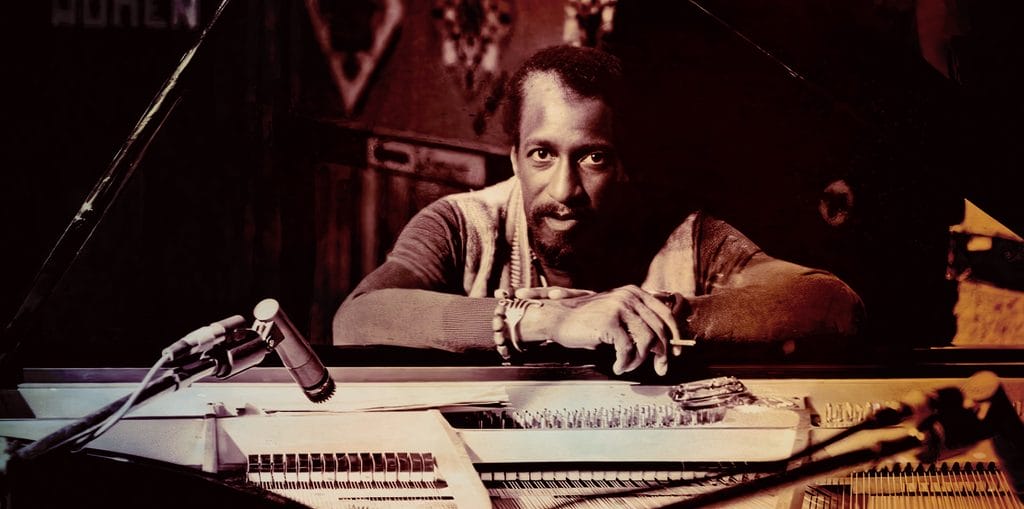
The Mal Waldron Quintet this Sunday – live at The Village Vanguard in New York City and recorded on December 30, 1982. Performing with Mal Waldron are; Charlie Rouse, saxophone – Benny Bailey, trumpet – Reggie Workman on bass and Ed Blackwell on drums.
From All About Jazz:
Waldron entered the professional jazz scene in the early 1950s, quickly gaining recognition as a reliable and imaginative accompanist. His big break came when he joined the band of bassist Charles Mingus, whose volatile, emotionally charged music aligned with Waldron’s own expressive instincts. Though his tenure with Mingus was relatively brief, it sharpened his sense of structure, tension, and narrative pacing.
Soon after, Waldron became the house pianist for Prestige Records, one of the most prolific jazz labels of the era. In this role, he appeared on hundreds of sessions, backing artists such as John Coltrane, Eric Dolphy, and Jackie McLean. These recordings placed Waldron at the center of hard bop’s evolution, even as his own playing grew increasingly spare and unconventional.
Billie Holiday and Compositional Identity
One of the most significant relationships of Waldron’s early career was his collaboration with Billie Holiday, whom he accompanied from 1957 until her death in 1959. Waldron served as Holiday’s musical director during her final years, a period marked by fragility, emotional rawness, and deep mutual respect.
For Holiday, Waldron composed “Left Alone,” a haunting minor-key ballad that became one of his most enduring works. The piece encapsulates many of Waldron’s defining traits: a cyclical harmonic structure, a mournful melodic line, and an atmosphere of unresolved tension. “Left Alone” would go on to be recorded by numerous artists and remains a touchstone of modern jazz composition.
Collapse, Recovery, and Reinvention
In the early 1960s, Waldron experienced a severe personal and professional crisis. Overwork, substance abuse, and exhaustion culminated in a physical and psychological collapse that left him temporarily unable to play the piano. Remarkably, Waldron had to relearn his instrument almost from scratch—a process he later described as both terrifying and liberating.
This rupture marked a decisive turning point in his music. Emerging from recovery, Waldron abandoned many bebop conventions and embraced a more minimalist, obsessive approach. Short motifs were repeated, transformed, and hammered into the keyboard, creating music that felt ritualistic rather than linear. Silence, once merely a pause, became an active component of his improvisations.
Exile and Flourishing in Europe
Frustrated with the commercial constraints and racial dynamics of the American jazz industry, Waldron relocated permanently to Europe in 1965, eventually settling in Munich. Like many African American jazz musicians of his generation, he found Europe more receptive to experimental forms and more respectful of artistic autonomy.
In Europe, Waldron’s creativity blossomed. He became a central figure in the avant-garde jazz scene, collaborating with musicians such as Steve Lacy, Barre Phillips, and Joachim Kühn. His performances grew darker, more confrontational, and deeply introspective, often blurring the boundaries between composition and free improvisation.
Compositional Voice and Piano Style
Waldron’s piano style defies easy categorization. His touch was heavy and percussive, his tempos often deliberate to the point of severity. Rather than spinning long, fluid lines, he favored fragments—short cells of melody and rhythm repeated with subtle variation. This approach created a hypnotic intensity, drawing listeners into a slow-burning emotional landscape.
As a composer, Waldron was equally distinctive. Works like “Soul Eyes,” “Warm Canto,” and “Fire Waltz” reveal his gift for memorable themes that resist resolution. His compositions are frequently modal, grounded in the blues, yet harmonically ambiguous, allowing performers wide interpretive freedom.
Later Years and Lasting Influence
In his later decades, Waldron continued to perform and record prolifically, often in solo settings that highlighted his uncompromising vision. His solo piano concerts—sometimes austere, sometimes ferociously physical—became events where patience and deep listening were rewarded.
Mal Waldron died on December 2, 2002, in Brussels, Belgium. Though never a mainstream star, his influence can be heard in generations of pianists drawn to minimalism, repetition, and emotional directness. Artists across jazz and improvised music cite Waldron as a model of integrity—someone who followed his inner logic regardless of trends or commercial pressures.
Legacy
Mal Waldron’s legacy is that of an artist who refused to dilute his voice. His music confronts listeners with darkness, resilience, and quiet defiance, offering no easy catharsis but profound truth. In a genre often associated with virtuosity and speed, Waldron demonstrated the power of restraint, repetition, and weight. His work remains a testament to jazz as a living, searching art—one that embraces struggle as a source of beauty rather than something to be concealed.
Dive in: