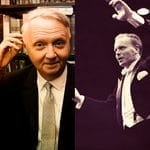
Mulgrew Miller this holiday weekend. Accompanied by bassist Rodney Whitaker and recorded in concert at the Stanley H. Kaplan Penthouse, Lincoln Center on April 21, 2001 by Jazz At Lincoln Center.
*Ben Ratliff, writing for The New York Times, commented that, “As a composer, Mulgrew Miller is difficult to peg; like his piano playing, he’s a bit of everything.” Critic Ted Panken observed in 2004 that Mulgrew Miller the pianist “finds ways to conjure beauty from pentatonics and odd intervals, infusing his lines with church and blues strains and propelling them with a joyous, incessant beat”. John Fordham in The Guardian commented that Miller’s “melodic fluency and percussive chordwork recalled Oscar Peterson but with glimpses of the harmonically freer methods of McCoy Tyner”, and that Miller was much more than the hard bop player that he was often stereotyped as being. The obituary writer for DownBeat observed that “Miller could swing hard but maintained grace and precision with a touch and facility that influenced generations of musicians.”
Mulgrew Miller had a strong reputation with fellow musicians. Pianist Geoffrey Keezer was convinced that he wanted to be a pianist after attending a performance by Miller in 1986. Vibraphonist Warren Wolf stated that Miller helped him early in his career, including by being a link to jazz history: “you’re getting that experience of playing with Art Blakey, that attitude of ‘Yes, it’s my band, but you have to give other people a chance to shine.'” Robert Glasper also cited Miller as an influence, and wrote and recorded “One for ‘Grew” as a tribute.
Speaking in 2010, Miller commented on his approach to playing standards, which was more conservative than that of many others: “I believe in giving due respect to the melody, playing it as true as possible, a solo is a creative process that improves the melody.” He almost never transcribed recordings (something that jazz musicians are typically taught to do); Miller credited this with slowing his learning process, but also with allowing him to express himself more freely, as he reached his own understanding of the compositions he played.
Miller explained the lack of critical attention he received, saying, “Guys who do what I am doing are viewed as passé.” He also contrasted his own approach with that of performers who produced “interview music”: “something that’s obviously different, and you get the interviews and a certain amount of attention”.
*Thanks Wikipedia.
Dive in and enjoy the rest of the weekend.
Share this:
- Share on Facebook (Opens in new window) Facebook
- Share on LinkedIn (Opens in new window) LinkedIn
- Share on Tumblr (Opens in new window) Tumblr
- Share on Mastodon (Opens in new window) Mastodon
- Share on Threads (Opens in new window) Threads
- Share on Bluesky (Opens in new window) Bluesky
- Share on X (Opens in new window) X
- More