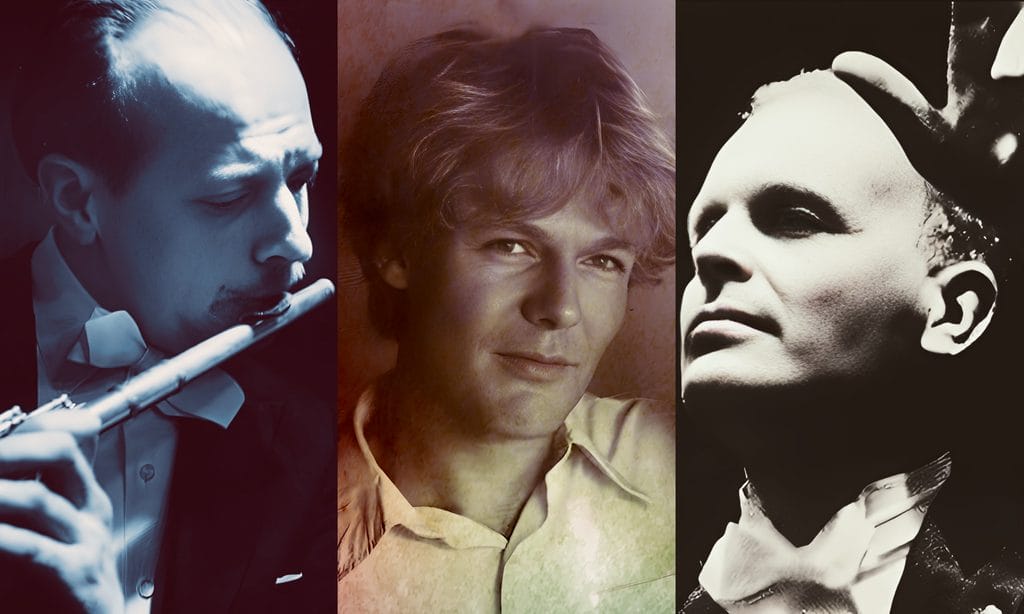
Koos Verhuel (L) – Jurriann Andriessen (C) – Willem van Otterloo (R)
Rarities from Radio Nederland this weekend – The Flute Concerto by Jurriaan Andriesen with Koos Verheul, flute and the Radio Philharmonic of The Hague conducted by Willam van Otterloo in this radio performance from circa 1968.
Jurriaan Andiressen studied composition with his father Hendrik at the Utrecht Conservatory before moving to Paris where he studied with Olivier Messiaen.
His brother Louis Andriessen (1939-2021) was also a composer and pianist, as well as his uncle Willem (1887-1964).
The bulk of Andriessen’s output is for the stage; his study in Paris was primarily in writing film music. He had a variety of musical influences which he drew upon, including American film music, Aaron Copland‘s ballets, folk music of various cultures, neoclassicism, and serialism; this eclecticism combined with his compositional skill made his writing well-suited to scoring dramatic works. His first stage composition was incidental music for “The Miraculous Hour”, a play premiered at the celebration of the 50th year of Queen Wilhelmina‘s reign, in 1948. In 1954 the Haagse Comedie (now the Nationaal Toneel, or “National Theatre”) appointed him resident composer, where he wrote scores for Eugene O’Neill‘s Mourning Becomes Electra and Tom Stoppard‘s Rosencrantz & Guildenstern Are Dead, among numerous others.
His stay in the United States on a Rockefeller Foundation fellowship from 1949 to 1951 was a fruitful one for his orchestral writing, another notable area of his work; during this time he composed the Tanglewood Overture for Serge Koussevitsky, and the Berkshire Symphonies, later used as ballet music by George Balanchine. His compositions were commissioned for state celebrations, including the wedding and the coronation of Queen Beatrix and the silver jubilee of Queen Juliana.
Koos Verheul studied at the Royal Conservatory in The Hague with Johan Feltkamp . In 1952 and 1953 he attended the master classes of Severino Gazzelloni in Darmstadt , a study made possible in part by the Amsterdam Artists’ Centre. In 1954, while still a student, he won the Kranichsteiner Musikpreis there ; at the time he was a member of the Rotterdam Chamber Orchestra (1949-1960 version) under the direction of Piet Ketting .
In 1955, he became a flutist alongside Jolle de Wit , and in 1959, principal flutist of the Residentie Orkest in The Hague under the direction of Willem van Otterloo , a position he held until his retirement in 1989. He premiered many works for flute and orchestra, conducted by Pierre Boulez , Bruno Maderna , and Hans Zender , among others; in doing so, he followed in the footsteps of Gazzeloni. He was a member of the Residentie Wind Quintet and formed a permanent duo with pianist Jan van der Meer for over fifty years . Their repertoire was broad, encompassing the earliest works written for flute up to and including the newest compositions. As a soloist, he performed in all the major music centers of the world. In 1991, Verheul received the Evert Cornelis Prize from the Johan Wagenaar Foundation , and in 2007, he was awarded the DF Kuiper Prize. Koos Verheul was appointed Knight in the Order of Orange-Nassau in 1981 (as principal flutist of the RO) .
Verheul was principal flute teacher at the Sweelinck Conservatory in Amsterdam and the Brabant Conservatory in Tilburg, and a guest lecturer in Utrecht. As a pedagogue, he attached great value to rhythmic precision, clear articulation, and a powerful tone. Although these qualities demonstrate the influence of the French flute school, his unorthodox approach to flute playing meant that he could not be categorized within a specific school. His students include Abbie de Quant , Rien de Reede , Harrie Starreveld , Eleonore Pameijer , Eline van Esch, Jacques Zoon , Maurice Heugen, Ingrid Geerlings, Lens Derogee, and Nine Sligter.
Willem van Otterloo was a driven orchestral pedagogue who achieved great heights with the Residentie Orkest and gained fame both at home and abroad. He set high standards for the orchestral musicians and emphasized precision and a clear orchestral sound. The countless engagements with foreign orchestras demonstrate that these qualities were appreciated worldwide. Under his leadership, the Residentie Orkest surpassed the Concertgebouw Orchestra in the 1950s . To his disappointment, he was not considered for the chief conductorship of that orchestra in 1959, following the death of Eduard van Beinum , because preference was given to the still young Bernard Haitink .
His favorite repertoire included the symphonies of Haydn , Beethoven , and Bruckner , Berlioz ‘s Symphonie fantastique , and works by Ravel , such as Daphnis et Chloé . Later in his career, he also increasingly developed as a Mahler conductor. He had little affinity for avant-garde repertoire , so Pierre Boulez and Bruno Maderna took care of that at the Residentie Orkest.
Van Otterloo did, however, particularly advocate for Dutch composers such as Diepenbrock , Pijper , Andriessen , Badings , Frid , Orthel , Voormolen , and many others. He always avoided the work of Vermeulen , though. His own compositional oeuvre was appreciated but remained limited, as he considered performance more important.
Press play and relax – it’s a holiday tomorrow (If you’re in the U.S.).