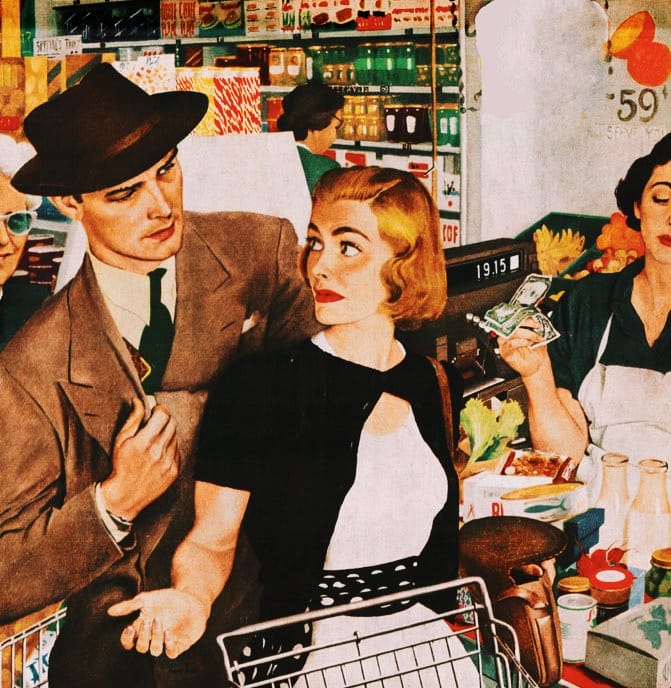
The ever-present concern: Money.
When Americans tuned in to American Forum of the Air on September 17, 1950, to hear a debate over price controls, they were listening to one of the most pressing domestic issues of the early Cold War. Only three months earlier, North Korea had invaded South Korea, drawing the United States into what would become the Korean War. Almost overnight, Americans feared that the economic disruptions they had experienced during the Second World War might return. Rising prices, shortages of raw materials, and concerns over inflation prompted renewed discussion of whether the federal government should once again regulate prices in order to protect consumers and stabilize the economy.
The debate was hardly new. During World War II, the federal government, through the Office of Price Administration, had imposed extensive price ceilings on food, gasoline, clothing, rent, and countless consumer goods. Although many Americans complained about ration books, shortages, and bureaucratic oversight, most accepted these measures as necessary wartime sacrifices. By the end of the 1940s, however, nearly all controls had been lifted, unleashing a surge in consumer spending but also significant inflation. The memory of rapidly rising prices after the war remained fresh in 1950.
The outbreak of war in Korea reignited fears that inflation would once again threaten family budgets. Demand for steel, copper, rubber, and other industrial materials increased dramatically as military production expanded. Consumers, remembering wartime shortages, began buying ahead whenever possible, further increasing demand. Prices climbed quickly, raising concerns that inflation might spiral out of control and erode wages and savings.
Supporters of renewed price controls argued that government intervention was necessary to protect ordinary Americans. Without limits on prices, they warned, manufacturers and retailers could take advantage of wartime demand by charging excessive prices. Fixed-income families, retirees, and lower-income workers would bear the greatest burden as the cost of food, housing, and household necessities continued to rise. Price ceilings, they argued, would prevent panic buying, discourage speculation, and spread the economic burden of national defense more fairly across society.
Advocates also viewed price controls as a vital weapon against inflation itself. Rising prices could force workers to demand higher wages, which in turn could lead businesses to increase prices even further—a cycle economists described as an inflationary spiral. By temporarily limiting price increases, supporters believed the government could stabilize the economy while military production expanded. They argued that a controlled economy during a national emergency was preferable to allowing inflation to weaken both consumer purchasing power and confidence in the nation’s economic health.
Opponents, however, contended that price controls often created more problems than they solved. Artificially low prices, they argued, discouraged production by reducing profits and incentives for manufacturers and farmers. If producers could not recover rising costs, shortages inevitably followed. Consumers might find prices lower on paper, but goods would simply disappear from store shelves. Black markets, illegal sales, and favoritism often emerged whenever government regulations interfered with normal supply and demand.
Critics also feared the expansion of federal authority. Many believed that once Washington began regulating prices, it inevitably became involved in determining production levels, wages, and distribution. To opponents, price controls represented an unnecessary intrusion into the free-market system that had made the American economy strong. They argued that increased production—not government regulation—was the real solution to shortages and rising prices.
The debate reflected a broader philosophical divide emerging during the early Cold War. Americans overwhelmingly supported resisting Communist aggression abroad, but many questioned how much government management was appropriate at home. Could the nation mobilize for war without sacrificing the economic freedoms that distinguished it from the centrally planned economies of the Soviet bloc? The discussion over price controls therefore became about much more than grocery bills or rent; it touched fundamental questions about the proper relationship between government, business, and individual liberty.
In retrospect, both sides raised legitimate concerns. Inflation during the Korean War proved serious enough that the federal government eventually implemented selective price and wage controls under the Office of Price Stabilization. While these measures helped moderate inflation for a time, they also generated criticism over complexity, enforcement, and unintended economic consequences. The American Forum of the Air debate captured a pivotal moment when Americans sought to balance national security with economic freedom—a challenge that has continued to shape public policy during later wars, economic crises, and periods of inflation.
Here is that episode of American Forum Of The Air from NBC Rad On September 17, 1950.