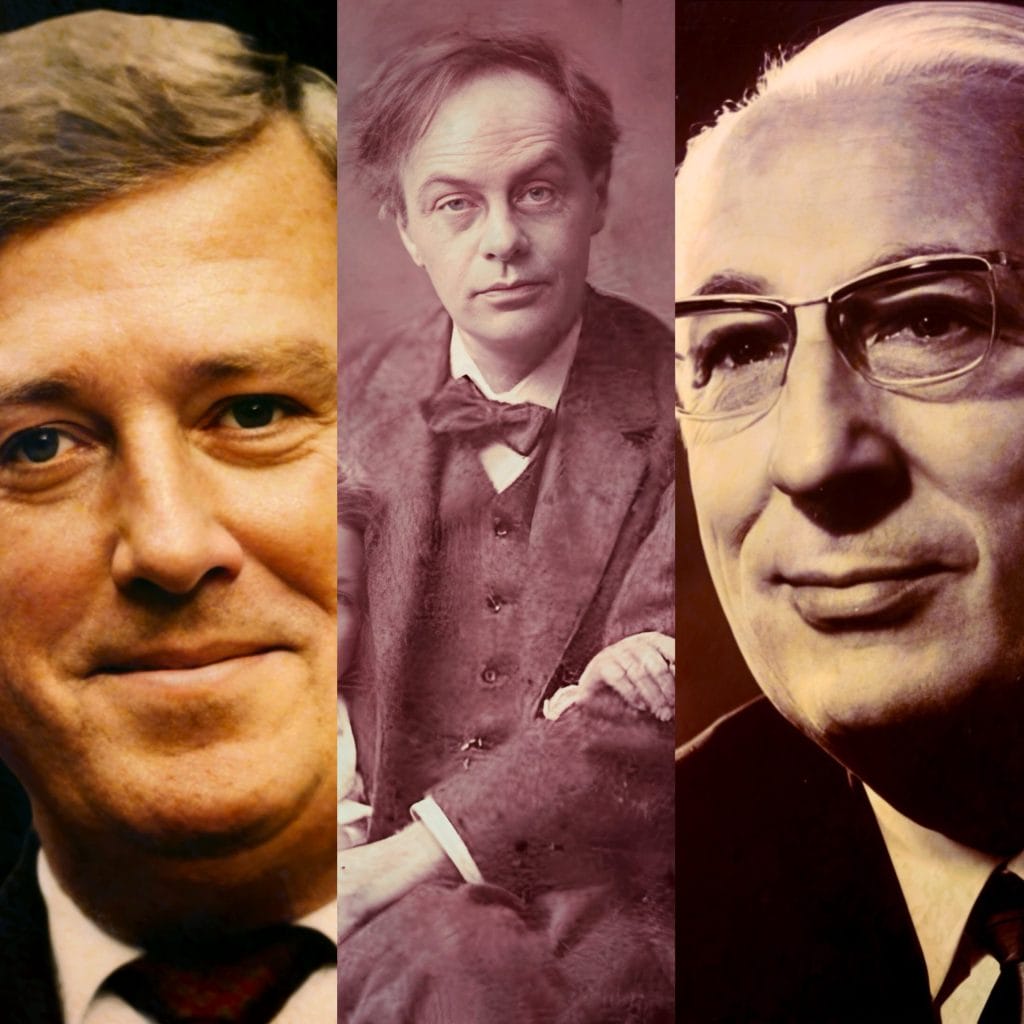
Baritone Ruud van der Meer (L) – composer Alphons Diepenbrock (Center) – Conductor Ferdinand Leitner (R)
Taking a short dive into the Dutch Radio Archives this weekend for this performance of Im Grossen Schweigen by Alphons Diepenbrock with Baritone Ruud van der Meer and the Hague Residente Orchestra conducted by Ferdinand Leitner in this 1973 Radio Nederland recording.
It’s only been in recent years that the music of Alphons Diepenbrock has been re-discovered and performed. Prior to that he was relegated to virtual obscurity and criminal neglect. A contemporary of Gustav Mahler, many critics labeled Diepbenbrock an also-ran whose work was unjustly maligned for striking similarities while providing no solid direction and a lack of originality. Critics aside, Diepenbrock enjoyed a healthy admiration in the Music community, and could count Mahler himself as a friend and colleague as well as Richard Strauss and Arnold Schoenberg. That perhaps he had no formal training in music and was largely self-taught caused many of the critic-elites to label him “not really a composer”. The argument, in truth held no water and the musical output of Alphons Diepenbrock is impressive.
The Dutch bass-baritone, Ruud van der Meer (actual name: is Rudolf Cornelius Adrianus van der Meer), studied music at the Royal Conservatory of The Hague, which covered also a conducting and oboe playing. His singing teacher was Marja Bons. He was winner of Singing Competitions of s’Hertogenbosch, Barcelona and Toulouse.
In 1967 Ruud van der Meer made his debut as a singer in a concert with the Concertgebouw Orchestra Amsterdam. However, he was firstly employed as oboist in the Hague Philharmonic Orchestra. In addition, he worked as a choir conductor and as a concert singer. Soon he became known by concerts, which he gave in his homeland Holland, in the music centres of Western Europe, in Scandinavia and in North America, as well as by his broadcasts and recordings. His concerts brought him to London and New York, to Berlin and Vienna, and Warsaw. He also appeared with great success in many festivals, including the Holland Festival, the Festival of Bregenz and the English Bach Festival. He appeared together with the well-known Dutch soprano singer Elly Ameling in London and New York in a programme of the Italian and the Spanishe Liederburch by Hugo Wolf to. He gave concerts in Moscow in 1988. In 1988 he undertook a big tour to Russia. On the concert podium he appeared in a very extensive repertoire and was characterised particularly as an outstanding Bach interpreter. However in his concerts he presented to the public many more oratorios and Lieder. He has lived in Wassenar, and since 1972 was a professor at the Conservatory of Amsterdam.
Ruud van der Meer made numerous recordings, particularly under the label of Telefunken, among them Bach Cantatas, Works of George Frideric Handel and the bass-solo in a complete recording of Matthäus-Passion (BWV 244) by J.S. Bach. Additional recordings appeared on the labels CBS, Erato, Polydor, Philips and Ottavo (Lieder of Johannes Brahms).
Conductor Ferdinand Leitner studied under Franz Schreker, Julius Prüwer, Artur Schnabel and Karl Muck.
He also was a composition student with Robert Kahn. Starting as a pianist, through the help of Fritz Busch, he became a conductor in the 1930s. He was conductor of the Nollendorfplatz Theater in Berlin from 1943 to 1945; in Hanover from 1945 to 1946; in Munich from 1946 to 1947; and the General Music Director of the Württemberg State Opera house (German “Staatstheater Stuttgart“) in Stuttgart from 1947 until 1969. To honour him, the city of Stuttgart has named a pedestrian bridge, that connects the Upper part (where the Staatstheater is located) and the Central part of the “Schlossgarten” (castle) park, after him (Ferdinand-Leitner-Steg).
He is famous as a conductor of opera, his favourite composers being Wagner, Richard Strauss, Mozart, and twentieth-century composers Carl Orff and Karl Amadeus Hartmann. He succeeded Erich Kleiber in 1956 as conductor for the Teatro Colón in Buenos Aires. From 1976 to 1980, he worked in The Hague as principal conductor of Het Residentie Orkest.
Among his more than 300 recordings is a recording of Busoni’s Doktor Faust.[2][3] He also conducted the Berlin Philharmonic for Wilhelm Kempff‘s 1961 cycle of Beethoven‘s piano concertos.
Enjoy and don’t think about Monday – it’s coming and you can’t stop it.