
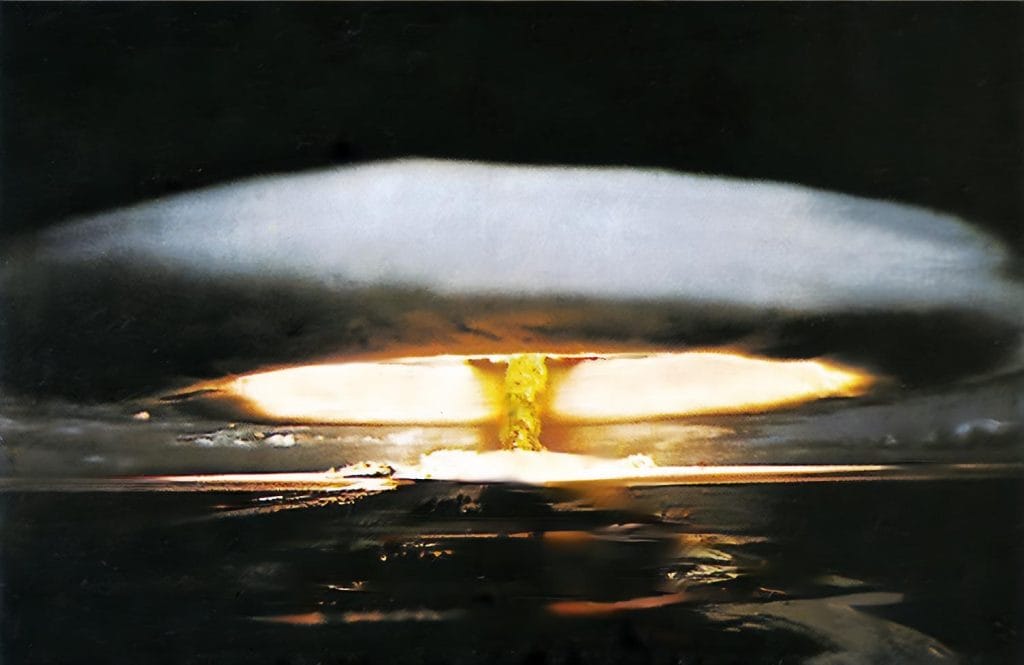
The question was asked; “how dead do we need to be?”
The question of outlawing the hydrogen bomb in 1955 emerged at a moment of profound anxiety and moral reckoning in the early Cold War. By this time, both the United States and the Soviet Union possessed thermonuclear weapons—devices vastly more destructive than the atomic bombs dropped on Hiroshima and Nagasaki. The Soviet test of a hydrogen bomb in 1953 shattered any lingering American monopoly on ultimate military power and intensified a global debate: could such weapons be controlled, or must they be abolished altogether?
The hydrogen bomb differed not only in scale but in implication. Whereas atomic bombs were devastating, thermonuclear weapons had the capacity to annihilate entire metropolitan regions, potentially killing millions in a single strike. By 1955, public awareness of this destructive power had grown considerably, fueled by scientific testimony, government disclosures, and increasingly vocal anti-nuclear activism. The idea of “mutual destruction” was no longer theoretical—it was becoming a strategic reality.
Advocates for outlawing the hydrogen bomb argued primarily on moral and humanitarian grounds. Many scientists who had participated in earlier nuclear research became outspoken critics of continued weapons development. Figures such as Albert Einstein and Bertrand Russell warned that thermonuclear war would threaten the survival of civilization itself. Their concerns were crystallized in the 1955 Russell-Einstein Manifesto, which called upon world leaders to renounce war as a means of resolving disputes. The manifesto framed the issue starkly: humanity must choose between cooperation and extinction.
Public opinion, particularly in Western Europe and parts of the United States, began to reflect these fears. Movements advocating nuclear disarmament gained momentum, emphasizing the indiscriminate nature of hydrogen bomb warfare. Critics argued that no political objective could justify weapons whose use would inevitably result in mass civilian casualties on an unprecedented scale. From this perspective, outlawing the hydrogen bomb was not merely desirable but morally imperative.
However, strong opposition to abolition arose from strategic and political considerations. By 1955, the Cold War had hardened into a global ideological and military rivalry. Policymakers in Washington and Moscow viewed nuclear weapons not simply as instruments of destruction but as essential components of deterrence. The doctrine that would later be termed “mutually assured destruction” was already taking shape: the possession of overwhelming retaliatory capability was believed to prevent either side from initiating war.
For many Western leaders, unilateral renunciation of the hydrogen bomb appeared dangerously naïve. If one side were to abandon such weapons while the other retained them, the balance of power would shift dramatically. Even proposals for bilateral or multilateral agreements faced significant obstacles, including deep mutual distrust and the practical difficulty of verifying compliance. The absence of reliable inspection mechanisms made any disarmament agreement seem fragile at best.
The Soviet Union, for its part, publicly supported general disarmament proposals but often coupled them with conditions that Western governments found unacceptable, such as the withdrawal of foreign military bases. This pattern reinforced skepticism in the West regarding Soviet intentions. Meanwhile, the United States continued to expand its thermonuclear arsenal, viewing it as a necessary counterweight to Soviet capabilities.
International institutions struggled to mediate these tensions. The United Nations served as a मंच for disarmament discussions, but concrete progress remained elusive. Proposals to ban nuclear testing or to establish international control over atomic energy were debated but not implemented. The hydrogen bomb, as the most advanced and destructive weapon of the age, became a symbol of both technological achievement and existential peril.
In retrospect, the 1955 debate over outlawing the hydrogen bomb reveals the central dilemma of the nuclear age: the tension between moral aspiration and strategic necessity. While many recognized the catastrophic potential of thermonuclear war, the realities of geopolitical rivalry made abolition seem unattainable. The result was a precarious equilibrium—one in which the very existence of these weapons was believed to prevent their use, even as it placed humanity under a constant shadow of annihilation.
Here is a debate over the question of outlawing the Hydrogen Bomb from the radio program Keys To The Capitol on NBC Radio from November 30, 1955.