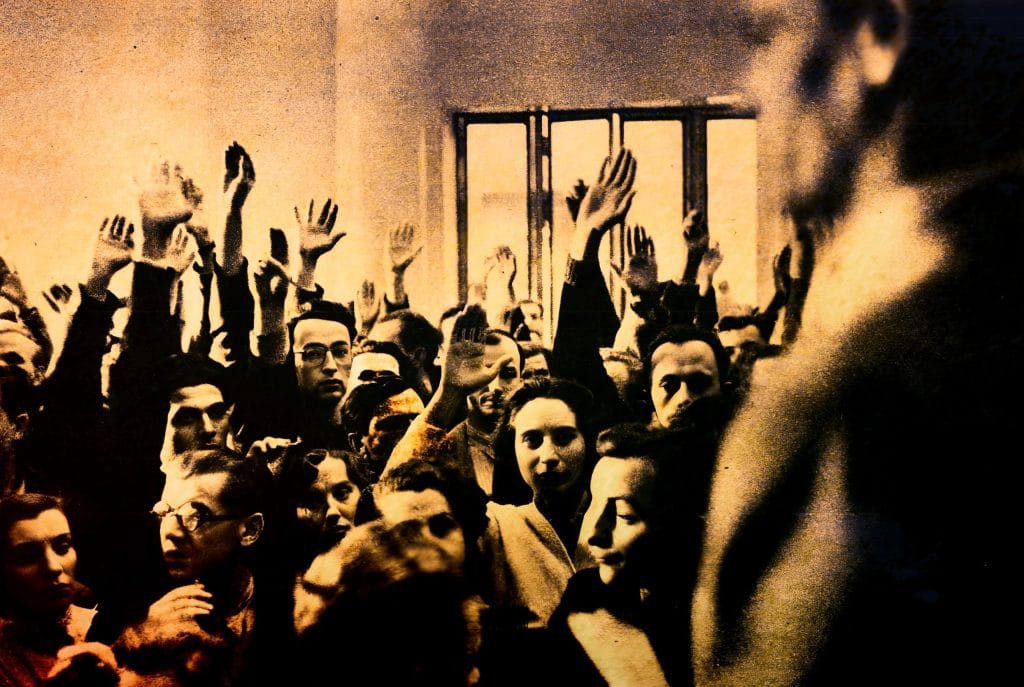
The Press Conference – otherwise known as The Gaggle or The Cattle Call. Serious business taken seriously.
Another in a series of historic broadcast from the BBC World Service in the 1950s.
This one, entitled; The Role Of The Press, took a look at how the press and how newspapers were viewed in America and Britain during these pivotal post-war years.
The discussion covers many areas; one being the loss of many newspapers around the country owing to declining circulation, as well as the audience gravitating to Radio and Television as the primary source for information. And how, with so few newspapers could there be a balance between local stories and World News? Time was, local news was something of a specialty and the primary domain for small down papers while the major metropolitan areas looked at the world picture with more interest. But how could a balance be struck?
The subject of corporate influence in the Press came up, by way of buying up newspapers and running the risk of that influence playing on what kind of stories were covered and how they would be covered. In 1950 it was still one company owning one newspaper in each metropolitan area. As opposed to now, where Corporate ownership extends to multiple outlets and multiple media formats in any given market.
And there was also the potential political aspect of the Press. In 1950 Political affiliation was vehemently frowned upon. The press was considered the ultimate neutral source for news regarding politics – party affiliations were left at the front door and never ventured into the newsroom. Of course, there were examples of party favorites being written about, but only in the context of commentary and it was designated as such. Names such as Drew Pearson, Fulton Lewis Jr. and Walter Winchell were clearly identified as commentators and not regular news reporters who wrote daily columns commenting on the big stories of the day.
The discussion points to how far a cry it is in 2026 from 1950 – how information has become intentionally skewed in one political direction or another. The concept of “fake news” is one of recent years, no doubt brought on by Social Media and the concept of the “citizen journalist” (a very loose description) which has flourished by way of blogs and podcasts and skillful editing. It has muddled the once sacred area of reporting and finding the truth. In 1950, according to this broadcast, it was of primary importance that a story be reported in a truthful and factual way. It was an obligation to the audience, the people who relied and trusted the reporter to uncover facts, not make them up.
So, a fascinating half hour from November 27, 1950 by way of the BBC World Service, once again. A reminder it hasn’t always been the way it is now.